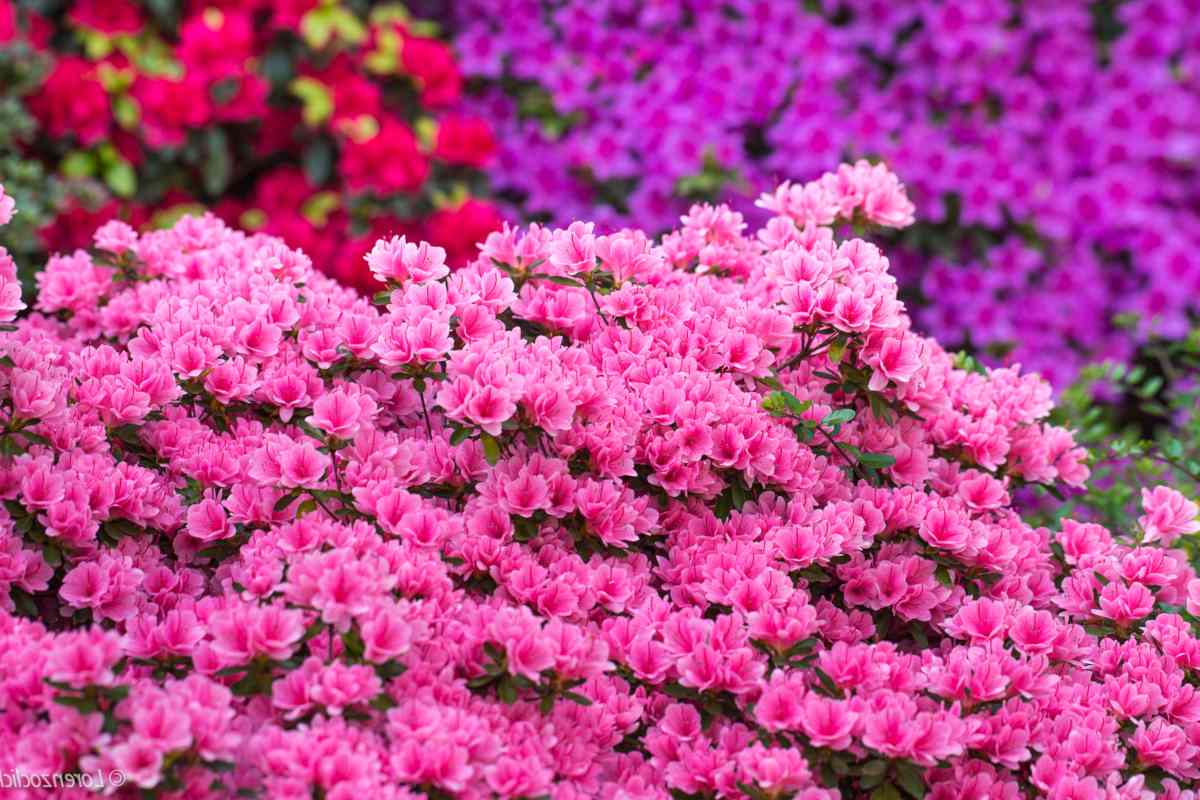
Round, dense shrubs that cover themselves in small bright flowers in mid-spring and late spring, azaleas (Rhododendron) are in fact small-flowered rhododendrons, grown for spring colour above deep green evergreen leaves. They are heath plants first of all: give them acid, well-drained soil in part shade, and the blooming is spectacular.
| Name | Rhododendron |
|---|---|
| Family | Ericaceae |
| Type | shrub |
| Height | 1 ½ to 4 feet (50 to 120 cm) |
| Exposure | part sun and shade |
| Soil | acid, heath soil |
| Foliage | evergreen |
| Flowering | mid-spring to late spring |
Caring for this plant, from planting to pruning and including watering, should give you magnificent flowers.
It is important to not over-expose your azaleas to sunlight, so favor a spot that is partly shaded.
To generate spectacular blooming, add heath plant fertilizer.
Indoor azaleas generally bloom over the winter because they were “forced”, that is, their development was sped up so that they would bloom early.
Thus, azaleas aren’t really indoor plants, and they are vulnerable to indoor heating as much as they are to freezing.
Here are the rules on growing your indoor azaleas:
Read on here to guarantee that the beautiful winter azalea you received will live on for years!
It is sadly quite difficult to keep a forced plant, because its life cycle has been disturbed.
But it is worth a try, because it may well work.
For that,
Even if azaleas normally bloom in spring, indoor azaleas won’t bloom again immediately if they had just bloomed indoors during the pas winter.
Pruning isn’t mandatory at all, but it might be needed at times, if only to reduce the size of the plant or balance the branches out.
Start with removing wilted flowers regularly (deadheading) to spur appearance of new buds.
Directional pruning is performed over the first 2 or 3 years of azalea plants, on new growth. Its purpose is to increase branch density.
Azaleas can be pruned their whole life long, even though it’s recommended to refrain from pruning as much as possible to ensure nice blooms every year and let the shrub take on its natural shape.
Pruning an azalea is never obligatory, but four distinct operations are described here, each with its own timing and its own consequence for the following spring. Match the one you need to what you are trying to achieve.
| Operation | When | How | Effect on blooming |
|---|---|---|---|
| Deadheading | Regularly, as flowers fade | Remove the wilted flowers, cutting just below the flower stalk | Spurs the appearance of new buds |
| Directional pruning | Over the first 2 or 3 years, on new growth | Pinch new growth with your fingernails, just above a leaf | Interferes temporarily, but much richer blooms later |
| Clearing dead wood | Before any other pruning | Take out dead and fragile wood, and branches with few or no leaves | The starting point of any pruning |
| Reducing size or balancing growth | Once blooming is over | Shorten branches to reduce the size of the plant or balance them out | Severe pruning jeopardises the following year’s bloom |
As a rule, prune as little as possible so the shrub keeps its natural rounded shape and flowers every year.
Garden azaleas fall into two camps: the low evergreen Japanese kinds that keep their leaves all winter, and the taller deciduous kinds grown for hot colours and, in some cases, scent. The table below sets out widely sold varieties of each.
| Variety | Type | Flower colour | Flower form | Habit band |
|---|---|---|---|---|
| ‘Vuyk’s Scarlet’ | Evergreen Japanese | Deep red | Large, wavy-edged single | Low and spreading |
| ‘Palestrina’ | Evergreen Japanese | White, faint green flecks | Open funnel single | Medium, upright |
| ‘Blue Danube’ | Evergreen Japanese | Violet-blue | Large, flat single | Low and spreading |
| ‘Hino-crimson’ | Evergreen Japanese | Crimson-red | Small single, very profuse | Dwarf, compact |
| ‘Rosebud’ | Evergreen Japanese | Rose-pink | Double, rosebud-like | Low, dense |
| ‘Gibraltar’ | Deciduous | Flame orange | Frilled trumpet | Tall, upright |
| ‘Klondyke’ | Deciduous | Golden yellow | Trumpet, scented | Tall, upright |
| ‘Homebush’ | Deciduous | Rose-pink | Semi-double, ball-shaped heads | Medium to tall |
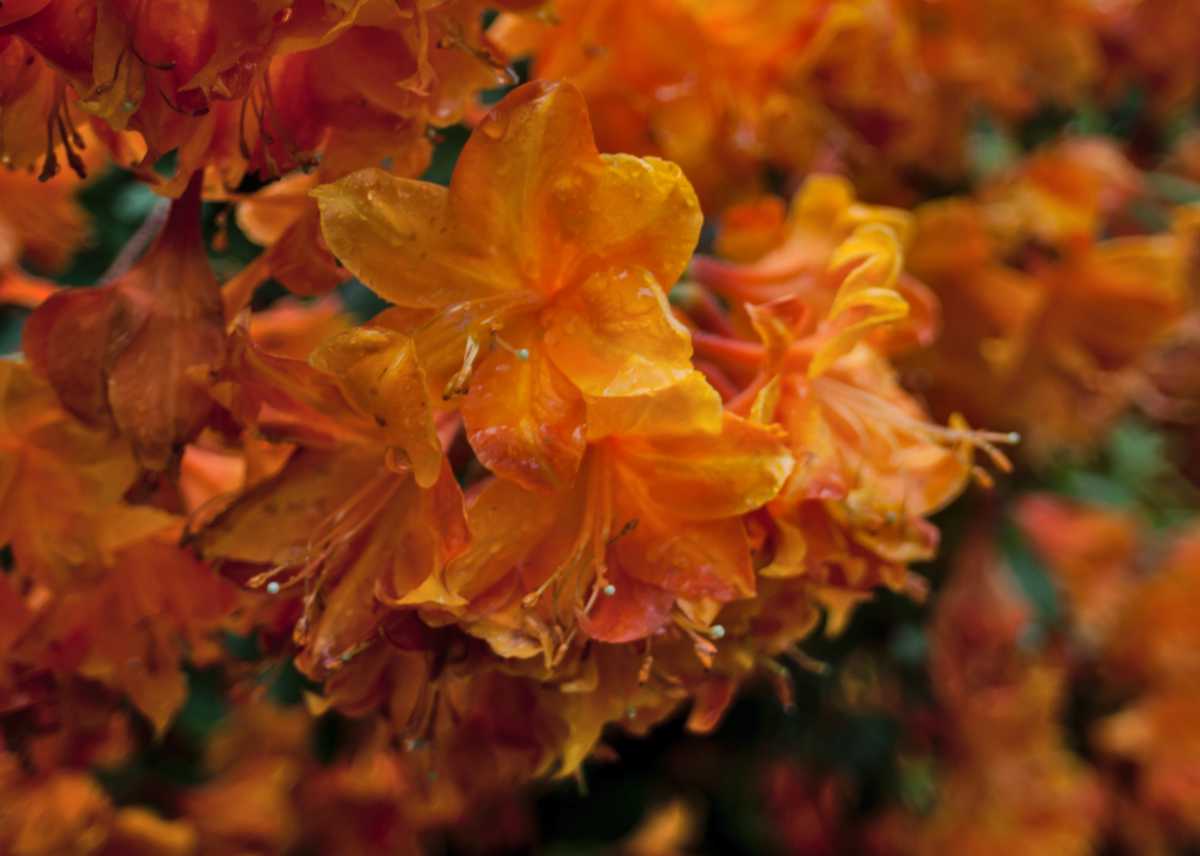
Azalea shrubs are actually small-flowered rhododendrons, and they stand out in spring thanks to their beautiful bright and colorful bloom.
Azalea grows into nice round shrubs that highlight its generous blooming and the deep green of its leaves.
Azaleas are part of the heath plant group, like camellia.
Japanese azalea is usually hardier than other types of azaleas.
To enhance azalea shrub growth, mulch the ground around it to retain moisture.
Favor any acidic mulch such as pine bark mulch.