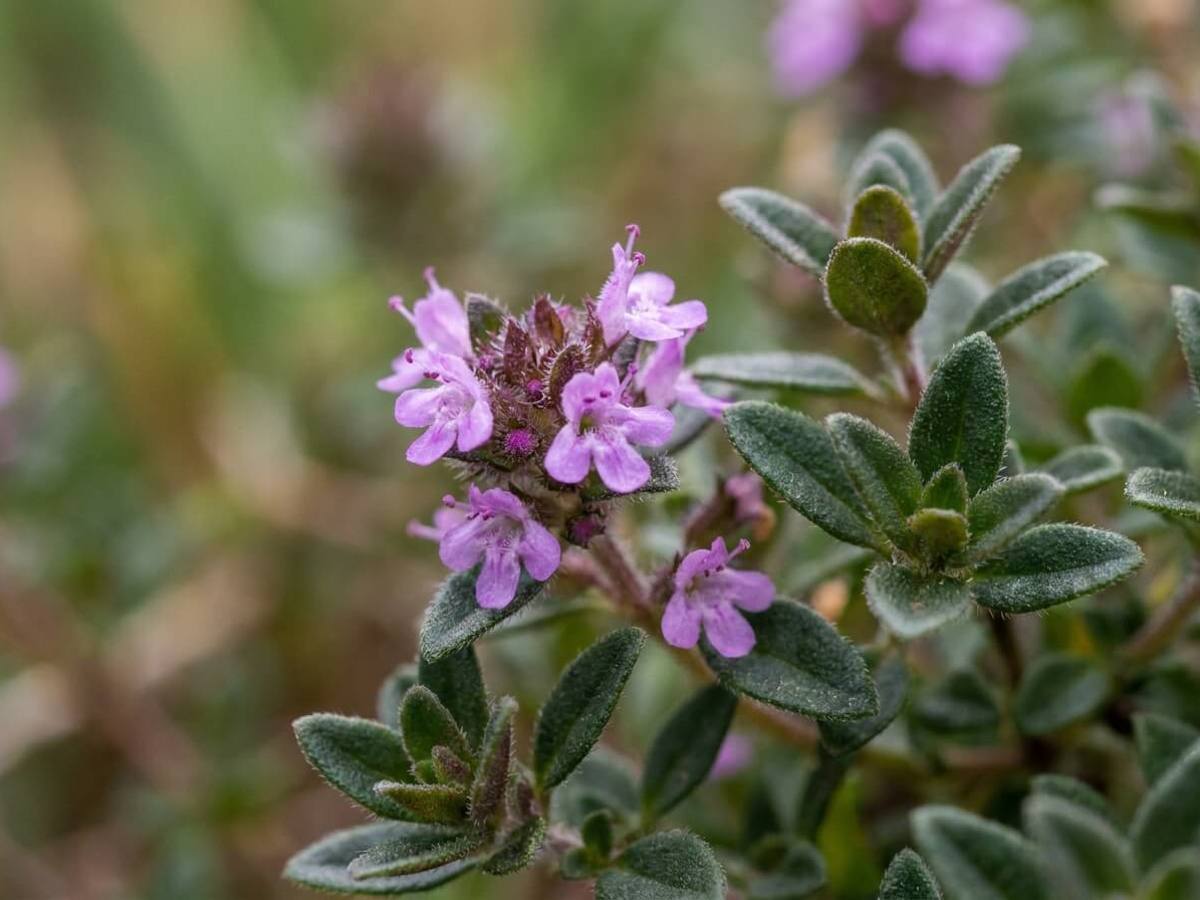
Caraway thyme is a low, spreading evergreen carpeter from the mountains of Corsica and Sardinia, grown as much for its scent as its looks. Brush the dark, needle-fine foliage and it releases a warm, unmistakable waft of caraway seed rather than the usual medicinal thyme. In early summer the mat disappears beneath a haze of soft rose-pink flowers that bees find irresistible.
Growing conditions
Caraway thyme demands full sun — a minimum of six hours a day, and preferably more. In shade or under the drip of overhanging shrubs it stretches, loses its aromatic punch and flowers sparsely. An open, airy position with free movement of air around the mat is ideal.
Drainage matters more than fertility. Give it a gritty, stony or sandy soil of low to moderate fertility, ideally neutral to slightly alkaline (pH 6.5–8.0). Heavy clay is the one real enemy; on such ground, raise the planting area or add generous quantities of horticultural grit to the top 20 cm.
It is hardy across most of the British Isles and northern Europe, shrugging off frosts to around −15 °C. Winter wet, not winter cold, is what kills it, so gardeners in mild damp regions should favour raised beds, gravel gardens, wall tops and containers.
How to plant Thymus
Plant in mid-spring, once the soil has begun to warm, so roots establish before the first summer drought. Early autumn planting also works in drier regions, but avoid setting out young plants just before a wet winter.
Spacing: 25–30 cm apart for ground cover — close enough to knit together within two seasons, open enough to keep air circulating.
Depth: Set the crown exactly level with the soil surface; burying the woody base invites rot.
Soil preparation: Fork in grit or coarse sand rather than compost or manure — rich soil produces soft, short-lived growth.
Watering in: Water thoroughly once at planting, then only during prolonged dry spells in the first season.
Propagation: The trailing stems self-layer readily; peg a shoot onto gritty soil in late spring and sever the rooted piece in early autumn.
Thymus herba-barona growing in a naturalistic garden border
Care through the seasons
Spring: Pull away any winter debris and dead patches as soon as new growth appears, usually in April. Trim lightly to reshape, cutting into green growth only. Feeding is rarely needed; container plants appreciate a single weak liquid feed at most.
Summer: Harvest freely through the growing season — picking is the best form of pruning. Shear the whole mat over by about a third immediately after flowering to prevent the centre going bare and woody. Established plants tolerate drought well, so water containers only when the compost has dried out.
Autumn: Resist cutting back hard at this stage; the leafy canopy protects the crown through winter. Lift and divide congested, bare-centred clumps in early autumn, or simply detach self-rooted layers. Top-dress around the plants with grit or fine gravel to keep stems dry and encourage rooting.
Winter: The foliage stays evergreen, often taking on a bronze-purple tinge in cold weather. No protection is needed beyond sharp drainage, though pots should be raised on feet and moved out of the rain shadow of gutters.
Best varieties to grow
Named selections are few, but the scent variations are worth seeking out, and related mat-forming thymes make excellent companions.
Thymus herba-barona (species) — the true caraway-scented form, with dark glossy foliage and rose-pink flowers in June; the best choice for culinary use.
T. herba-barona ‘Lemon-scented’ — a geraniol-rich selection smelling of lemon rather than caraway, slightly softer in habit and excellent with fish or in baking.
T. herba-barona ‘Nutmeg’ — a warm, spicy-scented form that is particularly flat and dense, ideal for paving crevices.
Thymus ‘Doone Valley’ — not a caraway thyme but a superb gold-splashed, lemon-scented mat that pairs well in the same gravel bed.
Pests, diseases and common problems
Root and stem rot: Patches collapse and blacken, usually after a wet winter or on clay. Replant healthy cuttings into grittier soil or a raised bed, and mulch with gravel rather than bark.
Rosemary beetle: Metallic green-and-purple striped beetles and their grey grubs chew the foliage from late summer through winter. Pick them off into a tray held beneath the plant and avoid spraying while bees are active.
Woody, bare centres: Old plants open up in the middle and flower poorly. Shear after flowering each year, layer the outer stems to make replacements, and renew the whole planting every three to four years.