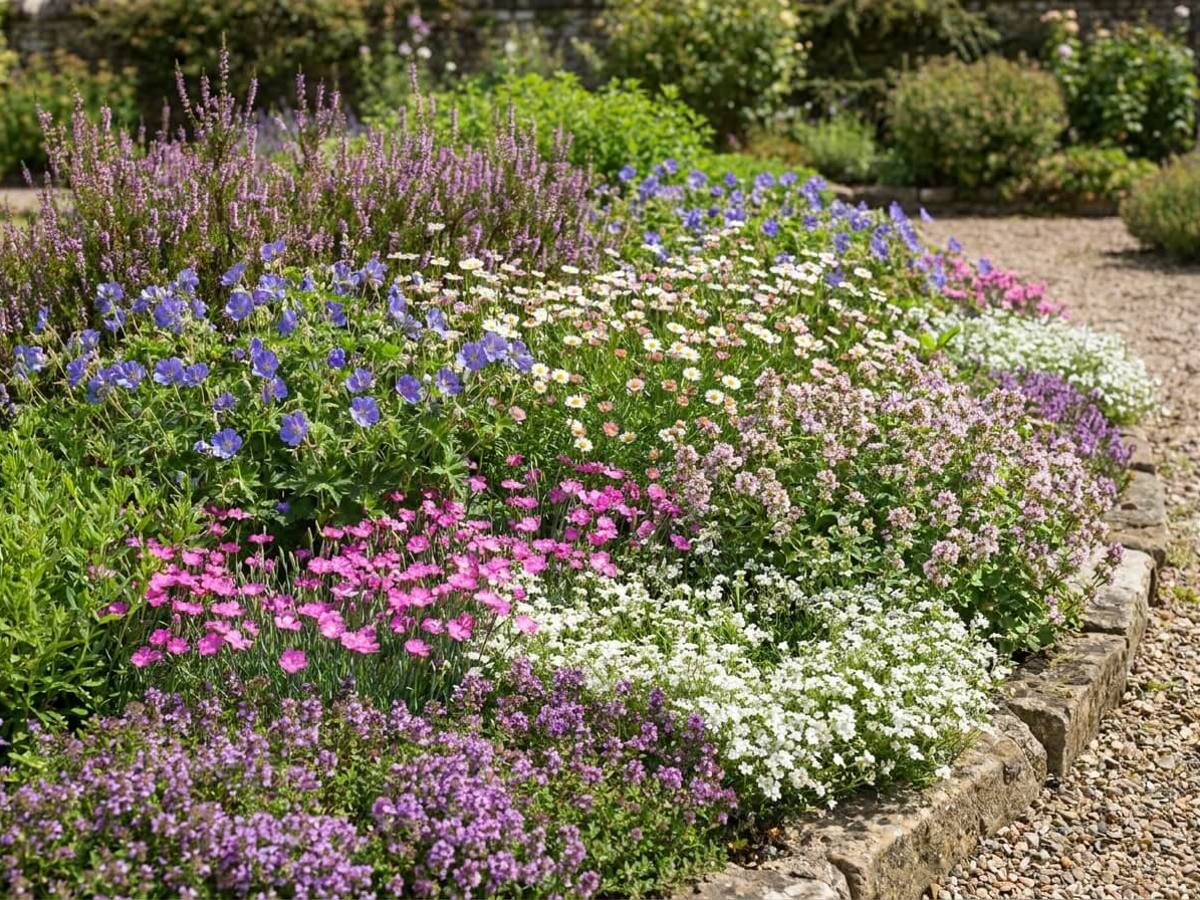
A flat, open stretch of ground that takes sun from morning to evening is one of the easiest places in the garden to get wrong. The soil dries fast, bare patches bake hard and crack, and anything leggy flops the moment it flowers. The answer is a dense, low carpet of drought-tolerant plants that knit together at the root, flower through the heat of summer, and keep enough structure and foliage colour to hold the ground when the flowers have gone.
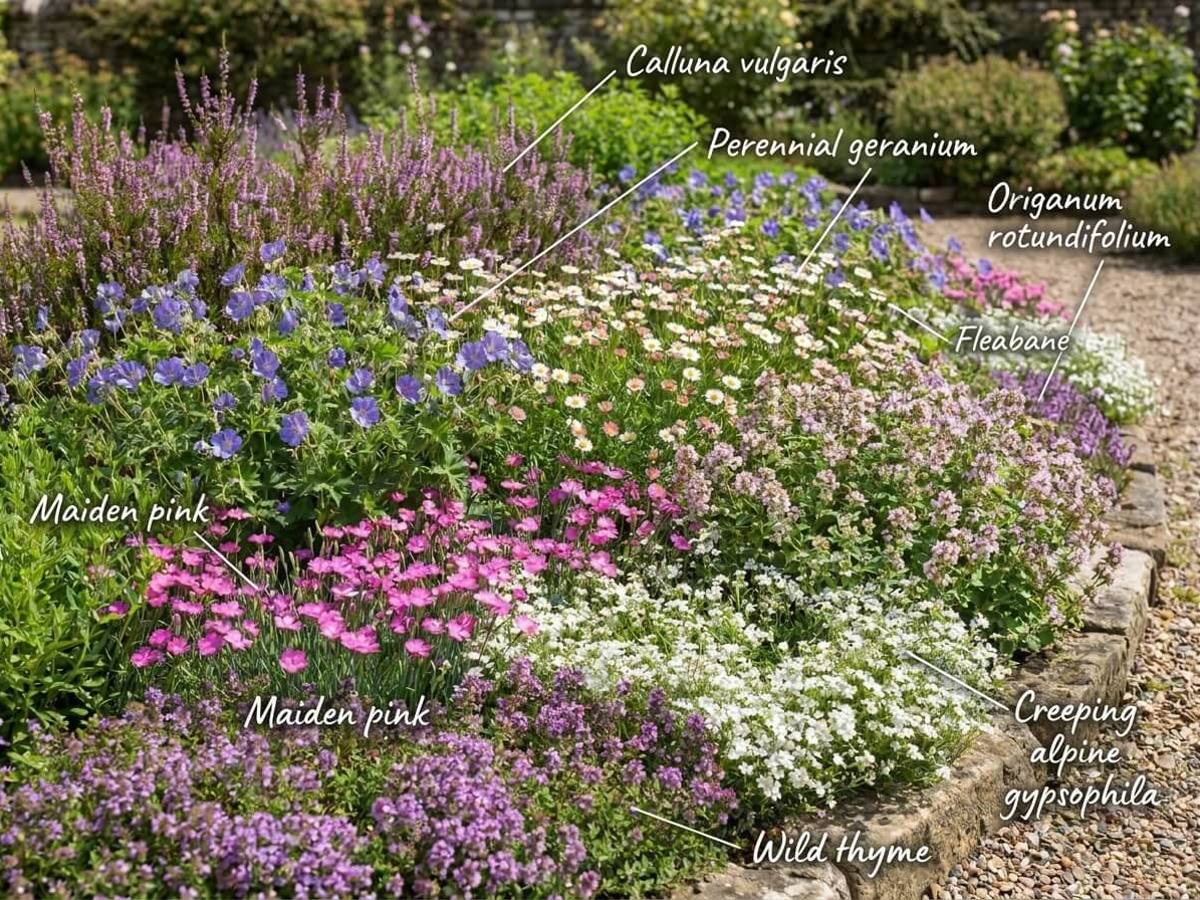
From back to front: Calluna vulgaris, Perennial geranium, Fleabane, Origanum rotundifolium, Maiden pink, Creeping alpine gypsophila, Wild thyme.
At the back of the carpet you want a little height and a little permanence, and Calluna vulgaris gives you both. Its tight, scaled evergreen foliage forms firm hummocks that read as a low hedge-line behind everything else, then throws up spikes of small pink to purple bells from late summer into autumn. It needs acidic, free-draining soil and full sun, which suits this spot exactly. Keep it as a run of solid blocks rather than scattered singles, so it reads as a backdrop rather than a series of bumps.
In front of the heather, perennial geranium does the heavy lifting of covering ground. The lobed leaves spread outwards into a mound that smothers weeds from late spring onwards, and the saucer-shaped flowers in pink, mauve or violet carry on through summer with very little fuss. It is the one plant here that tolerates a bit of shade cast by its neighbours, so it copes where the heather leans over it. Shear it back hard after the first flush and it will green up and flower again.
Fleabane is the softener of the scheme. Its small daisy flowers open white and age to pink, so a single plant carries both shades at once and the overall effect is a constant, airy flicker rather than a block of colour. It flowers for months in full sun and seeds itself gently into the gaps between clumps, stitching the planting together. Let it spill forwards over the perennial geranium and into the lower tier without worrying about neat edges.
For texture at knee height and below, Origanum rotundifolium brings something no other plant here offers: rounded blue-green leaves and tiered, hop-like papery bracts that hang in pale green and soft pink. The flowering stems arch sideways, so it drapes rather than stands. It is thoroughly happy in dry, sunny, gritty ground and the bracts hold their look long after the tiny flowers have finished, which extends the display well past high summer.
Coming forward into the middle of the carpet, maiden pink forms low mats of narrow grey-green leaves topped by bright pink flowers with a darker eye. The colour is sharp and clear, and it lifts the softer pinks and mauves behind it. It is genuinely mat-forming, so it fills the ground between the taller clumps rather than competing with them. A trim after flowering keeps the mat tight instead of woody in the middle.
Creeping alpine gypsophila is the froth that stops the front of the scheme from looking solid. It makes a flat cushion studded with tiny white or pale pink flowers through summer, and it thrives on the poor, stony, well-drained soil that defeats richer plants. Place it where the carpet meets a path or a wall edge and it will tumble over the lip. Next to the sharp pink of the maiden pink, the white haze acts as a visual break.
The very front of the carpet belongs to wild thyme, which hugs the ground more closely than anything else here. It forms a dense aromatic mat that takes light footfall, flowers in a purple-pink haze alive with bees in summer, and stays evergreen through winter. It will creep into every gap left by the plants behind it, sealing the soil surface against weeds and evaporation. Walk on it occasionally and the scent is released.
Work in bands, not rows. Set the Calluna vulgaris along the back in groups of three to five plants, 40 cm apart, so each group closes into one mass. In front, plant perennial geranium 40 cm apart in drifts of three, with fleabane dotted singly at 30 cm between and slightly in front of those drifts so it can seed about. Place Origanum rotundifolium in groups of three at 30 cm where it can arch over a lower neighbour. Fill the middle with maiden pink at 25 cm in odd-numbered groups of five or seven, then edge the front with creeping alpine gypsophila at 25 cm and wild thyme at 20 cm, overlapping the two at the corners so the join never looks like a line. Add a layer of grit or gravel between young plants on open ground; it keeps the crowns dry and the carpet closes over it within two seasons.
In spring the scheme is mostly foliage: grey-green mats at the front, fresh lobed leaves rising in the middle, dark evergreen blocks at the back. From June the middle and front ignite together, with maiden pink, wild thyme, creeping alpine gypsophila and perennial geranium flowering at once and fleabane running on behind them. Late summer shifts the interest backwards as Origanum rotundifolium colours up its bracts and Calluna vulgaris opens into autumn. Through winter nothing flowers, but the carpet is still covered: evergreen heather and thyme, silvered mats of pinks and gypsophila, and seedheads left standing until a tidy-up in early spring.