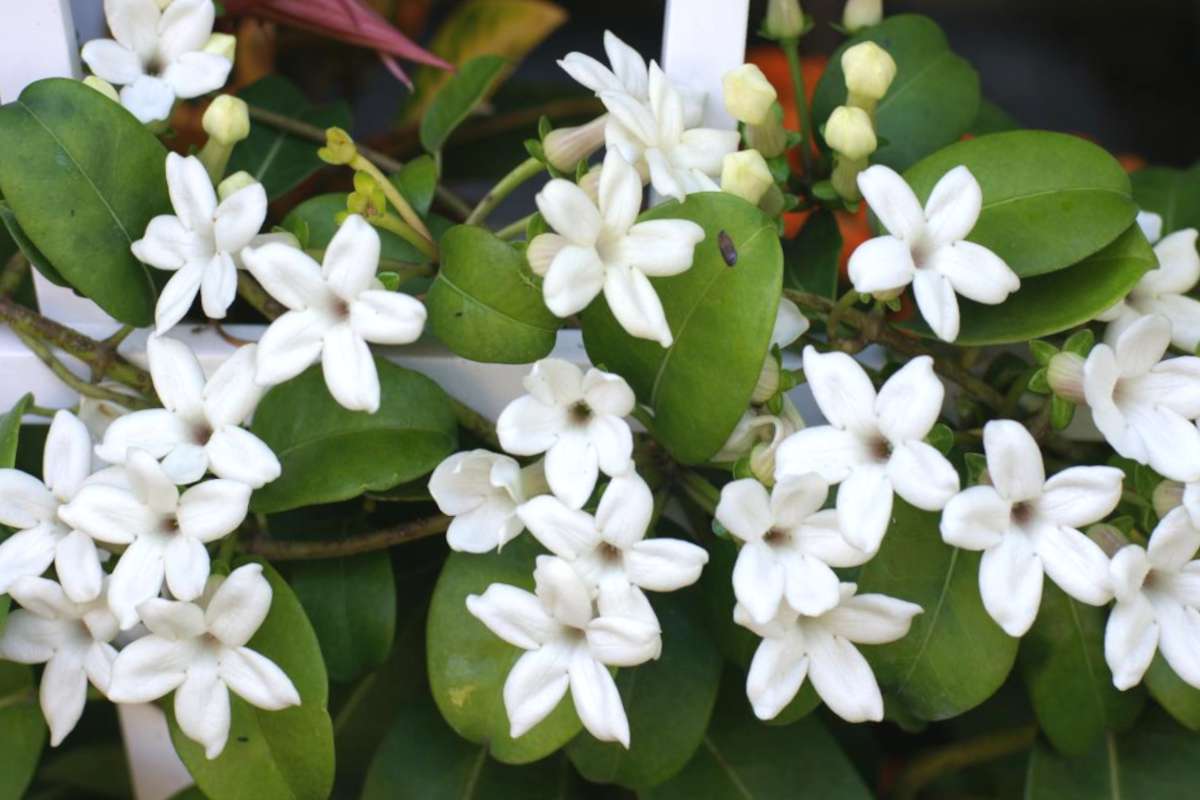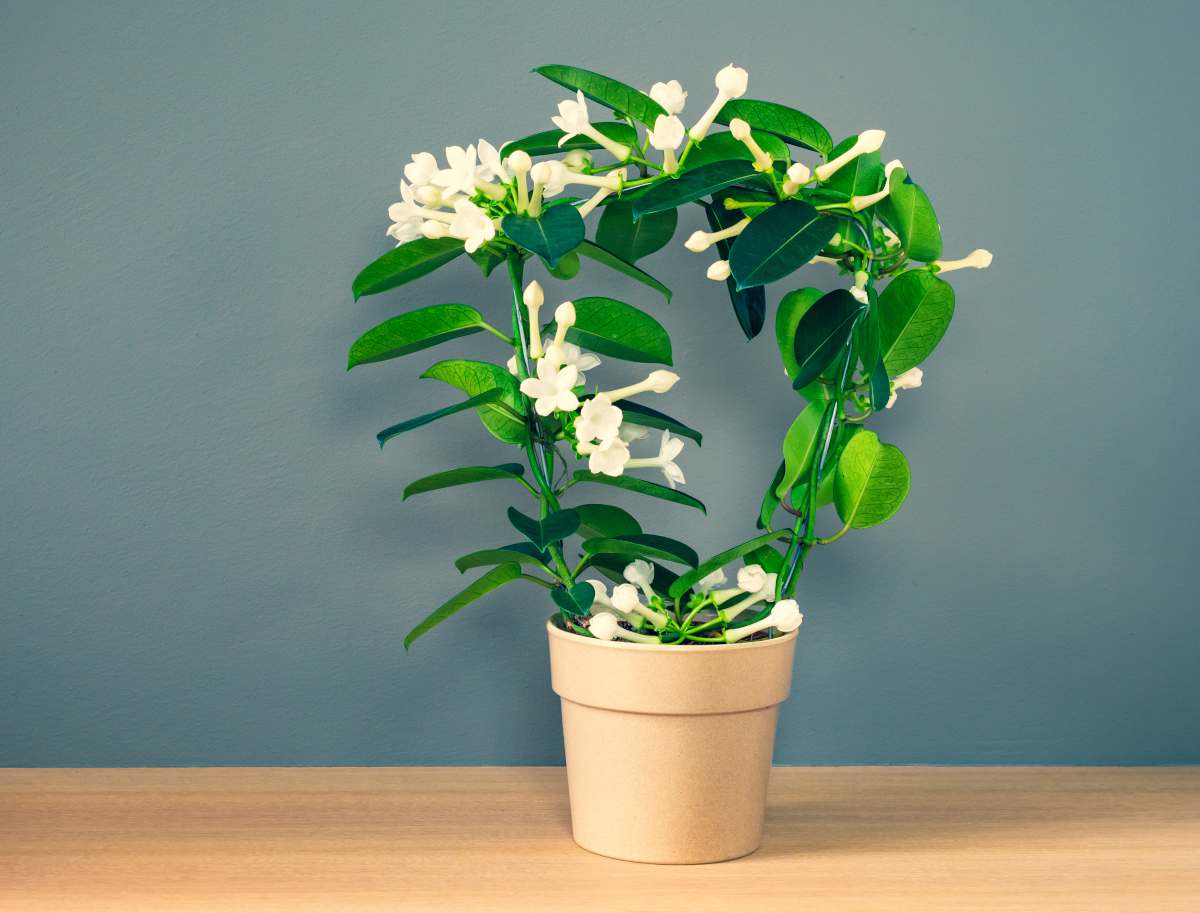
Thick, dark green leaves climb a hoop or a trellis, and from spring to autumn scented flowers open on short stems at the leaf nodes: this is Madagascar jasmine (Stephanotis floribunda), famous above all for its fragrance and grown as a houseplant in temperate regions. Keep it warm — below 55°F (13°C) it starts to die — and the perfume lasts for months.
| Name | Stephanotis floribunda |
|---|---|
| Common Names | Madagascar jasmine, creeping tuberose |
| Family | Apocynceae |
| Type | fragrant flower vine |
| Height | 10 to 15 feet (3 to 5+ meters) |
| Exposure | lots of light |
| Soil | soil mix, proper drainage |
| Hardiness | 50-55°F (10-13°C) |
| Foliage | evergreen |
| Flowering | late spring to mid-autumn |
Stephanotis floribunda isn’t hardy at all. Whenever temperatures drop to 50°F (10°C), the vine goes dormant and stops growing; any colder and it starts dying. One way around this problem: grow it in a pot!
A container or pot is best, so that you can bring your Stephanotis floribunda indoors when autumn chills roll about.
S. floribunda is native to Madagascar. It requires temperatures of at least 68°F (20°C) year-round to thrive.
The vine prefers climates where winter is slightly cooler than summer, marking a time of dormancy.

Frost will kill the vine. Bring the pot indoors in a lean-in or greenhouse.
Full-time indoor plants will appreciate a time of rest during winter months. Transfer them to a cooler spot, around 60°F/15°C, if possible, from late autumn to early spring.
In winter, water your potted Stephanotis only when the soil is dry, without adding fertilizer.
If temperatures drop below 50°F / 10°C, it’ll take a miracle for your Stephanotis floribunda to survive.
Water regularly but not too much, since roots can’t take wallowing in water for very long.
Stephanotis requires a lot of moisture because its natural habitat is forest underbrush.
Blooming on Stephanotis floribunda usually lasts from late spring to mid-autumn-late autumn.
After the blooming is over, let the plant go dormant: place it in a cooler but well-lit room.
During the dormancy, stop giving it fertilizer. Only water if the soil in the pot is dry.
Prune the vine in early spring, as much as you want. Pruning triggers lush growth and ensures it will bloom again.
If you can reach them, go ahead and remove dead flowers. This will lead the plant to bloom again.
It’s common in the tropics, but even in temperate climates you might discover an egg-shaped pod forming on the vine. It’s a fruit! See what you can do with it here: Stephanotis floribunda seeds.
Everything this vine needs changes with the season, and the difference between growth and dormancy is only a few degrees. Use the table to see what temperature, watering and task belongs to each part of the year.
| Period | Temperature | Watering and feeding | Main task |
|---|---|---|---|
| Flowering, late spring to mid-autumn–late autumn | 68 to 70°F (20 to 21°C) | Water once a week; liquid flower fertiliser every fortnight | Remove dead flowers to extend bloom |
| Early spring | Warmth returning | Resume regular watering | Repot and prune the vine |
| Autumn chills | Must not drop below 60°F (15°C) | Water less, as soil dries | Bring the pot indoors, away from radiators |
| Rest, late autumn to early spring | 57 to 60°F (13 to 15°C) | Water only when the soil is dry, no fertiliser | Keep it in a cooler but well-lit room |
Below 50°F (10°C) growth stops altogether, and colder still the plant begins to die.
Yellowing leaves? Insects and pests? White masses forming on leaves? Worse yet – no flowers?
Dealing with pest, disease, and blooming issues for Stephanotis floribunda
Sticky leaves usually indicate honeydew from sap-sucking pests, so inspect stems and leaf undersides for aphids, mealybugs, whiteflies or scale insects before deciding which one is responsible.

As its common name shows, this Stephanotis is native to Madagascar, where it can be found outdoors in the wild among other plants in forest underbrush. It is used under temperate climates as an indoor plant.
Madagascar jasmine is a vine that bears thick dark green leaves. It flowers from spring to fall from stems attached to leaf nodes.
Usually, you need a trellis or a stake to help it grow because it cannot stand upright on its own.
Stephanotis floribunda is one of several Stephanotis species. It’s a flower famous for its fragrance.
Add flower plant fertilizer to enhance its bloom.