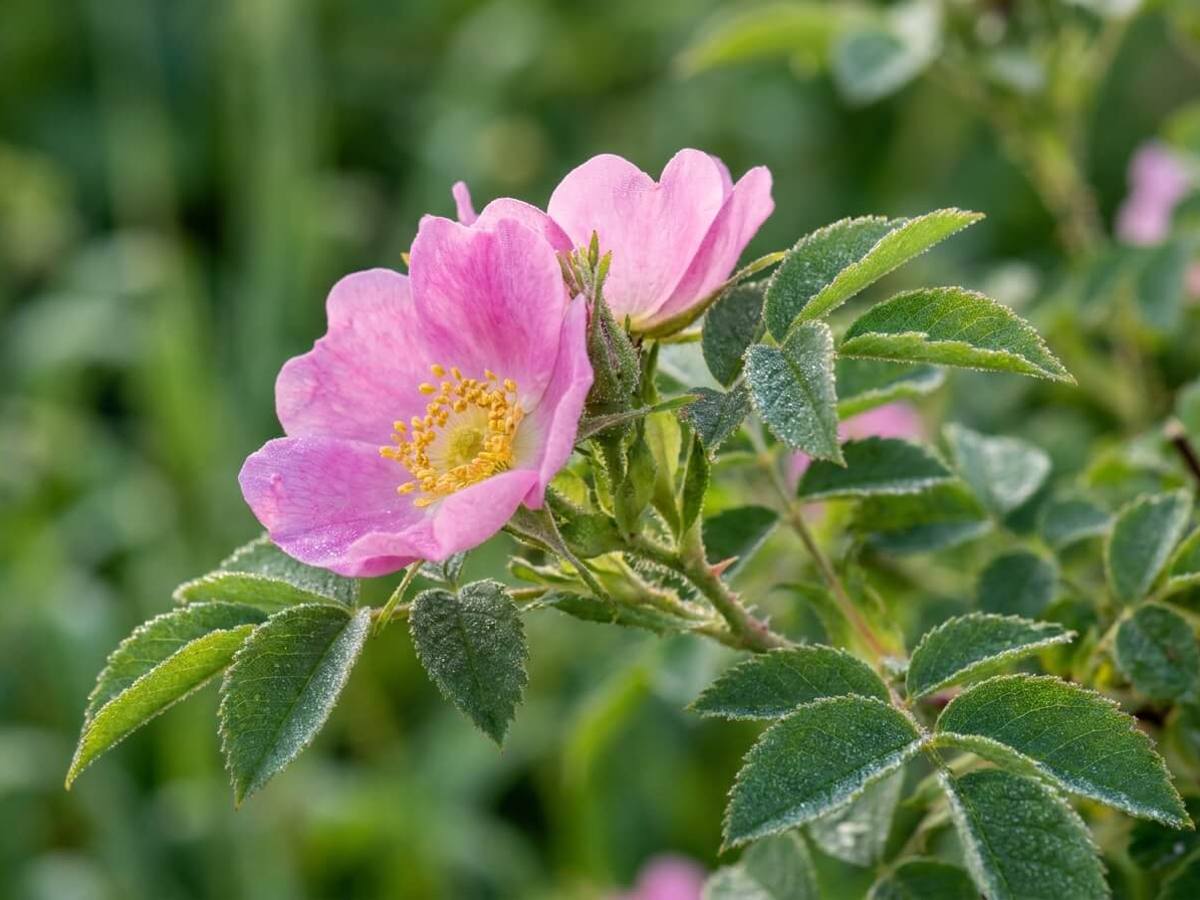
Rosa rubiginosa, the sweet briar or eglantine, is a vigorous wild rose grown as much for its foliage as its flowers: brush past the leaves on a warm, damp morning and the air fills with the scent of stewed apples. Single, clear pink blooms in early summer are followed by a heavy crop of glossy scarlet hips that persist well into winter. It makes a superb stock-proof, wildlife-friendly hedge for country gardens, though its hooked prickles demand respect.
Growing conditions
Give sweet briar the sunniest position you can. In full sun it flowers heavily, ripens hips reliably and produces the strongest leaf fragrance, because the aromatic glands develop best on well-lit growth. It will survive in dappled shade beneath high branches, but expect a lanky habit and a thinner crop of hips.
Soil is rarely a problem. This is a plant of chalk downland, hedgerows and limestone scrub, so it revels in free-draining alkaline ground, yet copes equally well with neutral loam and sandy or stony soils. A pH of 6.5–8 suits it best; the only real failing is waterlogged clay, where the roots rot over winter.
Hardiness is excellent throughout northern Europe and comparable climates, and the shrub shrugs off coastal wind and exposed, frost-pocket sites. In hot, dry regions it is notably drought-tolerant once established, but it dislikes prolonged humid heat, which encourages foliar disease.
How to plant Rosa
Plant bare-root stock between November and March whilst the shrub is dormant — this is cheapest and establishes fastest. Container-grown plants can go in at any frost-free time, though autumn planting gives roots a head start before the following summer.
Spacing: set hedging plants 45–60 cm apart in a single row, or in a staggered double row 40 cm apart for a dense, stock-proof barrier; allow 2 m for a free-standing specimen.
Depth: plant own-root species roses so the soil mark on the stem sits level with the surface; if budded, bury the union 5 cm deep to discourage rootstock suckers.
Soil preparation: fork over a square metre, remove perennial weed roots and work in a bucket of garden compost plus a handful of bonemeal — avoid rich manure directly against the roots.
Watering in: soak thoroughly with 10 litres per plant after backfilling, then mulch 5 cm deep, keeping the mulch clear of the stems.
Propagation: take 25 cm hardwood cuttings of pencil-thick stems in late autumn and line them out in a sheltered trench; seed needs warm then cold stratification and may take 18 months to germinate.
Rosa rubiginosa growing in a naturalistic garden border
Care through the seasons
Spring: Scatter a balanced organic rose feed or pelleted poultry manure around the base as buds break in March, and top up the mulch. Check hedges for frost-damaged or crossing shoots and remove them cleanly. Resist any urge to shorten the stems hard — flowers come on wood made the previous year.
Summer: Water new plants weekly in dry spells for the first two growing seasons; established shrubs almost never need irrigation. Do not deadhead if you want hips, which is usually the whole point of growing this rose. Any formative or renovation pruning is best done immediately after flowering ends in July, accepting the loss of that season’s hips.
Autumn: The hips colour from September and are the shrub’s great autumn asset, so leave them for blackbirds, fieldfares and redwings, or pick a share for syrup. Trim hedges lightly in late autumn if they are outgrowing their space. This is also the moment to take hardwood cuttings and to remove unwanted suckers by pulling rather than cutting.
Winter: Fully dormant and completely hardy, sweet briar needs no protection at all. Use the leafless months to thin out one in four of the oldest stems at the base on mature shrubs, encouraging vigorous replacement growth.
Best varieties to grow
Most named forms are Penzance Briars, hybrids raised by Lord Penzance in the 1890s that keep the apple-scented leaves but widen the colour range.
Rosa rubiginosa (the species) — single pink flowers with golden stamens, the strongest foliage fragrance and the heaviest crop of oval scarlet hips.
‘Lady Penzance’ — single coppery-salmon flowers flushed with yellow at the centre, arching to about 2 m, with good autumn hips.
‘Lord Penzance’ — soft fawn-yellow blooms ageing to rosy buff, slightly more compact and very free-flowering in June.
‘Manning’s Blush’ — a neat, bushy old form to around 1.5 m with double blush-white flowers, ideal where space is tight.
Pests, diseases and common problems
Blackspot and rust: purple-black blotches or orange pustules on leaves, worst in humid summers. Collect and bin fallen leaves rather than composting them, improve air flow by thinning stems, and avoid overhead watering.
Aphids: colonies on soft shoot tips in late spring distort growth and leave sticky honeydew. Squash them by hand or hose them off, and encourage ladybirds, hoverflies and blue tits rather than spraying.
Robin’s pincushion gall: mossy red-green growths caused by the gall wasp Diplolepis rosae, almost a signature of wild roses. They are harmless and genuinely attractive; leave them, or prune out in winter if you object.
🌿 Nature & Garden Newsletter
Gardening tips, recipes & seasonal advice, twice a week.