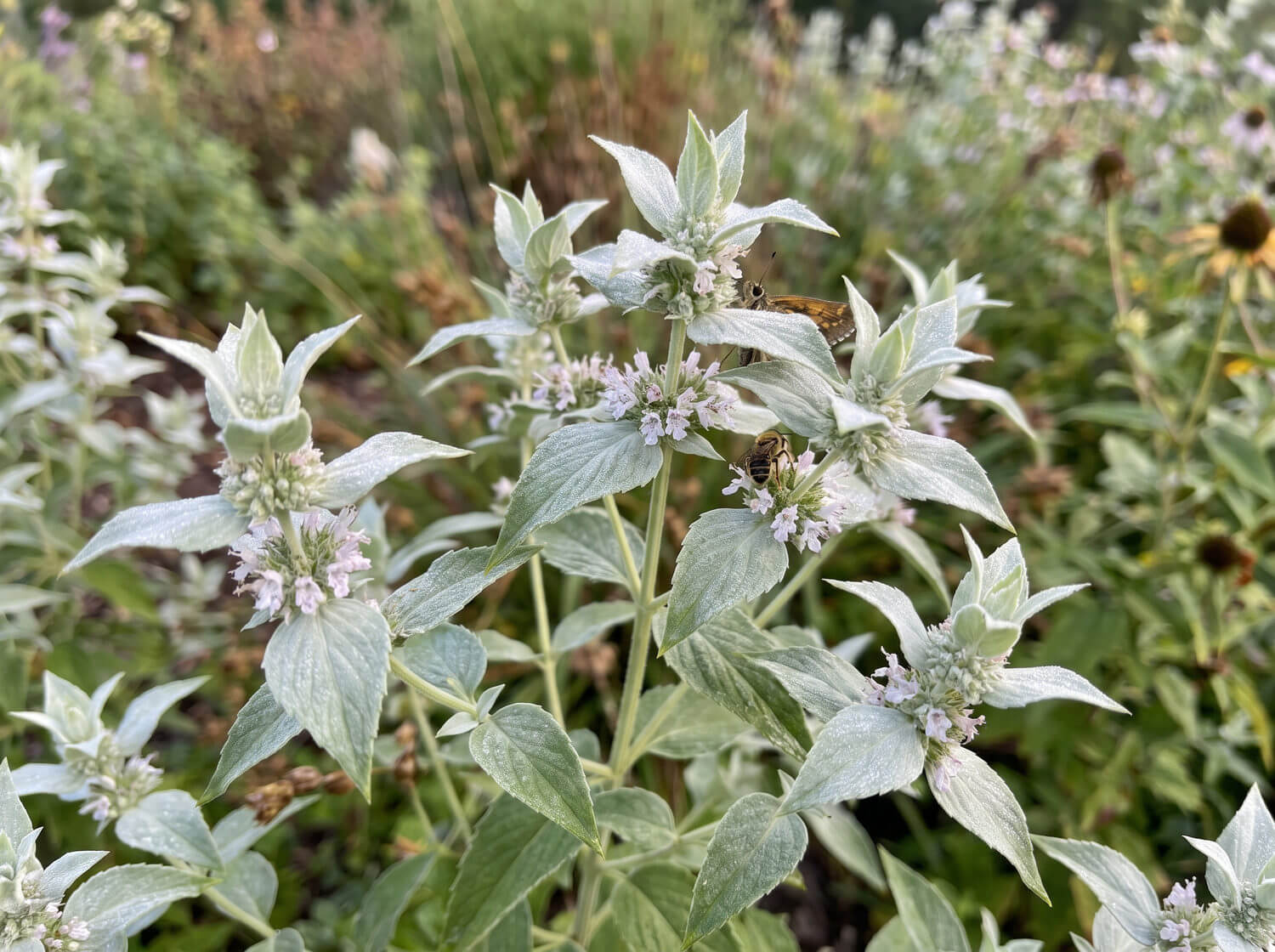
Clustered mountain mint is one of those perennials that earns its keep from midsummer until the frosts, not through showy petals but through broad, silver-dusted bracts that look permanently touched by hoar frost. It forms dense, bushy clumps of aromatic foliage that release a cool, peppermint scent at the slightest brush, and the flat flower heads hum with bees, hoverflies and wasps for weeks on end. It is a superb choice for the back of a sunny border, a prairie-style planting or a dedicated pollinator bed.
Growing conditions
Full sun produces the sturdiest stems, the brightest silver bracts and the heaviest pollinator traffic. It copes willingly with two or three hours of shade, particularly in hotter continental climates, but plants in deeper shade stretch, flop and silver less convincingly. Give it an open position with free air movement to keep the foliage dry.
Mountain mint is relaxed about soil type and will grow in loam, sand or heavy clay, provided the ground is not waterlogged through winter. Its natural habitat includes damp meadows and woodland edges, so consistently moist but drained soil suits it best. A pH anywhere from mildly acidic to neutral, around 5.5 to 7.0, is ideal, and it tolerates slightly alkaline conditions without complaint.
This is a genuinely tough plant, hardy well below −20 °C and untroubled by cold, wet British winters as long as drainage is adequate. In Mediterranean-type climates it needs supplementary summer watering; in mild maritime gardens it may spread more vigorously than expected.
How to plant Pycnanthemum
Plant in spring, from March to May, so the rhizomes have a full season to establish before winter. Early autumn planting also works in mild regions, provided the soil is still warm.
Space plants 60–75 cm apart — they knit together quickly and closer spacing simply speeds up congestion in the centre of the clump.
Set the crown level with the surrounding soil; burying it deeper invites rot in wet ground.
Fork over the planting area and incorporate leaf mould or garden compost, but avoid rich manures, which encourage soft, floppy growth.
Water in thoroughly and keep the soil evenly moist for the first six to eight weeks until new shoots appear.
Propagate by lifting and dividing established clumps in spring, or by taking 8 cm softwood cuttings in late spring — they root in two to three weeks in a shaded frame.
Mountain mint growing in a naturalistic garden border
Care through the seasons
Spring: Shoots emerge late, often not until April, so mark the position to avoid digging into dormant crowns. Pull out any wandering rhizomes that have strayed beyond their allotted space while the soil is soft. A light mulch is plenty — avoid feeding, as fertile conditions weaken the stems.
Summer: Water during prolonged dry spells, particularly on sandy soil, as drought-stressed plants drop their lower leaves and silver poorly. A Chelsea chop in late May, reducing stems by a third, produces a shorter, denser plant that needs no staking. Leave the flower heads be: they feed pollinators continuously from July onwards.
Autumn: The bracts hold their frosted look well into October and the dried stems have real winter presence, so delay cutting back if you can. Divide congested clumps every three to four years, in early autumn or the following spring. Lift the whole clump, discard the woody centre and replant vigorous outer sections.
Winter: The plant dies back completely to ground level and needs no protection in temperate gardens. Cut old stems to 10 cm in late winter, just before new growth begins, leaving hollow stems as overwintering sites for solitary bees.
Best varieties to grow
Named cultivars of P. muticum are scarce — the species is so good that it is almost always sold unimproved — so these close relatives are worth knowing.
Pycnanthemum muticum (species) — the benchmark for silvered bracts, dense habit and sheer pollinator appeal; buy seed-raised or divided stock from a reputable nursery.
Pycnanthemum tenuifolium — narrowleaf mountain mint, with fine, needle-like foliage and a softer, airier texture; less vigorous spread and excellent in gravel gardens.
Pycnanthemum pilosum — hairy mountain mint, taller at up to 1.2 m, with greyish downy leaves and a looser, more informal silhouette.
Pycnanthemum virginianum — Virginia mountain mint, the most tolerant of damp ground, making it the pick for rain gardens and pond margins.
Pests, diseases and common problems
Powdery mildew: Greyish bloom on the upper leaves in hot, dry late summer, usually where plants are crowded. Thin congested stems to improve airflow and water at the base rather than overhead; divide every third year to prevent dense, stagnant clumps.
Rhizomatous spread: The commonest complaint, not a disease — clumps expand 20–30 cm a year and swamp delicate neighbours. Sink a 30 cm vertical barrier at planting, or slice around the clump with a spade each spring and lift the runners.
Flopping stems: Open, splayed clumps with a bare centre point to too much shade, too much nitrogen or both. Move plants into full sun, stop feeding, and cut stems back by a third in late May to build sturdier growth.
🌿 Nature & Garden Newsletter
Gardening tips, recipes & seasonal advice, twice a week.