The staghorn fern is one of the most sculptural plants you can hang on a wall, its forked, antler-like fronds arching outwards from a neat shield of overlapping papery growth. Grown as a house plant across most of Europe and outdoors in frost-free gardens, it is an epiphyte that asks for a mount or a basket rather than a pot of compost. Uniquely among the commonly grown staghorns, it clumps freely, so a single plant will in time become a colony.
Growing conditions
Think of the dappled light beneath a rainforest canopy: bright, but filtered. An east- or north-facing window, or a spot a metre or so back from a west-facing one, suits it perfectly. Direct midday summer sun bleaches the fronds to a pale straw colour and eventually scorches them.
This is an epiphyte, so ordinary potting compost will rot it. Mount the plant on a hardwood board, cork bark or slab with a generous pad of sphagnum moss, or grow it in a wire basket lined with moss and filled with a chunky mix of bark, perlite and leafmould. A slightly acidic medium, around pH 5.5–6.5, mirrors the bark and leaf litter it would colonise in the wild.
Native to eastern Australia, New Guinea and Java, it is the toughest of the commonly grown staghorns and tolerates cooler, drier air than most. Outdoors it is reliable only in zones 9–11; elsewhere it makes an excellent conservatory, bathroom or shaded-patio plant that summers outside and overwinters indoors once nights fall below 10 °C.
How to plant Platycerium
Mount or repot in late spring, as light levels rise and the fern begins pushing new fronds — recovery is fastest when growth is active. Avoid disturbing plants in midwinter.
Allow at least 60 cm between mounted plants on a wall so air circulates freely and fronds do not shade or abrade one another.
Set the plant so the shield frond sits flat against the board, with the growing point (the bud at the centre of the shield) facing upwards and never buried.
Soak a good handful of sphagnum moss, squeeze it out and build a mound 5–8 cm deep behind the root ball before fixing the fern with fishing line, plastic-coated wire or nylon tights.
Water in by submerging the whole mount in tepid water for 10–20 minutes, then let it drain completely before hanging.
Propagate by detaching pups with a clean knife once they reach about 10 cm across, taking a portion of root and shield with each, and mounting them straight away.
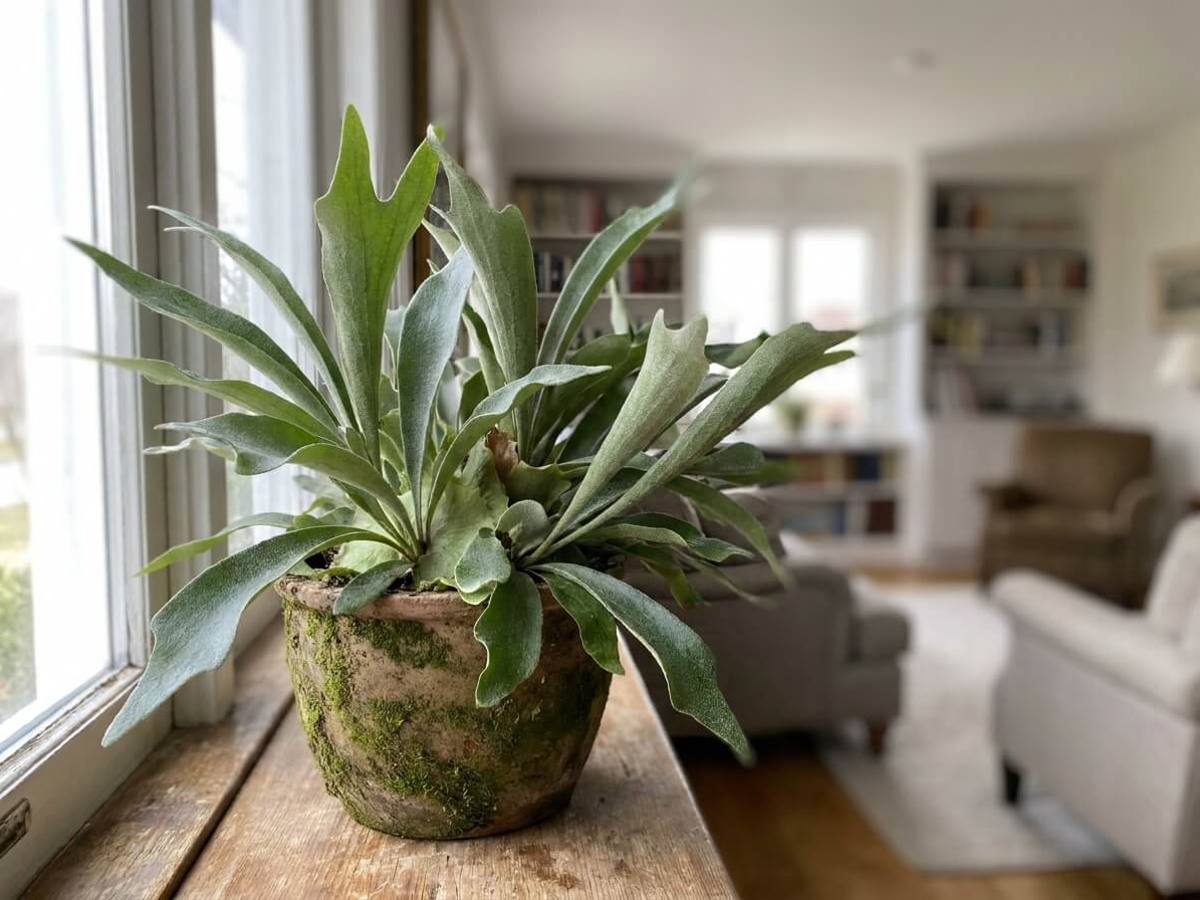
Platycerium bifurcatum displayed as a houseplant in a home interior
Care through the seasons
Spring: Growth restarts as days lengthen; increase watering to roughly once a week and begin feeding. A balanced liquid feed at half strength, applied monthly, is ample — tuck a banana skin or a pinch of slow-release fertiliser behind the shield frond if you prefer. This is the moment to mount new divisions and to tie on any plant that has outgrown its board.
Summer: In warm, dry weather soak the mount twice weekly, judging by weight: a light mount is a thirsty one. Mist in the mornings if indoor humidity drops below about 50 per cent, and move plants outdoors into full shade once nights stay above 12 °C. Never let water stand in the crown overnight in still, humid conditions.
Autumn: Spore patches appear as velvety brown felt on the undersides of the frond tips — leave them, they are a sign of maturity, not disease. Stop feeding from early October and reduce watering as growth slows. Bring plants back under cover before the first frost.
Winter: Water sparingly, perhaps every two to three weeks, keeping the moss barely moist and the temperature above 10 °C. Old shield fronds will brown and crisp at the edges — this is normal and they should be left in place.
Best varieties to grow
A handful of selections differ usefully in size, frond width and vigour.
‘Netherlands’ — the most widely sold form, compact, free-branching and quick to produce pups; the easiest choice for a first mount.
‘Majus’ — larger and bolder, with longer, more deeply divided antler fronds for a dramatic wall piece.
‘Roberts’ — narrow, finely forked fronds that hang in a pronounced cascade, excellent in a basket.
‘San Diego’ — upright, stiffly held fronds with broad shields, tolerant of lower humidity than most.
Pests, diseases and common problems
Scale insects: Small brown limpet-like bumps along frond ribs, often with sticky honeydew below. Dab them off with a cotton bud dipped in dilute soft soap solution, repeating fortnightly, and avoid oil sprays, which clog the protective frond hairs.
Rhizoctonia black spot: Dark, rapidly spreading patches at the frond bases after prolonged damp and poor airflow. Remove affected fronds, move the plant somewhere brighter and better ventilated, and water in the morning only.
Crown or root rot: The central bud blackens and fronds pull away limply, usually from a mount that never dries out. Soak rather than drip-water, always let the moss approach dryness between soakings, and reduce frequency sharply in winter.