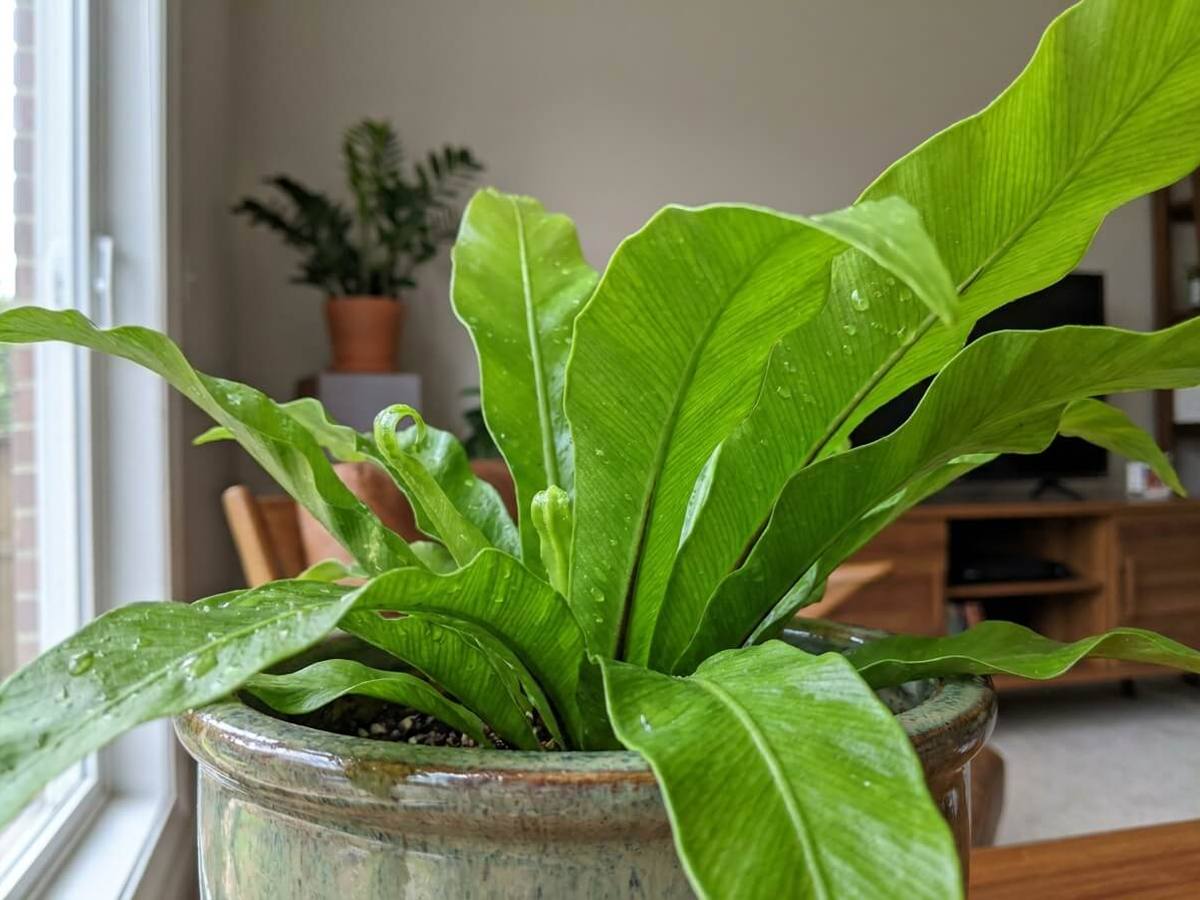
With its glossy, apple-green fronds unfurling from a dark, fuzzy central rosette, Asplenium nidus is one of the most architectural ferns you can grow indoors. The undivided, strap-shaped leaves give it a bold, tropical presence that most feathery ferns cannot match, and it copes with lower light than almost any other houseplant fern. In frost-free gardens it makes a superb epiphyte, lodged in the fork of a tree or a shaded wall niche.
Growing conditions
Think of the dappled gloom of a rainforest understorey. Bright but filtered light suits it best — an east- or north-facing windowsill, or a metre or two back from a brighter window. Direct midday sun scorches the fronds within days, leaving irreversible bleached patches.
The roots are those of a tree-dweller, so they demand air as much as moisture. Use a loose, bark-based epiphyte mix, or two parts peat-free houseplant compost to one part fine orchid bark and one part perlite. A slightly acidic pH of 5.5–6.5 is ideal, and the mix should never be allowed to turn to sludge.
Humidity above 50 per cent keeps frond tips green; below 40 per cent they brown and crisp. Outdoors it only succeeds in genuinely frost-free, humid climates such as coastal Queensland, Florida or the Canaries, where it can be wedged into tree forks with sphagnum moss.
How to plant Asplenium
Pot or repot in spring, as light levels rise and new fronds begin to unfurl from the crown — roots re-establish fastest then. Repotting is only needed every two to three years, as this fern flowers best when slightly snug.
Allow 60–90 cm between plants in a shaded border or trough, so the mature rosettes can spread without the fronds shading and marking one another.
Set the plant so the base of the rosette sits just proud of the compost surface — burying the crown is the commonest cause of rot.
Mix fine orchid bark, coarse perlite or leaf mould into the compost to keep it open; add a 2 cm layer of crocks in the base of the pot.
Water in around the rim of the pot with tepid, preferably rainwater or filtered water, then allow the surface to dry slightly before watering again.
Propagation is from spores sown on sterile, moist compost under glass at 21 °C — the plant produces no offsets and cannot be divided.
Asplenium nidus displayed as a houseplant in a home interior
Care through the seasons
Spring: New fronds emerge as tight, pale-green crosiers from the centre of the nest — resist touching them, as the delicate tips bruise and distort permanently. Begin feeding every fourth watering with a balanced liquid feed diluted to half strength. Repot if roots fill the pot or the plant topples easily.
Summer: Keep the compost evenly moist but never saturated, watering around the edge of the rosette rather than into it. Mist in the morning, or stand the pot on a tray of damp gravel, during hot spells. Move plants away from south-facing glass, where temperatures above 30 °C combined with direct sun will scorch the fronds.
Autumn: Taper off feeding from early October as growth slows. Wipe dust from the fronds with a damp cloth so they make the most of weaker light, and snip off any wholly brown outer leaves at the base with clean scissors. Bring any plants summered outdoors back under cover before night temperatures fall below 12 °C.
Winter: Growth virtually stops; water sparingly, allowing the top 2–3 cm to dry out first. Keep the plant well away from radiators, open fires and cold draughts, both of which cause rapid browning.
Best varieties to grow
Nurseries offer several crested and wavy forms, some of which are botanically the closely related Asplenium antiquum but sold under the bird’s nest fern name.
‘Crispy Wave’ — deeply rippled, upright fronds with a stiff, almost plastic-looking texture; the most widely sold and arguably the toughest.
‘Osaka’ — narrow, strongly undulating fronds forming a tidy, upright vase, ideal for narrow shelves.
‘Crissie’ — distinctive forked, fish-tail tips at the end of each frond, giving a crested silhouette.
‘Victoria’ — long, wavy-edged fronds with a pronounced dark midrib, making a dramatic specimen in a wide, shallow pot.
Pests, diseases and common problems
Scale insects: Raised brown or straw-coloured bumps scattered along the midrib and frond undersides, with sticky honeydew below. Wipe them off with a cotton bud dipped in diluted horticultural soap, repeating weekly for a month.
Crown rot: The centre of the rosette blackens and new fronds collapse, usually after water has been poured into the nest or the plant has been left standing in a saucer. Remove affected tissue, repot into fresh gritty mix and water only at the pot edge.
Bacterial leaf blight: Water-soaked spots that spread along the veins and turn dark brown, worst in cool, wet, still conditions. Cut out affected fronds, stop misting, and improve air movement — there is no organic cure once established.