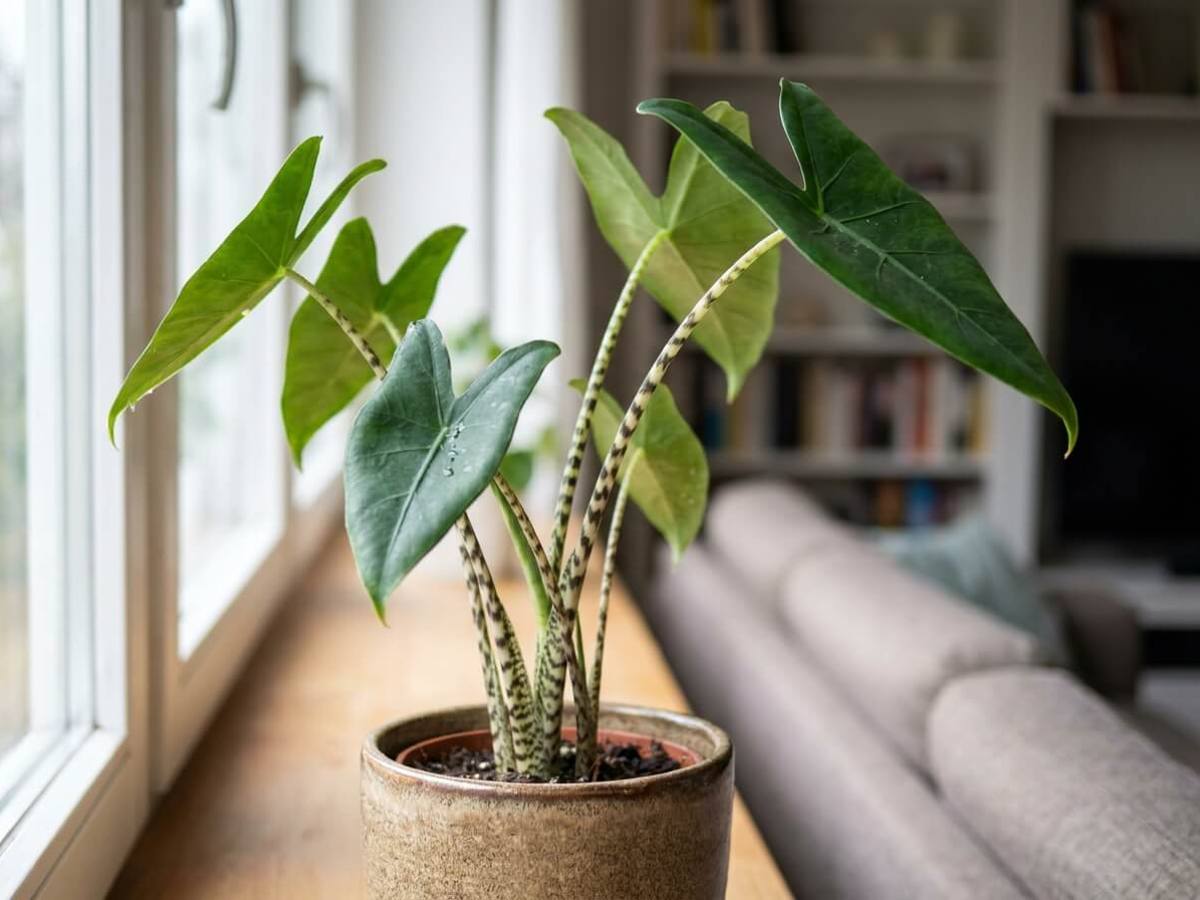
Few houseplants carry themselves with the poise of Alocasia zebrina, whose slender, tiger-striped stalks lift arrow-shaped leaves high above the pot like a flock of green kites. It is grown as much for those boldly barred petioles as for the glossy foliage itself, making it a natural choice for a bright corner that needs height without bulk. Unusually among aroids, the stems are the star of the show — the leaves are merely the applause.
Growing conditions
Bright, indirect light is the single most important condition. An east-facing window, or a position a metre back from a south- or west-facing one, suits it perfectly. Direct midday sun scorches the leaves to papery brown patches, whilst deep shade produces stretched, floppy stalks that cannot hold their leaves upright.
The roots demand air as much as moisture. Use a chunky aroid mix — roughly equal parts peat-free potting compost, fine orchid bark and perlite, with a handful of horticultural charcoal. Aim for a slightly acidic pH of 5.5–6.5; heavy, water-retentive compost is the quickest route to corm rot.
Warmth and humidity matter enormously: 18–27 °C with humidity above 60% keeps growth continuous. Below about 15 °C the plant slows and may drop into dormancy, so keep it well away from draughty doors and cold windowpanes in winter.
How to plant Alocasia
Pot or repot in spring, as light levels rise and the rhizome breaks into active growth — this allows roots to colonise fresh compost before the plant’s strongest growing months.
Allow 60–90 cm of clear space around each plant so the arching petioles can spread without rubbing; crowding encourages spider mites.
Set the rhizome so its crown sits just at compost level — burying it deeply invites rot at the base of the stalks.
Choose a pot only 2–4 cm wider than the rootball and add a generous proportion of bark and perlite; Alocasia zebrina flowers and grows best when slightly snug.
Water in thoroughly with tepid water until it runs from the drainage holes, then let the surface dry before watering again.
Propagate by separating offsets or small corms from the parent rhizome at repotting; pot them individually and keep them warm, humid and barely moist until shoots appear.
All parts contain calcium oxalate crystals, so wear gloves when dividing and keep the plant out of reach of pets and children.
Alocasia zebrina displayed as a houseplant in a home interior
Care through the seasons
Spring: Growth resumes as days lengthen. Begin feeding every third or fourth watering with a balanced liquid fertiliser at half strength, repot if roots are circling the pot, and remove any leaves that yellowed over winter by cutting the petiole close to the base.
Summer: This is the season of fastest growth, with a new leaf roughly every three to five weeks. Water when the top 2–3 cm of compost feels dry, never allowing the pot to stand in a saucer of water, and raise humidity by grouping plants or standing the pot on a damp pebble tray. A spell outdoors in deep, sheltered shade from June to early September is appreciated, provided nights stay above 15 °C.
Autumn: Taper feeding from late September and reduce watering as light fades. Bring any plant that has summered outdoors back inside before nights drop below 15 °C, inspecting the undersides of leaves for pests first. Autumn is also the last reasonable moment to divide, though spring gives better results.
Winter: Growth stalls and some plants shed most of their leaves and rest as a bare rhizome. Keep the compost barely moist, hold off feeding entirely, and be patient — a dormant corm usually resprouts in spring.
Best varieties to grow
Selections are few, but the variations in petiole markings are striking and worth seeking out.
Alocasia zebrina ‘Reticulata’ — the netted form, with a fine web-like pattern on the stalks instead of clean bands; much sought after by collectors.
Alocasia zebrina ‘Tigrina Superba’ — bolder, more contrasting dark markings and a slightly more upright, vigorous habit.
Alocasia zebrina ‘Variegata’ (Aurea Variegata) — leaves splashed with cream and pale green; slow, scarce and in need of brighter light than the plain form.
Alocasia zebrina ‘Reticulata Superba’ — compact in leaf but exceptionally well marked, useful where space for a 1.2 m plant is limited.
Pests, diseases and common problems
Spider mite: Fine stippling, dull foliage and faint webbing where petiole meets leaf, always worst in dry indoor air. Raise humidity, rinse both leaf surfaces under a tepid shower weekly, and treat with insecticidal soap or neem until clear.
Mealybug: White cottony clusters tucked into the leaf joints and along the stalks, leaving sticky residue. Dab each colony with a cotton bud soaked in surgical spirit, then follow up with insecticidal soap every seven days for a month.
Rhizome and root rot: Stalks collapse at the base, the rhizome feels soft and the compost smells sour — nearly always caused by overwatering in cool, dark conditions. Unpot immediately, cut away all soft tissue with a sterilised blade, dust the cuts and repot into fresh, very gritty compost kept only just moist.
🌿 Nature & Garden Newsletter
Gardening tips, recipes & seasonal advice, twice a week.