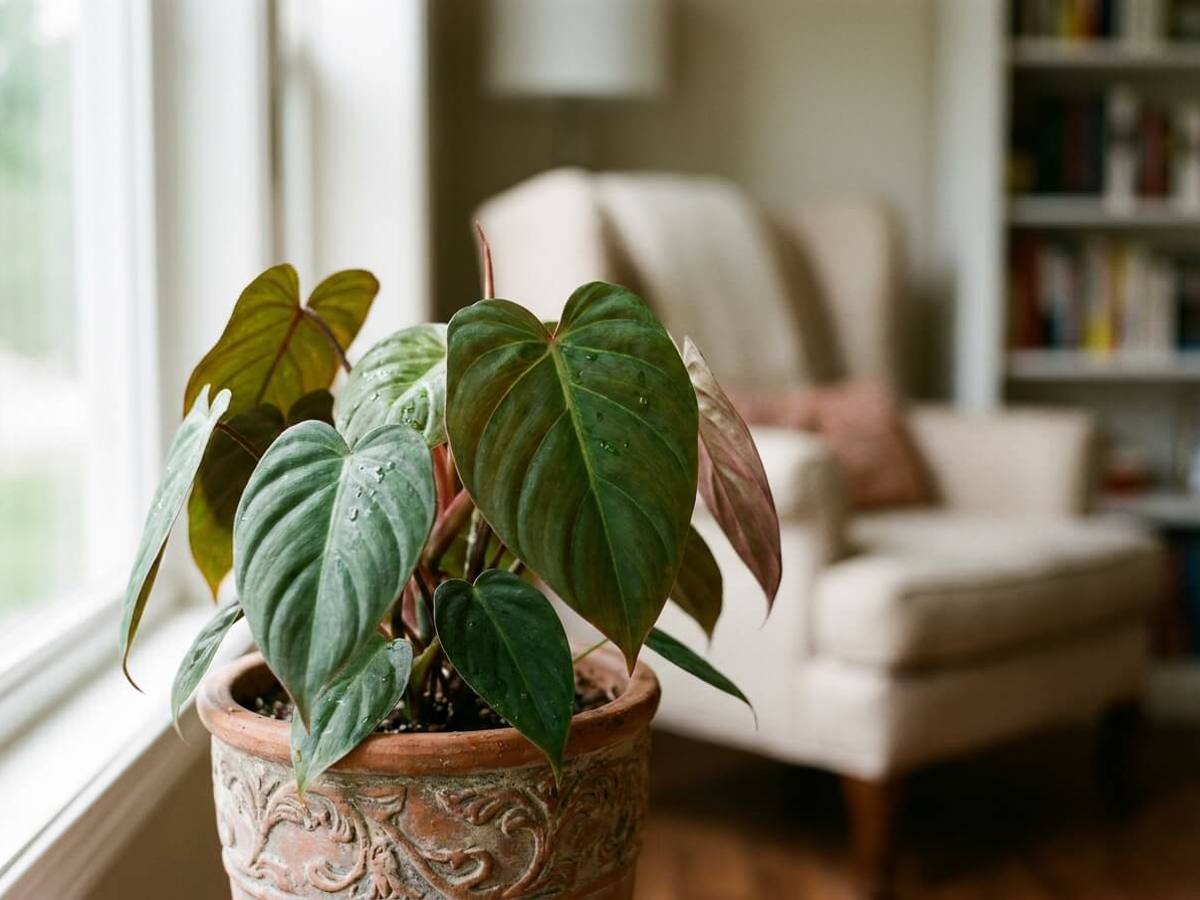
Few houseplants deliver drama as effortlessly as the blushing philodendron, whose glossy, arrow-shaped leaves unfurl from wine-red sheaths on burgundy stems. A natural climber from the rainforests of Colombia and Venezuela, it will scale a moss pole to two metres or more indoors, making it ideal for filling a tall, awkward corner. Its distinctive trait is the flush of deep red on the leaf undersides and petioles — the “blush” that gives the species its name.
Growing conditions
Bright but filtered light gives the best results: think a position a metre or so back from an east- or west-facing window. Direct midday sun scorches the leaves to pale, papery patches, whilst deep shade causes long, bare stretches of stem between leaves. Red and pink-variegated forms need noticeably brighter light than the plain green types to hold their colour.
Use an airy, chunky mix rather than ordinary potting compost — roughly equal parts peat-free compost, orchid bark and perlite, with a handful of coarse charcoal. The aim is a medium that drains within seconds yet holds a little moisture, at a slightly acidic pH of 5.5 to 6.5. Dense, waterlogged compost is the single most common cause of failure.
Treat it as a warm-room plant: growth stalls below 15 °C and cold draughts cause yellowing. In mild, frost-free climates it can be grown outdoors in dappled shade, but anywhere in Britain and northern Europe it should spend the colder months indoors, moved outside only after night temperatures settle above 15 °C.
How to plant Philodendron
Pot or repot in spring, as lengthening days trigger root activity and the plant recovers quickly. Avoid repotting between November and February, when roots are barely growing.
Allow 60–90 cm between plants in a grouped display so air can circulate and leaves are not forced to overlap.
Set the plant at the same depth it grew before, with the crown and lowest node just clear of the compost surface.
Choose a pot only 2–4 cm wider than the last; oversized pots stay wet and invite rot.
Insert a moss pole or bark slab at planting time, then tie the stem in loosely so aerial roots meet the support.
Water in thoroughly until liquid runs from the drainage holes, then let the top third dry before watering again.
Propagate from stem cuttings with at least one node and one aerial root, rooted in water or damp sphagnum at 22–25 °C.
Philodendron erubescens displayed as a houseplant in a home interior
Care through the seasons
Spring: This is the moment to repot, start feeding and train new growth onto the support. Begin a balanced liquid feed at half strength every third watering from March, and mist the moss pole to encourage aerial roots to attach. Wipe dust from the leaves so they can photosynthesise efficiently.
Summer: Water as soon as the top 3–4 cm of compost feels dry — typically every five to seven days in warm rooms. Humidity above 60 per cent produces larger, better-coloured leaves, so group plants together or stand the pot on a tray of damp gravel. Pinch or prune leggy stems in June or July to encourage branching from lower nodes.
Autumn: Taper feeding from late September and stop entirely by the end of October. Take any cuttings early in the season so they root before light levels fall. Move plants closer to a window to compensate for the weakening sun, and check carefully for pests before central heating comes on.
Winter: Growth slows to a near standstill; water sparingly, allowing half the pot to dry out between drinks. Keep away from radiators and cold glass, and never let the temperature drop below 13 °C.
Best varieties to grow
Breeders have produced a striking range of leaf colours, from near-black burgundy to candy-pink variegation.
‘Red Emerald’ — vigorous and reliable, with glossy emerald leaves on bright red petioles; the best choice for a tall pole.
‘Imperial Red’ — a compact, self-heading selection whose new leaves emerge deep oxblood before maturing to dark green, excellent where space is limited.
‘Pink Princess’ — the famous collector’s form, with chocolate-brown leaves splashed pink; the variegation is chimeric and must be managed by pruning.
‘Burgundy’ — an older, slower cultivar with rich wine-coloured young foliage and a graceful, less rampant habit.
Pests, diseases and common problems
Root rot: Yellowing lower leaves, a sour smell and soft, brown roots point to overwatering. Unpot, cut away damaged roots with sterilised secateurs, repot into fresh bark-rich mix and water less often.
Spider mite: Fine speckling, dull foliage and faint webbing in the leaf axils, worst in dry winter air. Rinse the plant under a tepid shower, raise humidity and spray weekly with an organic soap-based insecticide for three weeks.
Mealybug: White, cottony clusters tucked into leaf joints and under petioles, with sticky residue below. Dab each colony with a cotton bud dipped in surgical spirit, then follow with neem or horticultural soap until clear.
Leggy, small-leaved growth: Long gaps between leaves mean too little light or no support. Move to a brighter spot and train the stem onto a damp moss pole; cut back hard in spring to force fresh shoots.