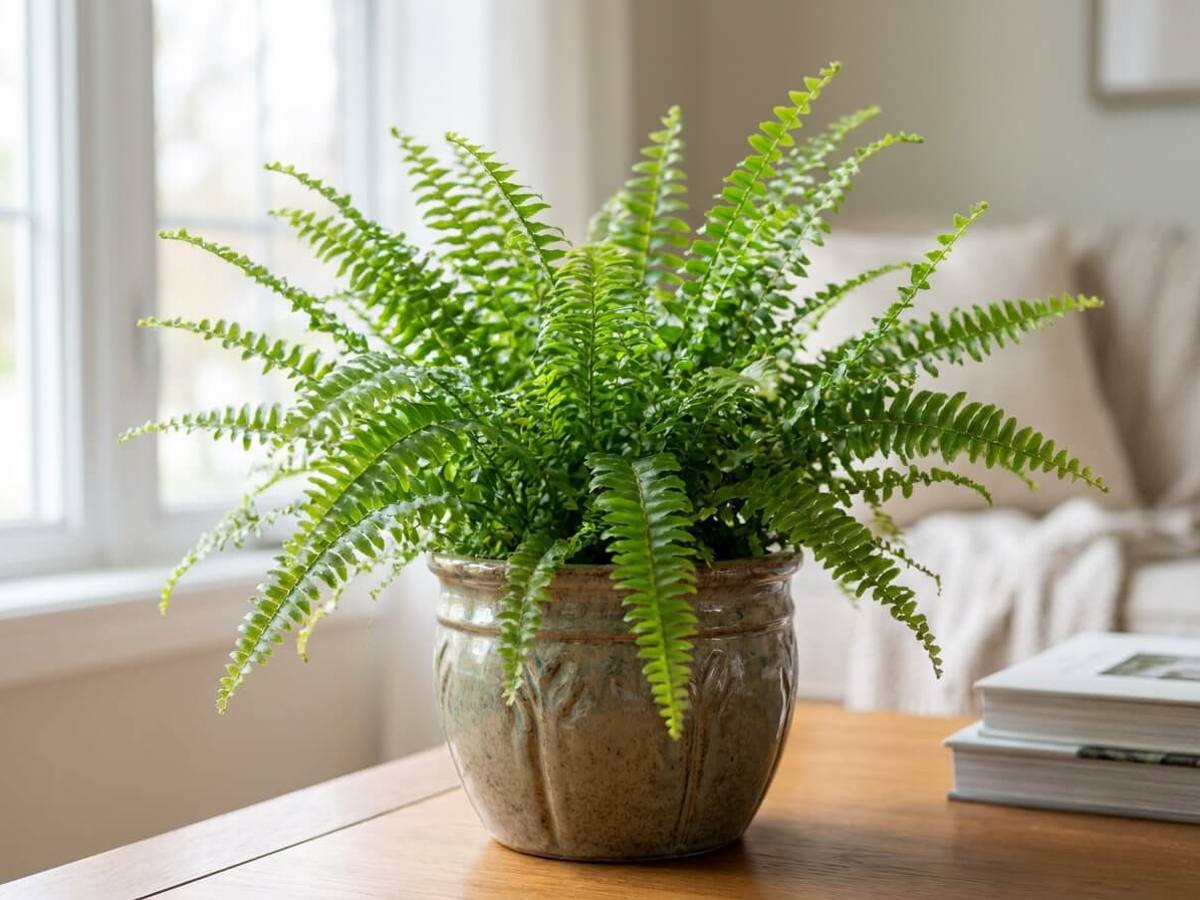
With its cascading, finely divided fronds and soft arching habit, Nephrolepis exaltata is the classic drawing-room fern — equally at home spilling from a hanging basket, perched on a plant stand or filling a shady summer veranda. It is grown entirely for its lush evergreen foliage, which can reach a metre in length on well-fed plants. Unusually among popular houseplants, the most familiar form was never bred deliberately: it appeared by chance as a sport.
Growing conditions
In the wild this fern grows in humid forests and swamps of the Americas, often perching on tree trunks or rotting stumps. Give it bright but filtered light — an east-facing windowsill, or a metre or so back from a south-facing one. Direct summer sun through glass bleaches the fronds to a sickly yellow and then crisps them.
Roots need air as much as moisture. Use a loose, open, peat-free mix: two parts quality houseplant compost to one part fine bark or coir, plus a generous handful of perlite. A slightly acidic pH of around 5.0 to 6.5 suits it best, and the compost should never be allowed to set hard or sit sodden.
Humidity matters more than most people expect — aim for 50 per cent or above, which is why bathrooms and kitchens suit it so well. Outdoors it is reliable only in zones 9–11; in temperate gardens treat it as a summer container plant and bring it in before night temperatures drop below 10 °C.
How to plant Nephrolepis
Pot up or repot in spring, just as new croziers begin to unfurl, so the plant has a full season of active growth to re-establish. Avoid repotting in the depths of winter, when root activity slows and wet compost lingers.
Space plants 60–90 cm apart when used as groundcover in frost-free climates, as each clump spreads steadily by stolons.
Set the crown level with the compost surface — burying it invites rot, whilst planting too high dries out the growing points.
Work plenty of leaf mould, fine bark or coir into the mix to hold moisture without compaction; add perlite for drainage.
Water in thoroughly with rainwater or cooled boiled water, then allow the top 2 cm to dry slightly before watering again.
Divide congested clumps in spring with a sharp knife, giving each section several healthy fronds and a good share of roots.
Nephrolepis exaltata displayed as a houseplant in a home interior
Care through the seasons
Spring: Growth restarts as light levels rise. Begin feeding every three to four weeks with a balanced liquid feed diluted to half strength, and repot into a container one size up if roots are circling. Snip out any fronds that browned over winter, cutting right back to the base.
Summer: This is the thirstiest period — check the compost every two or three days and never let it dry out completely, as Boston ferns rarely recover well from a full wilt. Mist in the morning or stand the pot on a tray of damp pebbles, and move containers outdoors into dappled shade once nights stay above 12 °C.
Autumn: Taper feeding from early September and stop by late October. Bring outdoor plants back under cover before the first chilly nights, checking carefully for slugs and scale insects beforehand. Trim away tatty fronds and divide any plant that has outgrown its pot, if you missed the spring window.
Winter: Growth pauses, so water sparingly — just enough to keep the compost barely moist. Keep plants away from radiators, open fires and draughty doorways, all of which strip humidity and brown the frond tips.
Best varieties to grow
Dozens of cultivars exist, differing mainly in frond size, texture and the degree of frilliness.
‘Bostoniensis’ — the original sport and still the benchmark, with long, gracefully arching fronds ideal for hanging baskets.
‘Dallas’ — compact and notably more tolerant of dry indoor air, making it the sensible choice for centrally heated rooms.
‘Fluffy Ruffles’ — densely crested, upright and finely divided, with stiffer, almost mossy-looking fronds.
‘Rita’s Gold’ — bright chartreuse new growth that ages to soft lime, lovely for lifting a dim corner.
Pests, diseases and common problems
Red spider mite: Fine webbing between pinnae and a dull, stippled bronze cast to the fronds, always worst in dry heat. Raise humidity immediately, rinse the foliage under a tepid shower and repeat weekly until clear.
Scale insects and mealybugs: Brown limpet-like bumps along the midribs, or white fluff in the crown, with sticky honeydew below. Dab them off with a cotton bud dipped in dilute soft soap solution — avoid oil-based sprays, which ferns resent.
Brown, crisp frond tips: Caused by dry air, erratic watering, or a build-up of fluoride and salts from tap water and over-feeding. Switch to rainwater, flush the compost through every couple of months, and feed at half strength only.