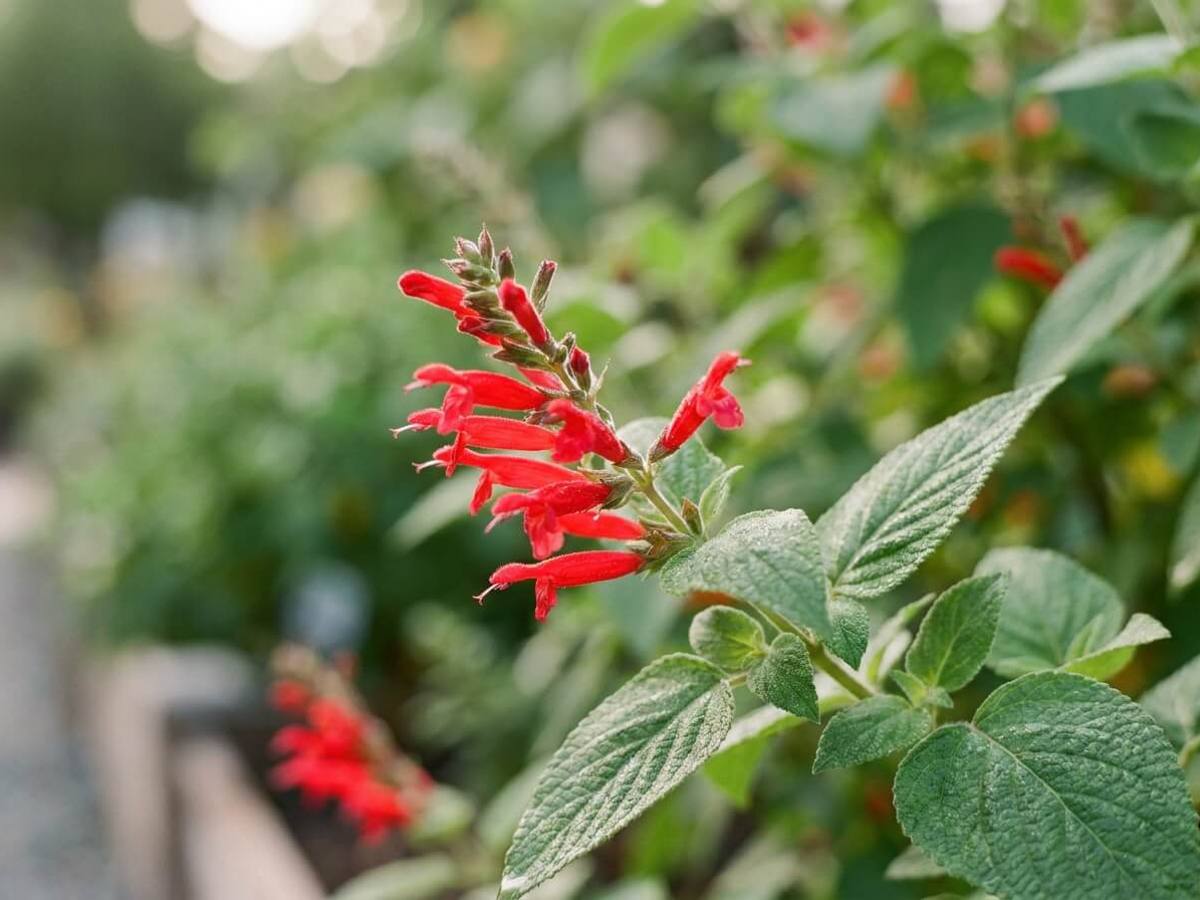
Pineapple sage earns its place at the back of the border twice over: first for its soft, apple-green foliage that releases a startling burst of fresh pineapple when brushed, and then for the blazing scarlet flower spikes that arrive just as most of the garden is winding down. It is a tall, airy Mexican perennial that flowers from late summer well into autumn, feeding late bees and, in warmer regions, hummingbirds. Both the leaves and the flowers are edible, which makes it as much a kitchen plant as an ornamental one.
Growing conditions
Give pineapple sage the sunniest, most sheltered position you can offer — a south- or west-facing wall is ideal. At least six hours of direct sun produces sturdy stems and a dense flush of flowers; in shade the plant stretches, flops and may never bloom at all. Shelter from wind matters too, since the hollow stems snap easily once they reach full height.
Soil should be fertile and moisture-retentive yet free-draining, as this is not a dry Mediterranean sage. A loam enriched with garden compost suits it perfectly, while heavy, cold clay should be lightened with grit and organic matter. It is unfussy about pH, performing well anywhere between pH 6.0 and 7.8, including on chalk.
In mild coastal and urban gardens it often survives outdoors year-round under a deep mulch, whereas in colder inland areas it is safest treated as a container plant or lifted for winter. Gardeners in short-season climates should choose an early-flowering cultivar, or the frost may beat the flowers.
How to plant Salvia
Plant out in late spring, once night temperatures stay reliably above 10 °C and all danger of frost has passed. Autumn planting is rarely successful outside frost-free regions, because the roots have no time to establish before cold, wet weather arrives.
Spacing: allow 60–75 cm between plants — this is a big, bushy salvia, and crowding encourages mildew on the lower leaves.
Depth: set the crown level with the surrounding soil, never buried, as a sunken crown rots quickly in winter wet.
Soil preparation: fork in a bucket of well-rotted compost per planting hole, plus a handful of horticultural grit on heavier ground.
Watering in: soak thoroughly at planting, then water deeply twice weekly for the first month to settle the roots.
Propagation: softwood cuttings root in two to three weeks in a warm, shaded propagator — take them in late summer as insurance against winter losses.
Salvia elegans growing in a naturalistic garden border
Care through the seasons
Spring: Wait until mid-spring before cutting back last season’s stems, as the dead growth shields the crown from late frosts. Once green shoots appear at the base, trim old stems to 10 cm and apply a balanced general fertiliser with a mulch of compost. Pinch the growing tips twice before midsummer to build a bushier, self-supporting plant.
Summer: This is the main growth phase, and plants are thirsty — water deeply once or twice weekly in dry spells, especially in containers, which may need daily attention in heat. Avoid high-nitrogen feeds from midsummer onwards, since lush soft growth delays flowering and tempts aphids. Stake or ring-support tall clumps by late July before the flower spikes add weight.
Autumn: The display peaks from September, so deadhead spent spikes to keep new ones coming and harvest leaves and flowers for the kitchen. Take cuttings in early autumn if you have not already done so. Once frost blackens the foliage, leave the top growth in place and pile a 10–15 cm mulch of bark, leaf mould or straw over the crown.
Winter: Outdoors the plant dies back completely and may not reappear until late May, so mark its position to avoid digging it up. Where temperatures dip below −5 °C, overwinter rooted cuttings or potted plants in a frost-free greenhouse or porch at 5–10 °C, kept barely moist.
Best varieties to grow
Only a handful of cultivars exist, but they differ usefully in flowering time and foliage colour.
‘Scarlet Pineapple’ — the classic selection, with the strongest pineapple scent and vivid vermilion flowers on 150 cm stems.
‘Golden Delicious’ — bright chartreuse-yellow foliage that lights up a border all season, topped with scarlet spikes; more compact at around 90 cm.
‘Honey Melon’ — shorter and earlier, flowering from late August, which makes it the best choice for cooler or short-season gardens.
‘Frieda Dixon’ — an unusual salmon-pink to coral-flowered form, lovely with purple asters and late grasses.
Pests, diseases and common problems
Slugs and snails: the soft new shoots emerging in late spring can be stripped overnight. Protect young growth with wool pellets or a grit barrier, and search by torchlight after rain.
Powdery mildew: a white bloom on leaves in late summer, usually caused by dry roots and poor airflow. Water at the base rather than overhead, thin congested stems, and remove affected leaves promptly.
Capsid bug and red spider mite: capsids cause ragged, distorted holes in young leaves, whilst mites bronze the foliage under glass. Encourage predators outdoors, and raise humidity around overwintering plants to deter mites.