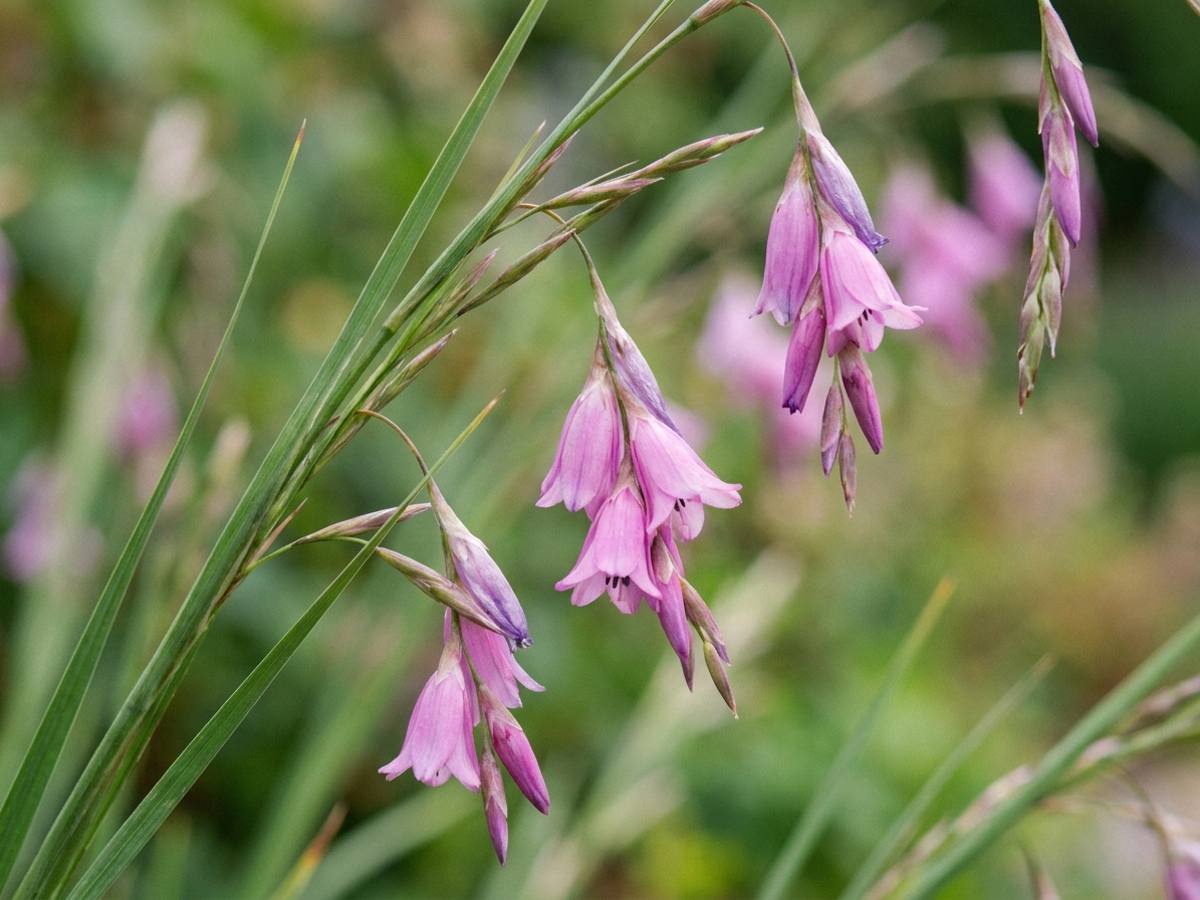
Few plants capture movement in the garden quite like Dierama pulcherrimum, whose wiry, arching stems dangle bell-shaped flowers that sway at the faintest breath of wind. Rising from grassy, evergreen fans of foliage, the wands reach up to two metres and pour out blooms in shades of magenta, pink, mauve and white throughout midsummer. Its common name — angel’s fishing rod — is one of the most fitting in horticulture, and once established the plant resents disturbance, making a well-chosen planting position essential.
Growing conditions
Dierama demands full sun to flower well — at least six hours a day, and preferably an open, unshaded site. Plants grown in partial shade produce fewer wands and lean awkwardly towards the light. Give them room to arch freely, ideally where the stems can hang over a path, low wall or pond edge without being crowded by neighbours.
Soil is where most gardeners go wrong. The corms need consistent moisture in the growing season yet must never sit in cold, wet ground over winter, so aim for a fertile loam enriched with well-rotted organic matter and improved with grit if the ground is heavy. A neutral to slightly acidic pH suits them best, though they tolerate mildly alkaline conditions; thin, hungry chalk is the least suitable soil of all.
Native to the summer-rainfall grasslands of South Africa, Dierama pulcherrimum copes with British and northern European winters far better than its exotic looks suggest, provided drainage is good. In colder inland gardens or where the soil is clay, plant on a slight mound or raised bed and mulch generously.
How to plant Dierama
Spring, from March to May, is by far the best planting time, giving the corms a full season to root before winter. Container-grown plants establish more reliably than dry, dormant corms bought loose.
Spacing: allow 45–60 cm between plants so the arching stems can cascade without tangling; groups of three to five look far better than single specimens.
Depth: set corms 5–8 cm deep, with the fan of foliage sitting just proud of the soil surface — planting too shallowly leaves them vulnerable to frost.
Soil preparation: dig in a bucketful of garden compost or leaf mould per square metre, plus a couple of handfuls of horticultural grit on heavier ground.
Watering in: soak thoroughly after planting and keep the soil evenly moist through the first summer; drought in year one is the usual cause of failure.
Propagation: divide only when absolutely necessary in mid-spring, or sow fresh seed in autumn — seedlings flower in their third or fourth year and often show pleasing colour variation.
Dierama pulcherrimum growing in a naturalistic garden border
Care through the seasons
Spring: Comb through the evergreen fans by hand to pull away dead, browned leaves rather than cutting them, which leaves unsightly blunt tips. Apply a balanced general fertiliser or a mulch of well-rotted compost around — but not over — the crown. Keep watering going if spring turns dry, as flower buds form now.
Summer: Water deeply during prolonged dry spells; established clumps are reasonably drought-tolerant but flower far more freely with steady moisture. Deadhead spent wands unless you want the papery seed capsules, which are attractive in their own right and will self-sow modestly. Stake only in very exposed gardens — the swaying stems are the whole point of the plant.
Autumn: Remove faded flower stems at the base once the seed has ripened or dropped. Avoid cutting back the foliage, which stays evergreen and protects the crown. Top-dress with gritty compost in colder districts, and lift and divide only if the clump is genuinely congested — expect a year without flowers afterwards.
Winter: The leaves remain green but may scorch brown at the tips in hard frost; this is normal and tidied away in spring. In gardens below −10 °C or on wet soils, cover the crown with a dry mulch of bark or bracken from late November.
Best varieties to grow
Named forms offer more predictable flower colour than seed-raised plants, though availability varies between nurseries.
Dierama pulcherrimum ‘Blackbird’ — deep wine-purple bells on tall wands, one of the darkest and most dramatic selections.
Dierama pulcherrimum var. album — pure white flowers that glow at dusk, superb beside dark-leaved shrubs or over water.
Dierama pulcherrimum ‘Merlin’ — rich violet-purple blooms, robust and reliably free-flowering in a sunny border.
Dierama ‘Guinevere’ — creamy white bells flushed pink at the base, slightly shorter and very elegant in a gravel setting.
Pests, diseases and common problems
Slugs and snails: young fans and emerging shoots are grazed to shreds in spring, especially on newly planted specimens. Protect with wool pellets, sharp grit or nematode treatments applied when soil temperatures reach 5 °C.
Corm rot in winter wet: foliage yellows and collapses, with soft, mushy corms at the base. There is no cure — prevent it by improving drainage with grit and planting on a raised mound rather than in a hollow.
Failure to flower: usually caused by too much shade, recent division, or drought during bud formation in late spring. Move to full sun if needed, then leave the clump undisturbed for at least three years and water through dry spells.