Mahonia berry – sweet & tart, best after freezing!
·
1
The Mahonia shrub isn’t only a formidable winter flower shrub – it’s also a source of high-value berries that you can really take advantage of! Many species are also known as oregon grape, so if you’ve been reading up on keeping mahonia berries under that name, it’s the very same fruit.
Mahonia berry, a rediscovery in these modern times
Today, Mahonia is barely starting to reappear as a berry fruit that deserves attention.
There aren’t any plantations or farms that grow Mahonia on scale yet.
At most, organized foraging takes place in certain areas where native Mahonia grows.
This is actually rather surprising, since the health benefits of Mahonia have long been used by tribes and peoples in the Canadian and American West. In Traditional Chinese Medicine, Chinese Mahonia is an oft-used ingredient as well. This simple but bountiful berry can do much more than simply feed the birds!
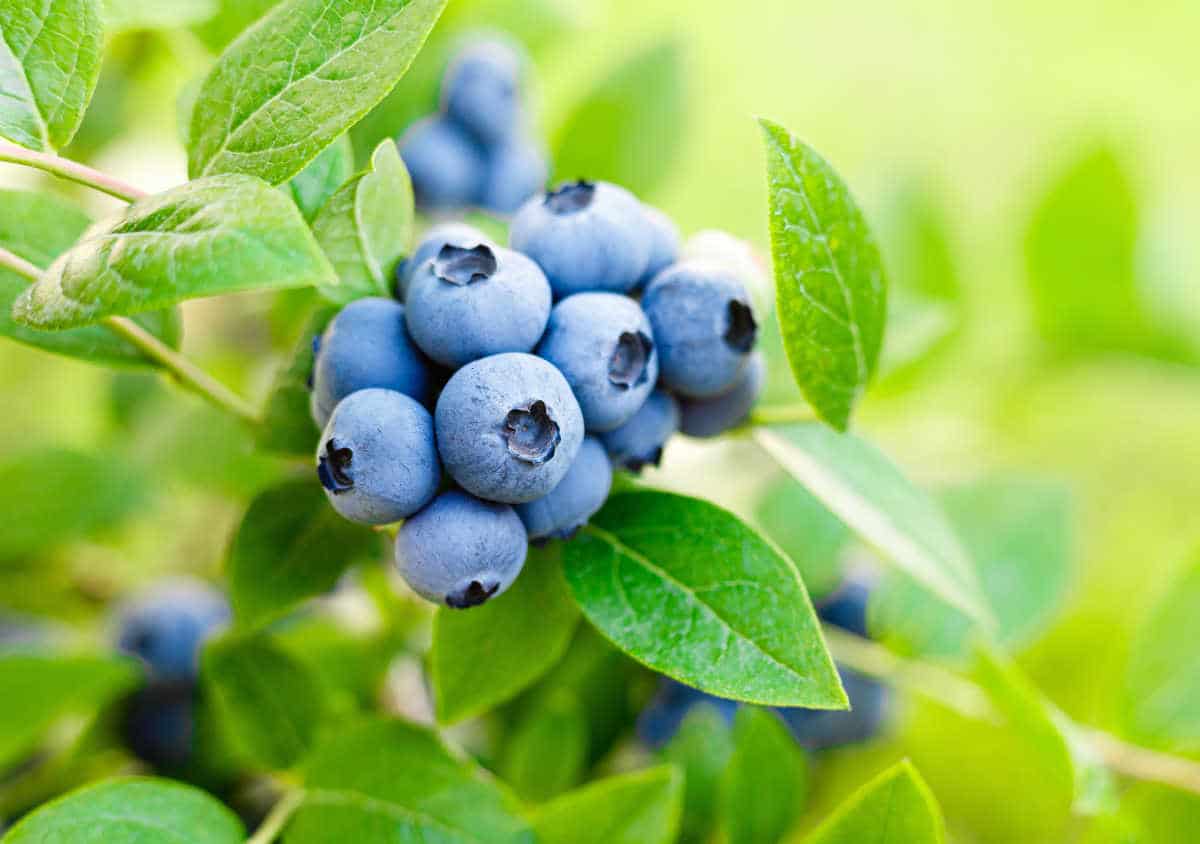
The seed fruits are very similar to blueberry. However, since they’ve only recently begun to raise serious interest, not much breeding and selection has taken place.
The Mahonia species we’re planting now are as close to being “developed by nature” as they can be!
Most recent developments aim for ornamental appeal, hence the increased promotion of the unique Chinese Mahonia.
Unlike blueberry and bilberry, which are sweet, luscious and plump thanks to centuries of selection, Mahonia berries still bear the marks of nature’s way. They’re rough, tart, and straight to the point – full of vitamin C and anti-oxidants!
However, thanks to cross-breeding, selection and an increase in demand, newer varieties that bear more interesting fruit will soon appear.
Mahonia seeds, rich colors and easy sowing
Description of the Mahonia berries
These fruits are grown in clusters that match the appearance of the Mahonia flowers. Usually, these clusters form a long ream of berries.
These bunches of fruits are called “racemes” when they’re in long rows, such as for Mahonia eurybracteata species.
These are purple in color, a deep violet sheen that explains why the common name for many species of Mahonia is “Oregon grape”.
Mahonia berries are covered in a whitish coating. Touching them with your fingers leaves a mark. This is a natural wax coating that the plant itself produces. It wards off pests and keeps moisture in.
A single Mahonia shrub, especially one that is well established, can yield quite a harvest.
For a shrub that’s 1 by 1 yard tall and wide (1 x 1m), expect around 4 pounds (2 kg).
Mahonia berry flavor
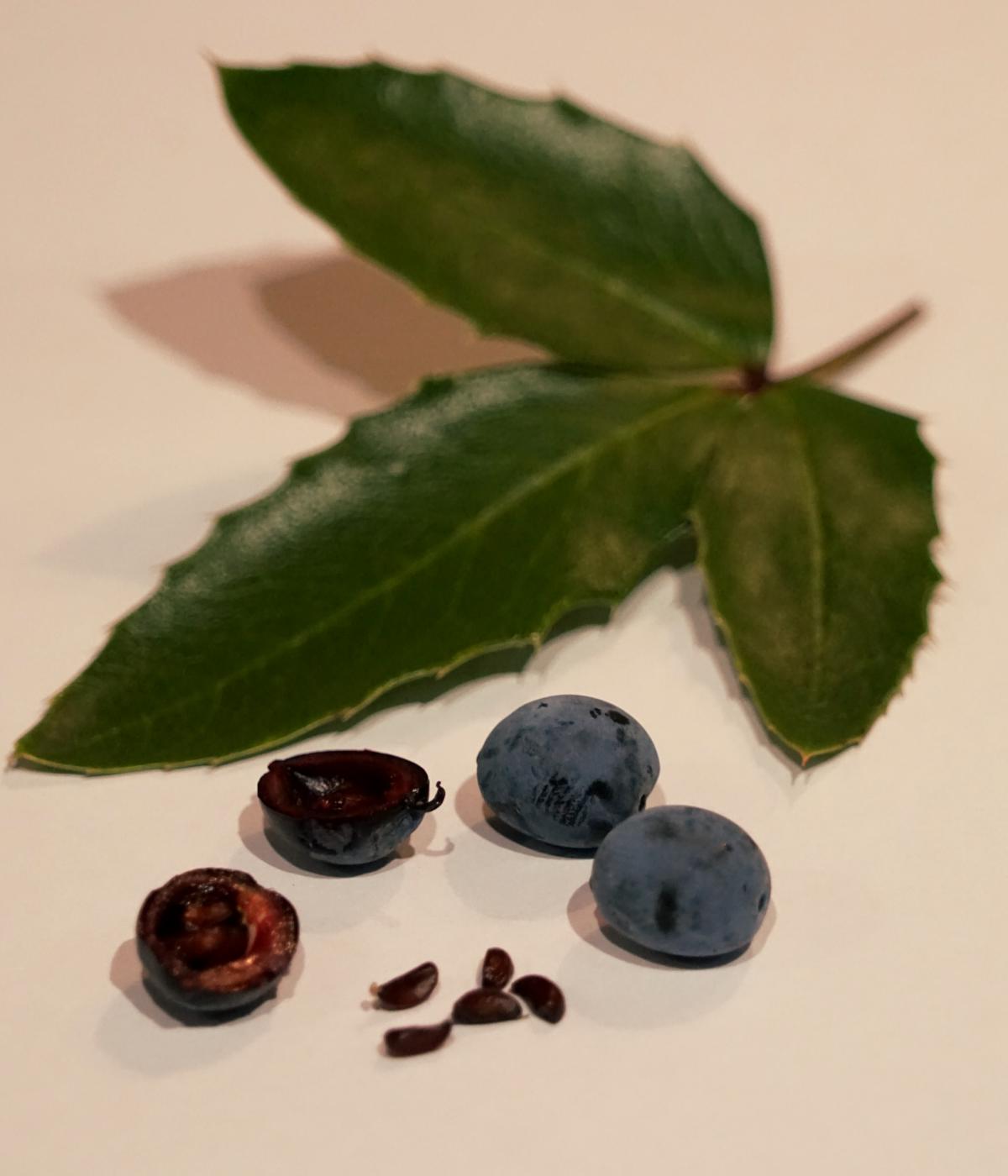
The seeds themselves take up the major part of the berry. Not much flesh surrounds them, but there’s definitely enough to still consider eating the fruit!
When you first burst the berry in your mouth, a tart, green-tasting burst of juice makes you pucker up.
After the first few seconds, the true taste of the Mahonia berry appears. It’s soft and somewhat woody, quite pleasant.
Don’t bite the seeds, they’re a bit bitter.
Mahonia seeds
In each berry, from 3 to 6 seeds are clustered towards the center. These seeds, once the flesh is removed, are a rich brown color. They’re also edible, with one drawback. Indeed, they contain berberine, which is a compound that interferes with brain development for babies and children.
If you plan on eating mahonia on a regular basis, better remove the pips.
Keep a few seeds aside if you wish to sow and grow new plants.
It’s possible to remove the seeds from the flesh, even though it’s a tough job.
Quick and easy way is to mash the berries up, without breaking the pits.
Sieve the flesh through a sieve, keeping the seeds behind.
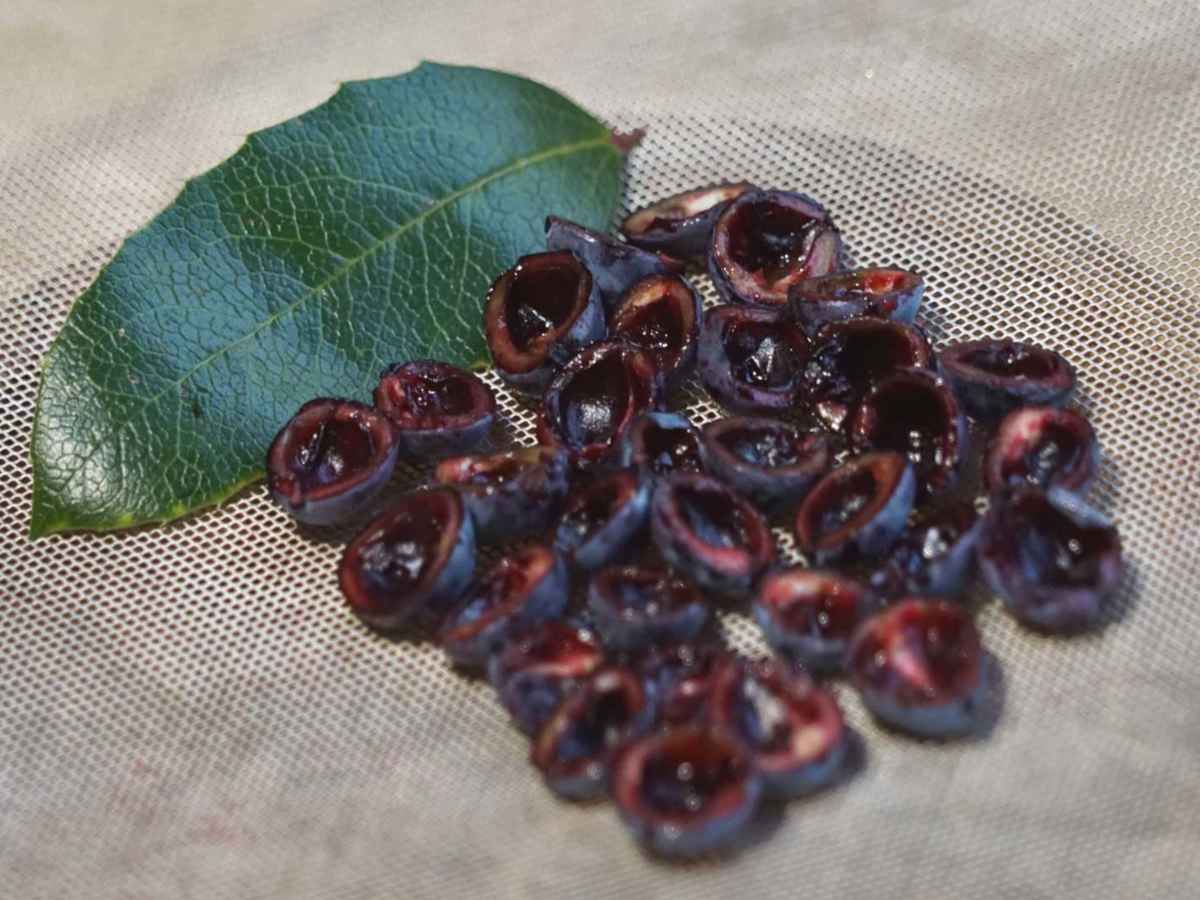
If you want to keep a few berries looking nice to decorate a dish, it’s easy to slice them open with a sharp knife and pick the seeds out. Each half still looks great.
Harvesting mahonia berries
Here is a full article on harvesting mahonia berries, but, in a nutshell, the main facts are as follows:
When to harvest your mahonia berries
Mahonia berries are only fully ripe when they’ve gone through a couple night’s worth of freezing.
Low temperatures transform chemical compounds in the fruit.
The tart compounds that usually make unripe fruits bitter and acidic break down as fruit cells start to ice over.
Long, bland sugar chains are shortened and make the fruit turn sweet!
This is similar to the phenomenon of bletting.
Bletting makes many otherwise unsavory fruits edible, such as medlar and blackthorn sloes.
How long do I have before the mahonia berries go bad?
Rinse them out properly in any case to remove dirt, bugs and twigs.
In the refrigerator, the berries will easily keep for a week.
You can set the nicest ones aside to plop them in fresh yoghurt.
However, if larger quantities were harvested, they’re likely to be a bit crushed together already.
Process these into jams, syrups within a day, at most two.
For liquor and wine, you’ve got a bit longer since fermentation is part of the process anyway. Aim for having everything in bottles within a week.
Keeping mahonia berries for the long run
The best way to keep these berries is freezing them, but it’s also possible to dry them out. Include them in a whole range of syrups, jams and liquors to savor them all the way to the next season!
Freezing keeps the nutritional benefits of mahonia berries for months, ready for pies, jams and ice creams.
Freezing is best for mahonia berries
If you want to preserve this berry’s nutritional benefits for a long time, freezing is the way to go.
Rinse the berries out under running water
Eliminate any that are dried out and withered. Also remove sticks and leaves.
Drip-dry them or spread them on a tray or cloth to remove any extra water. Caution, the juice stains cloth, use only something that you won’t regret staining!
Loosely pack the berries in an airtight plastic container (not glass) or freeze sealable pouches.
If you want to keep the nicest, plumpest berries whole, follow these steps instead of packing them with the others in freeze pouches:
Spread them on a tray so that they don’t touch or overlap too much.
Freeze them for a couple hours or overnight.
Once they’re frozen, you can bundle them together in a regular freeze pouch. They won’t stick and clump together as much since they’re already frozen.
When you need to unfreeze them, spread them out on a tray again for them to thaw without breaking.
Freezing is the only way to keep mahonia berries for use in pies, jams, and ice creams later on.
Dehydrating mahonia berries
Dehydrated mahonia berries also keep for a long time. They’re perfect for traveling and hiking.
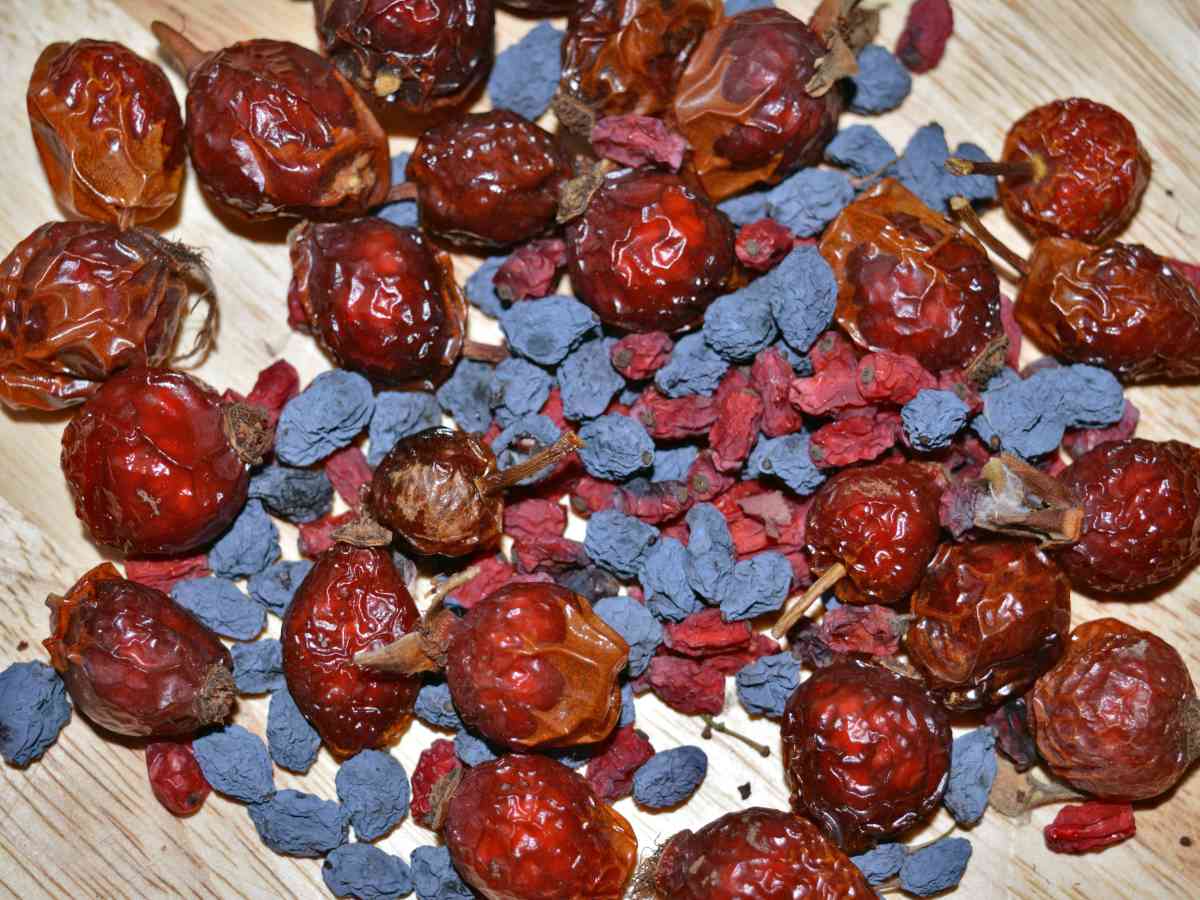
Dried mahonia berries, shown with small red goji and larger barberry fruit.
Rinse the berries first to get rid of twigs, bugs and dirt. Removing the seeds or pips is hard: it’s possible, but will take a long time to slice each berry open to take them out.
Simply accept that they’re going to be part of the crunch at every bite!
Or, if patient, slit each berry open and remove the seeds before drying.
With a dehydrator
Easiest is to use a dehydrator. Spread the berries evenly on the tray, don’t overload.
Dry at a temp of 130-140°F (55-60°C) for at least 12 hours.
If you don’t have a dehydrator
Spread the berries on a tray not far from a heat source (fireplace, wood stove or warm radiator).
Set a low-speed fan to send warm air around the berries.
Check on them every couple hours to turn them over.
Ready when they’ve shriveled up and become chewy.
A simple device such as a dehumidifier for the home can also dry the berries out:
Best slit the berries open for this method, since it’s the least effective means to dry them out.
Spread the half-berries on a sieve, only one layer thick.
Find a way to hold the sieve about half-a-foot (10-15cm) above the vent.
Let dry for around two-three days. Remember to empty the water tank when full.
Don’t spill them or you’ll stain the carpet or woodwork!
In the oven
Usually this isn’t the most cost-effective solution, but it works.
Open the door to the oven, and set it on low (130°F or 55°C).
Spread the berries on a tray, so that they’re touching but only the occasional berry sits up over other berries.
If your oven has a fan function that circulates air, turn it on.
With the door opened up a crack, let the heat do its thing and dry the berries out. Moist air needs to be let out of the oven, hence the open door.
Open the door to shuffle the berries around every couple hours.
This can take up to 8 hours. Either start early, or interrupt it overnight so you don’t create a fire hazard.
This makes these berries really appealing – if you can take their tartness!
Nutritional content of Oregon grape holly berries
This data relates to Mahonia aquifolium, one of the most common varieties.
Nutritional content of Mahonia aquifolium berries, per 100g
Nutrient
Content
Vitamin C
72.3 to 110.2 mg/100g
Sugars/carbs
4.8 to 7.2 g/100g
Anthocyanins
101.6 to 252.5 mg/100g
Trace elements
iron, potassium, manganese, phosphorus, calcium, copper, zinc, lead (depending on growing conditions and rinsing of fruits prior to consumption)
Smart tip about Mahonia berries
These berries are best after the first frosts, so rejoice when the weather is starting to get cold!
Mahonia berry has a truly distinctive taste. It’s a real treat when you add a dollop of mahonia berry syrup in a glass of white wine or champagne to make delicious mahonia kir!
Sources:
“Mahonia aquifolium as a promising raw material for the food industry”, by Vladimir N. Sorokopudov, Nina I. Myachikova, Cecilia Georgescu, at the Lucian Blaga University of Sibiu, in Chemistry & Chemical Engineering, Biotechnology, Food Industry 2017, 18 (4), pages 427-434 (ISSN 1582-540X)
Images: own work: Rosalyn & Gaspard Lorthiois, Pixabay: Alina Kuptsova
Written by Gaspard Lorthiois | Loves helping out, especially when it comes to growing things. Worked in herbal medicine, runs a farm, and dabbles in tech. Master's degree and engineer.