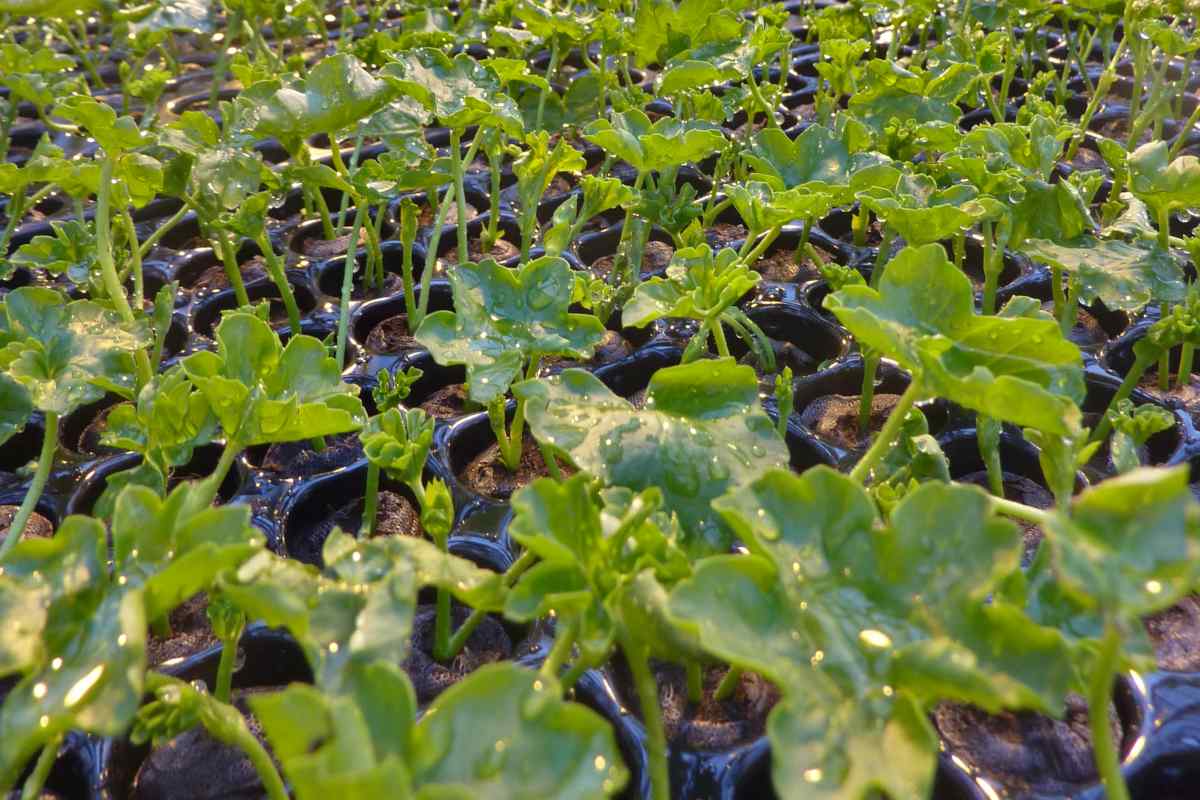
Despite the name, it doesn’t climb: ivy geranium (Pelargonium peltatum) trails, its thick ivy-shaped leaves and clusters of flowers spilling from garden boxes, hanging pots and balcony rails from late spring to mid-autumn. Give it full sun without scorching heat and a well-drained soil left to dry between waterings, and the blooming will carry most of the summer.
| Name | Pelargonium peltatum |
|---|---|
| Family | Geraniaceae |
| Type | perennial |
| Height | 12 to 32 inches (30 to 80 cm) |
| Exposure | full sun |
| Soil | well-drained |
| Foliage | deciduous |
| Flowering | late spring to mid-autumn |
Its growing and care are easy and lead to beautiful flowers. On a balcony, terrace or in a garden, its ornamental contribution guaranteed.
Ivy-leafed geranium isn’t a climbing vine, which is surprising when one thinks about its name.
Don’t even try to have the plant climb along a lattice.
Planting ivy geranium
In pots or containers, you can plant as early as early spring in your garden boxes but you’ll have to bring them indoors if it freezes.
If planting in the garden directly, wait for mid-spring to earth them and add special geranium soil mix to the soil.
Propagating ivy geranium
This plant is very easy to propagate through cuttings or through sowing under shelter.
Work on the cuttings starts at the end of summer by snipping off stem cuttings from the mother plants.
For varieties that are propagated through seed sowing, start in late winter.
Remove wilted flowers regularly, since this increases production of new flowers.
At the end of the season, you can cut back shorter in order to balance out the shape and silhouette of your ivy geranium.
Water abundantly but check and wait for the soil to be dry before watering again.
Excess water could lead the roots to rotting or the leaves could turn yellow.
Ivy geranium can keep from one year to the next, but regrowth isn’t guaranteed, unlike conventional geraniums.
At the season’s end, if they are in pots or garden boxes:
Bring the pots in before the first frost, as ivy geranium is not frost hardy and blackens as soon as the stems freeze.
Planting, propagating and overwintering each have their own moment in the year. This table gathers the timings given above so you can see the whole cycle at once.
| Task | When | Where | What to do |
|---|---|---|---|
| Planting in pots or containers | As early as early spring | Garden boxes, balcony, terrace | Bring them back indoors if it freezes |
| Planting in the garden | mid-spring | Open ground, 32 inches (30 cm) apart | Add special geranium soil mix to the soil |
| Propagating by cuttings | End of summer | From the mother plants | Snip off stem cuttings |
| Sowing | late winter | Under shelter | Only for varieties propagated through seed |
| Pruning | End of the season | Pots and garden boxes | Cut back to ⅔ of the original length |
| Overwintering | Winter | A shed out of the cold | Water once a month, no more |
Follow this rhythm and the flowering will run from late spring right through to mid-autumn.
Ivy geraniums differ far more in flower form and foliage than in their needs, so the choice comes down to the look you want spilling over the edge of a box or basket. The table below sets out the trailing pelargoniums most often sold in garden centres and seed catalogues.
| Variety | Flower colour | Flower form | Foliage | Habit |
|---|---|---|---|---|
| ‘White Mesh’ | Pink | Semi-double | Cream-veined | Moderate trailing |
| ‘Tornado White’ | White | Single | Small, plain green | Compact, seed-raised |
| ‘Sugar Baby’ | Pink | Semi-double | Small, plain green | Dwarf trailing |
| ‘Mini Cascade Red’ | Bright red | Single | Small, plain green | Compact trailing |
| ‘Ville de Paris’ | Salmon-pink | Single | Plain green | Very long trails |
| ‘Lilac Cascade’ | Lilac-mauve | Single | Plain green | Vigorous trailing |
| ‘Tornado Lilac’ | Lilac | Single | Small, plain green | Compact, seed-raised |
| ‘Amethyst’ | Mauve-purple | Double | Plain green | Vigorous trailing |
| ‘L’Elegante’ | White, flushed mauve | Single | Cream-variegated, pink-tinted in sun | Moderate trailing |
| ‘Crocodile’ | Mauve-pink | Single to semi-double | Cream net-veined | Vigorous trailing |
| ‘Sybil Holmes’ | Rose-pink | Rosebud double | Plain green | Compact trailing |
| ‘Rouletta’ | White with red picotee edge | Double | Plain green | Vigorous trailing |
| ‘Galilee’ | Soft pink | Double | Plain green | Vigorous trailing |
Although geranium is famous and appears in most of our gardens and windowsills, ivy geranium is much less common but just as magnificent.
Its ornamental impact is very much sought after, especially in garden boxes and large pot arrangements.
Indeed, you can let it cascade down and run along the ground or hang it to a ramp.
Its wide array of available colors and shapes will match every taste!
Caring for it stays easy, and the fabulous blooming will enchant you for the greater part of the summer season.
Avoid scorching sun for the exposure.
Adding organic fertilizer in spring will enhance its bloom.