Dodecatheon meadia: expert tips for growing shooting star
0
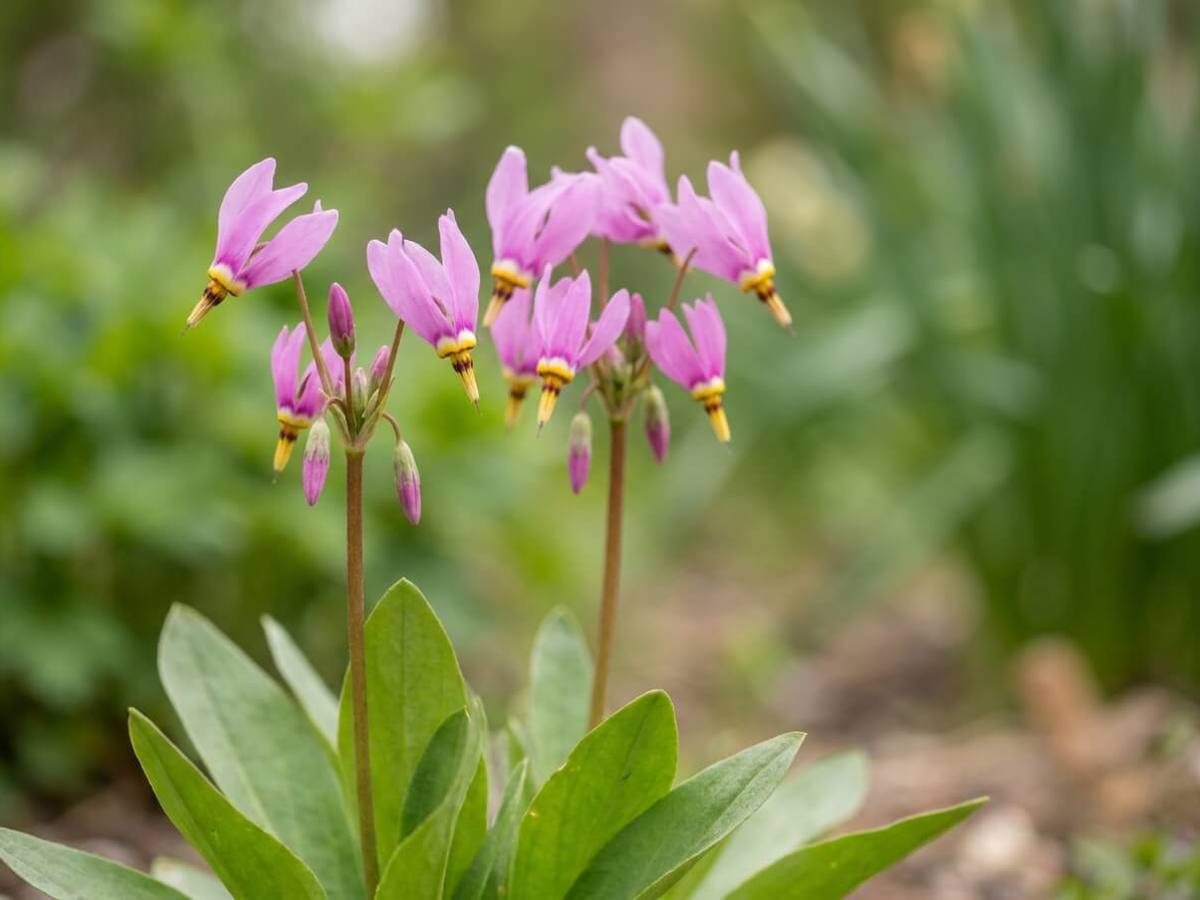
Few spring perennials have such a theatrical silhouette as Dodecatheon meadia, whose swept-back petals and pointed beaks of fused anthers look exactly like tiny shuttlecocks caught mid-flight. Rising on bare, wiry stems above a neat ground-hugging rosette, the nodding pink, lilac or white flowers bring an airy elegance to woodland edges, shady borders and raised beds. Most remarkably, the plant vanishes entirely by midsummer, retreating underground long before its neighbours have peaked.
Growing conditions
In the wild this is a plant of open woodland, limestone glades and tallgrass prairie, so it tolerates a wide spread of light levels. Dappled shade beneath deciduous trees suits it perfectly: bright during spring growth, shaded once the canopy closes and the plant goes dormant. Full sun is fine in cooler regions provided the ground does not bake in April and May.
Give it a deep, humus-rich loam that holds spring moisture yet never becomes waterlogged in winter. A neutral to slightly alkaline pH is ideal, reflecting its affinity for limestone soils, though it performs well on mildly acidic ground too. Heavy clay is the chief enemy — improve it generously with leaf mould and grit before planting.
Cold is no obstacle: established crowns shrug off hard frosts and actually benefit from a proper winter chill. Gardeners in mild, wet maritime climates should concentrate on sharp drainage instead, as winter wet kills far more plants than low temperatures ever will.
How to plant Dodecatheon
Autumn is the best planting season, giving roots several months to settle before the brief spring growth surge. Early spring planting also works, but water attentively through the first season.
Spacing: set crowns 20–25 cm apart so rosettes can expand without competing, and plant in groups of five or more for impact.
Depth: position the crown level with the soil surface, with the fleshy roots fanned downwards — burying the crown invites rot.
Soil preparation: fork in leaf mould or well-rotted compost to a spade’s depth, adding horticultural grit on heavier ground.
Watering in: soak thoroughly after planting, then keep the soil evenly damp until the foliage dies down naturally.
Propagation: lift and divide congested clumps in early autumn when dormant, teasing apart the small offsets that form around the parent crown.
Dodecatheon meadia growing in a naturalistic garden border
Care through the seasons
Spring: Rosettes appear from March and growth is rapid, so scatter a thin dressing of leaf mould or a balanced organic fertiliser as leaves emerge. Keep the soil consistently moist through the flowering period — drought at this stage shortens the display dramatically. Deadhead only if you do not want self-sown seedlings.
Summer: Foliage yellows and disappears within a few weeks of flowering, which is entirely normal rather than a sign of failure. Mark each clump with a label or cane so you do not spear the dormant crowns whilst weeding or planting. Dormant plants need no watering and resent summer irrigation on heavy soils.
Autumn: There is nothing to cut back, as the plant has already vanished. Divide crowded colonies in September or October, and top-dress the area with 2–3 cm of leaf mould to feed the soil and suppress weeds. Sow fresh seed outdoors at this time for natural cold stratification.
Winter: Crowns rest safely underground and need no protection in all but the most exposed gardens. Ensure winter rainfall drains away freely rather than sitting around the dormant roots.
Best varieties to grow
Selections are few but worthwhile, differing mainly in flower size and colour intensity.
Dodecatheon meadia f. album — pure white reflexed petals with a bright yellow anther ring, luminous in shade and holding an RHS Award of Garden Merit.
‘Aphrodite’ — the largest and most vigorous selection, with broad rosettes and unusually big rose-mauve flowers on sturdy stems.
‘Queen Victoria’ — a deep lilac-pink form with generously flowered umbels, excellent at the front of a shaded border.
‘Goliath’ — tall and robust, reaching the upper end of the height range with large pink blooms that carry well at a distance.
Pests, diseases and common problems
Slugs and snails: they shred the soft emerging rosettes in early spring, sometimes destroying a crown before it flowers. Apply wool pellets or sharp grit around each plant from March, and hunt after dusk on damp evenings.
Crown and root rot: plants fail to reappear in spring after a wet winter, the roots having turned brown and mushy. Prevention is the only cure — raise beds, add grit, and never mulch directly over the crown with wet material.
Vine weevil: container-grown plants collapse as grubs hollow out the fleshy roots. Tip out pots in autumn to check, and drench with parasitic nematodes when soil temperatures exceed 5 °C.
🌿 Nature & Garden Newsletter
Gardening tips, recipes & seasonal advice, twice a week.