Growing Camassia leichtlinii: planting tips and care guide
0
Great camas is a stately North American bulb that sends up tapering spires of starry blue, white or cream flowers just as the spring bulbs fade and before the summer perennials get going. It thrives in the damp, heavy soils that defeat tulips and most other bulbs, which makes it invaluable for naturalising in long grass, damp borders and meadow plantings. Unusually among bulbs, it actually appreciates a soil that stays moist through spring — a genuine problem-solver for clay gardens.
Growing conditions
Great camas flowers most freely in full sun, where the spires stand upright and the flower colour is at its strongest. It also copes well with dappled or partial shade, such as the edge of deciduous shrubs or beneath fruit trees, though stems may lean slightly towards the light. Avoid deep, dry shade, where flowering becomes sparse.
The ideal soil is deep, fertile and moisture-retentive in spring — heavy loam and clay soils suit it perfectly. It is happy on neutral to slightly acidic ground and tolerates mild alkalinity, but it resents thin, sandy soils that bake dry before flowering finishes. Ground that lies wet and stagnant all summer can rot the bulbs, so damp-but-draining is the target.
Fully hardy across the British Isles and northern Europe, camassia needs no winter protection and actually benefits from a proper cold spell. In hotter, drier regions it performs best with a little afternoon shade and a mulch to keep the root zone cool.
How to plant Camassia
Plant dry bulbs in early to mid-autumn, from September to November, so roots establish before winter. Container-grown or “in the green” plants can be moved in spring immediately after flowering.
Spacing: Set bulbs 10–15 cm apart for drifts, or 20 cm apart if you want individual clumps to build up over years without competing.
Depth: Plant 10–15 cm deep, with the pointed nose upwards; deeper planting helps anchor the tall flower stems in exposed gardens.
Soil preparation: Fork in garden compost or well-rotted manure before planting — camassia is greedier than most bulbs and rewards fertile ground.
Watering in: Water thoroughly after autumn planting only if the soil is dry; normally autumn rainfall does the job for you.
Propagation: Lift congested clumps in late summer dormancy and detach offsets, or collect ripe seed — seedlings take three to five years to flower.
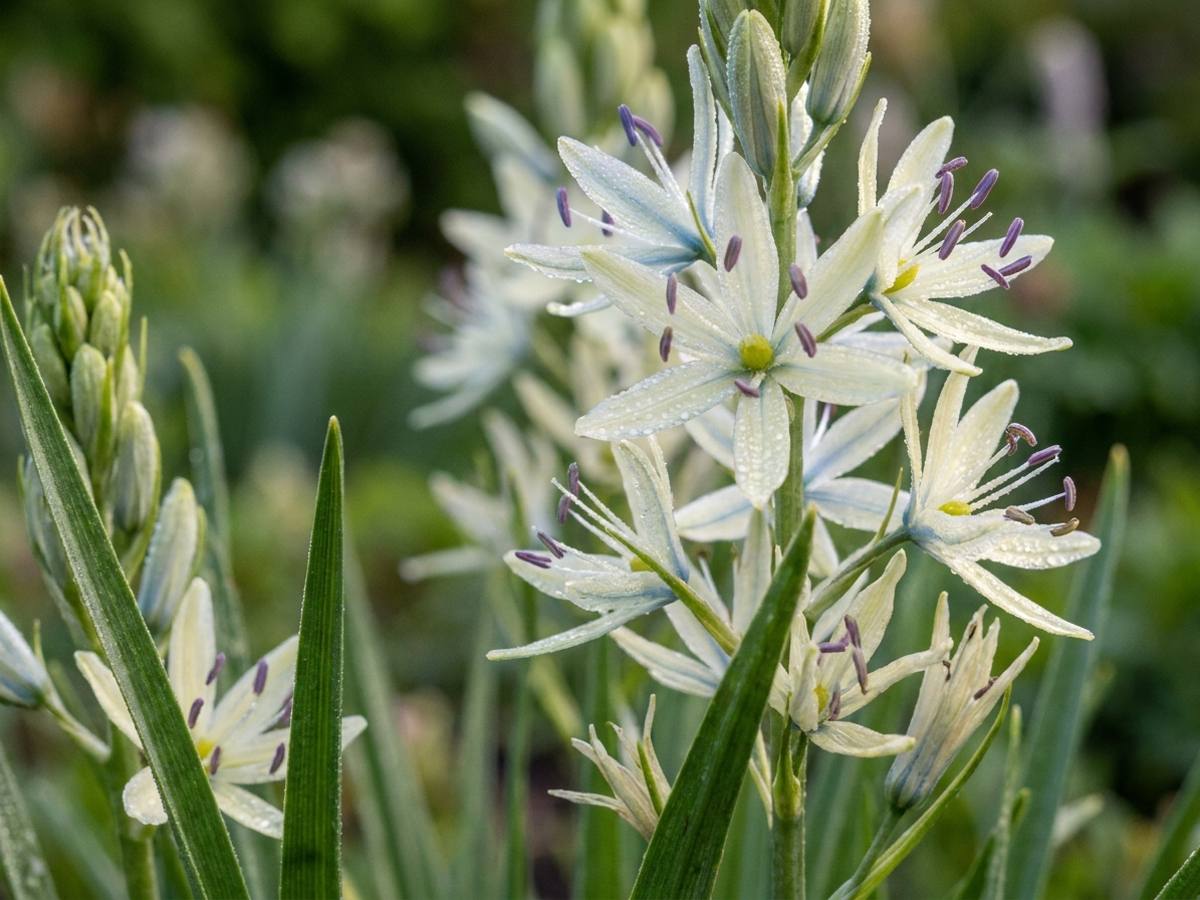
Camassia leichtlinii growing in a naturalistic garden border
Care through the seasons
Spring: Strappy grey-green leaves emerge early, followed by the flower spikes from late April. A light scatter of general-purpose fertiliser or a mulch of compost as growth begins supports next year’s flowers. Remove faded spikes if you dislike the seed heads, but leave some if you want self-sown seedlings.
Summer: Foliage yellows and dies down within weeks of flowering, so plant late-emerging perennials such as hardy geraniums, hostas or day lilies nearby to fill the gap. Let the leaves wither naturally rather than cutting them, as they are recharging the bulb. Watering is rarely needed once the plant is dormant, and a dry summer rest suits it well.
Autumn: Tidy away any remaining dead foliage and mark clump positions so you do not spear the bulbs when planting. This is the season to divide overcrowded colonies and to plant new bulbs. A mulch of leaf mould over the crowns improves soil moisture for the following spring.
Winter: Bulbs sit dormant and utterly hardy underground, needing no protection whatsoever. In waterlogged ground, consider raising planting areas slightly to prevent winter rot.
Best varieties to grow
A handful of reliable cultivars cover the useful range of colour and stature.
Camassia leichtlinii ‘Caerulea’ — the classic violet-blue form, holds an RHS Award of Garden Merit and the best choice for naturalising in grass.
Camassia leichtlinii subsp. leichtlinii ‘Alba’ — creamy-white stars on tall stems, luminous in partial shade and lovely with forget-me-nots.
Camassia leichtlinii ‘Semiplena’ — soft double creamy flowers that last noticeably longer than the singles, and set little or no seed.
Camassia leichtlinii ‘Blue Danube’ — an intense deep blue selection with a compact, densely packed spike, excellent in borders.
Pests, diseases and common problems
Slugs and snails: They graze emerging spring foliage and can shred flower buds in wet springs. Water on biological nematodes, use wildlife-safe ferric phosphate pellets, or patrol on damp evenings.
Bulb rot in wet soils: Bulbs that sit in stagnant water all winter go soft and fail to appear. Improve drainage with grit and organic matter, or plant on a slight ridge in the wettest ground.
Blind or floppy plants: Sparse flowers usually mean too much shade, overcrowding or foliage removed too early; leaning stems indicate rich, shaded conditions. Divide congested clumps, feed in spring, and grow in grass or among other perennials for natural support.
🌿 Nature & Garden Newsletter
Gardening tips, recipes & seasonal advice, twice a week.