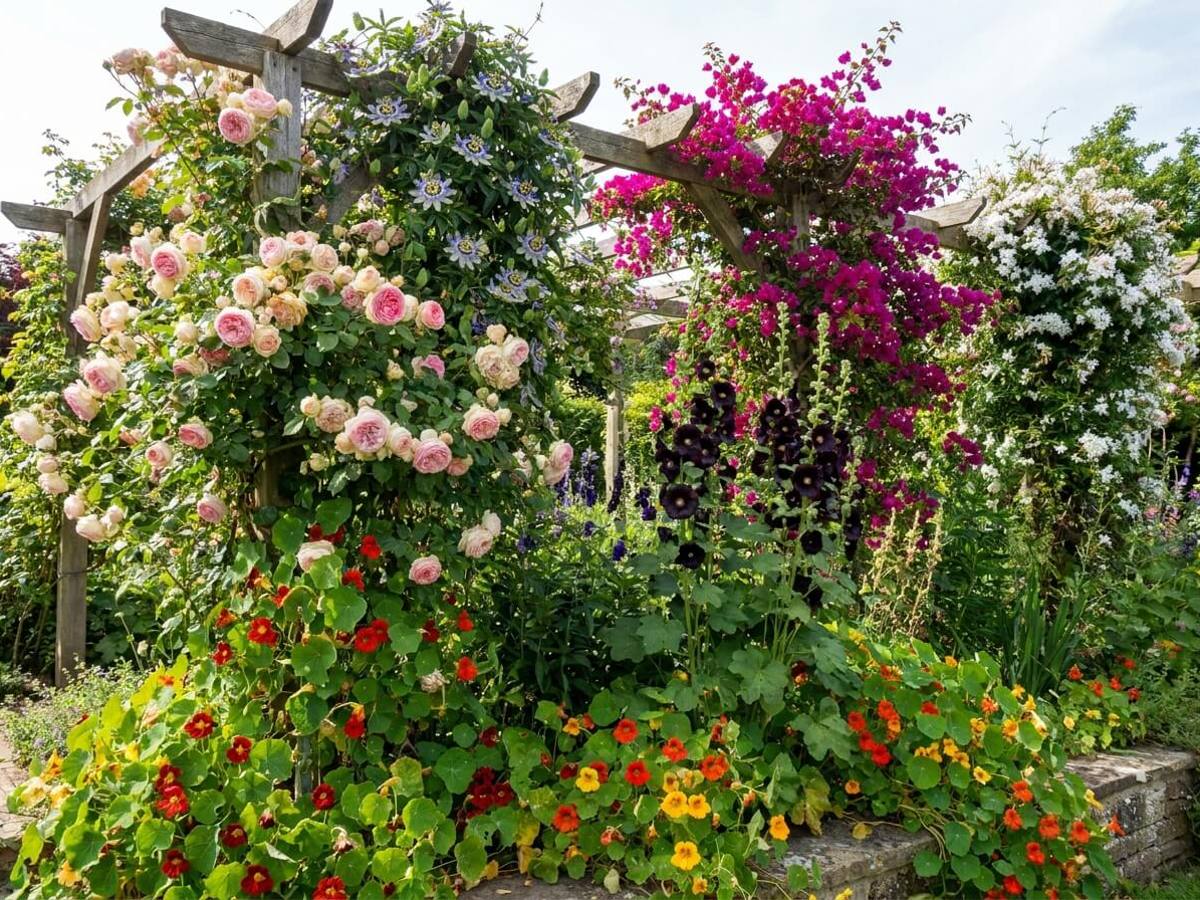
A south- or west-facing wall with a pergola running off it is the hottest, driest spot in most gardens. The brickwork throws back heat long after sunset, rain rarely reaches the soil at the foot of it, and anything planted there has to cope with glare above and dust below. A scheme that works here layers heat-lovers overhead with tough, deep-rooted plants at the base, so the structure disappears under flower from June until the first frosts.
From back to front: Ornamental and generous, Blue Passion flower, Pierre de Ronsard rose, Bougainvillea, Jasmine, Black hollyhock, Climbing nasturtium.
Start with the pergola roof, because it sets the shade and shelter everything else will live with. Ornamental and generous sends its stems straight along the crossbeams and spreads broad, hand-shaped leaves that filter the midday glare without blocking light altogether. Its contribution is texture and shadow rather than flower, which is exactly what the showier climbers need beside them. In autumn the foliage turns and the whole structure changes character for a few weeks.
On the wall itself, Blue Passion flower gives you the longest flowering run of the scheme, opening its strange blue-and-white discs from early summer well into autumn. The leaves are deeply cut and glossy, a fine contrast to the broad canopy above. It climbs by tendrils, so give it wires or trellis rather than expecting it to cling to brick. Keep it a pillar or two away from the roses, as it grips anything within reach.
For old-fashioned weight against the stonework, train Pierre de Ronsard rose on the sunniest panel. The heavy, cupped blooms in cream flushed pink hang their heads slightly, which makes them perfect seen from below under a pergola. Its colouring softens the sharper blues and hot shades elsewhere and stops the scheme looking brash. Tie the main stems horizontally and you will get flowers along their whole length rather than only at the top.
Where the wall is hottest and most sheltered, Bougainvillea supplies the blast of magenta, orange or purple that only a baking corner can carry. It loves reflected heat and poor, sharply drained soil, so the dry strip at the wall foot suits it. In colder gardens grow it in a large pot against the brickwork and move it under cover for winter. Keep it clear of the rose so the two colour schemes do not fight at close quarters.
Scent belongs next to where you sit, so place Jasmine on the pergola post nearest the bench or the door. The small white stars are modest at a distance but the perfume carries on warm evenings, which is when this corner is used most. Its fine, twining growth threads neatly through the base of the heavier climbers without smothering them. Prune it back after flowering to keep the growth within its allotted post.
At the foot of the wall you need vertical punctuation, and Black hollyhock provides spires of near-black, satiny flowers that read as deep velvet against pale brick. The dark tone anchors the pinks and magentas above and keeps the whole planting from looking sugary. It tolerates the dry, stony ground along a wall base better than most perennials. Expect it to seed itself about gently, which is a bonus here.
Finish at the front with Climbing nasturtium, sown straight into the ground in spring to scramble over the lower woodwork and spill onto the paving. The round, blue-green leaves cover bare stems at knee height, where climbers are always at their thinnest, and the hot orange and yellow flowers pick up the brightest tones in the scheme. It asks for nothing but sun and poor soil, and it is finished by the first frost, leaving the permanent planting unchallenged.
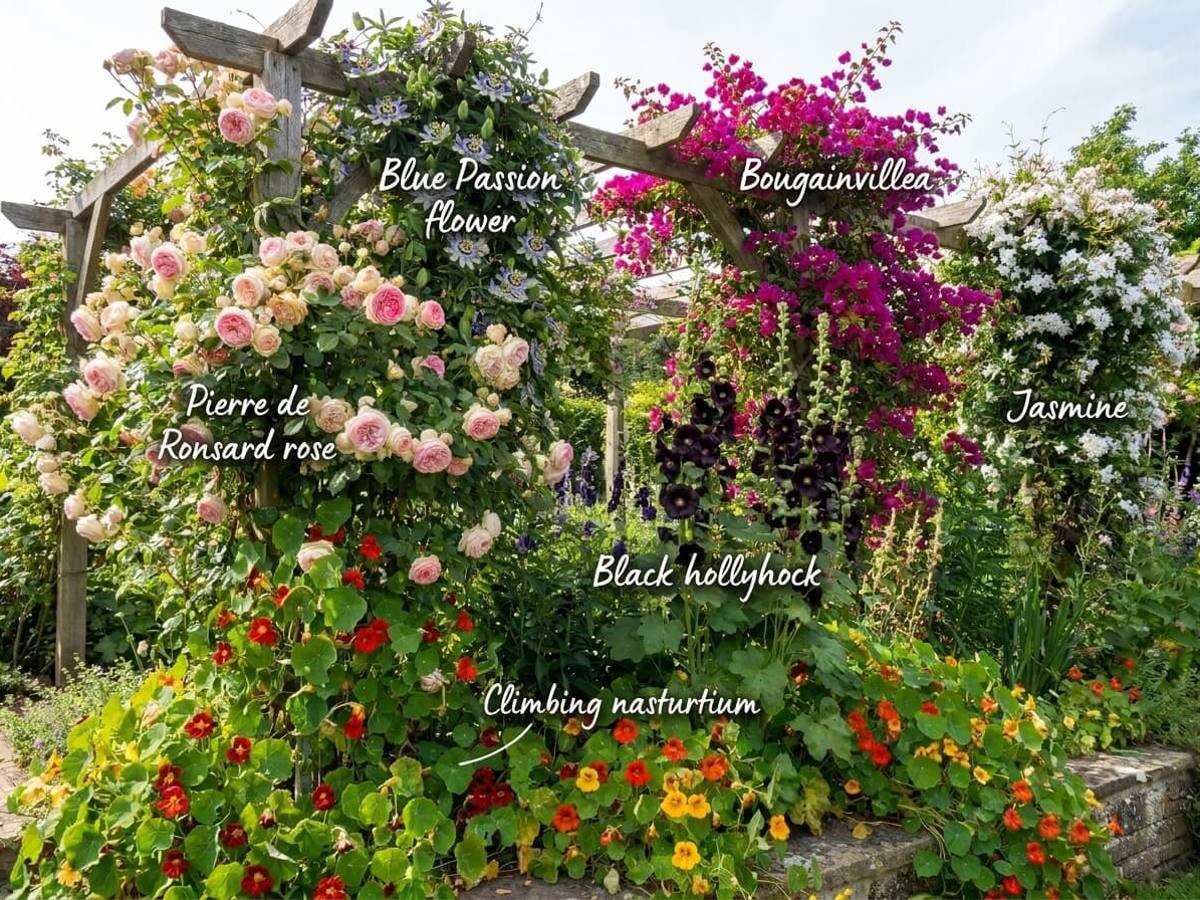
Plant the climbers about 40 cm out from the wall rather than tight against it, where the soil is driest, and lean the stems back towards their wires. Space the three wall climbers roughly 2 m apart so each gets its own panel: Pierre de Ronsard rose on the sunniest stretch, Blue Passion flower to one side, Bougainvillea in the hottest sheltered corner or in a pot of at least 40 cm. Set Ornamental and generous at a corner upright and lead it straight up to the crossbeams, and give Jasmine the post nearest the seating. In front, plant Black hollyhock in a group of three about 50 cm apart to read as a single vertical accent, and sow Climbing nasturtium 30 cm apart along the very front edge.
In spring the scheme is mostly green: new vine growth unfurling overhead, rose shoots extending along their wires and hollyhock rosettes widening at the base. From June to August everything arrives at once, with roses and passion flowers on the wall, bougainvillea blazing in its corner, jasmine scenting the evenings and hollyhock spires rising through nasturtium at ground level. September and October belong to the later passion flowers and the turning vine leaves, while the nasturtium goes over with the first frost. Through winter you are left with the bare framework of stems on the wall and the pergola’s own lines, which is why training the permanent climbers neatly in autumn pays off.