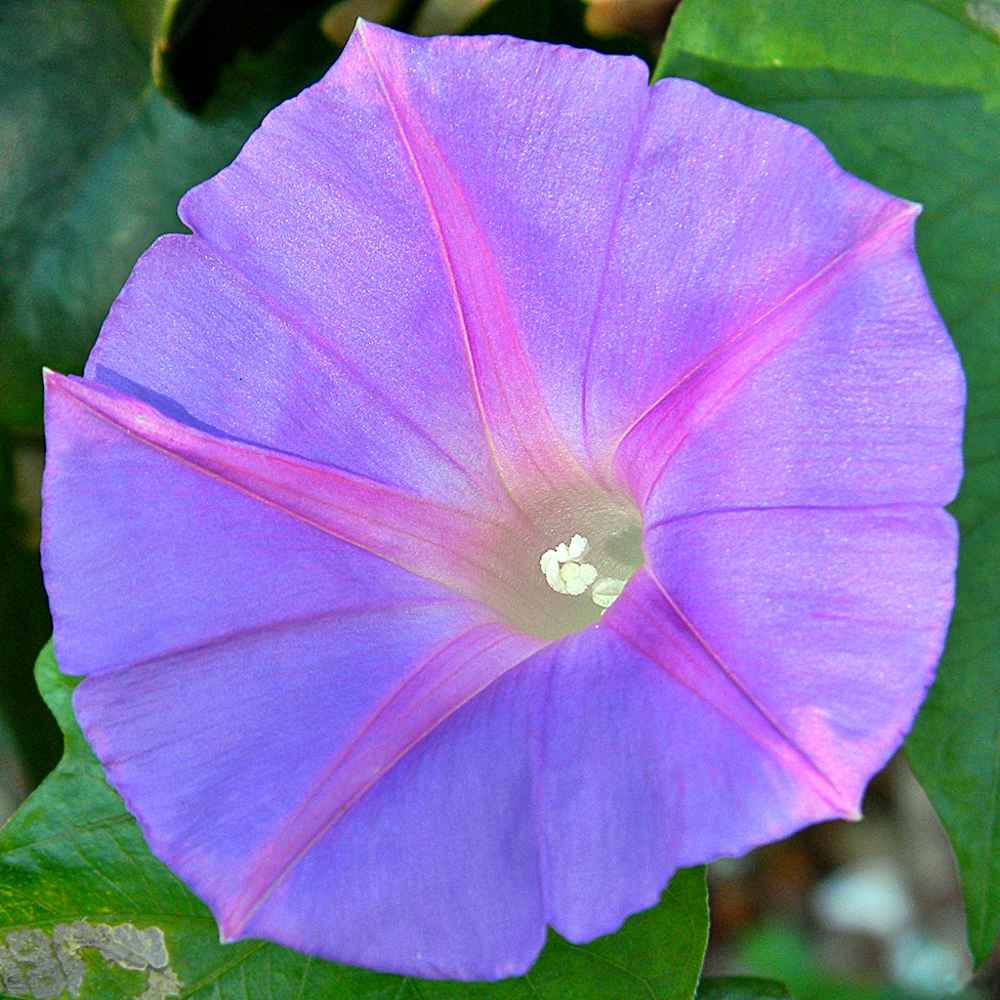
Deep blue trumpets open across a twining vine that can put on 3 to 6 metres in a couple of weeks, hauling itself up lattices, fences and railings with no help at all. Grown as an annual in colder latitudes, it asks for full sun and frequent watering, and repays both with bloom after bloom.
| Name | Ipomoea |
|---|---|
| Family | Convolvulaceae |
| Type | climbing vine, annual |
| Height | 10 to 20 feet (3 to 6 meters) |
| Exposure | full sun |
| Soil | rich enough |
| Foliage | deciduous |
| Flowering | early summer to late autumn |
Although it can be quite invasive, oceanblue morning glory requires very little care and will quickly satisfy you whether in the garden or on a terrace.
In tropical environments it grows as a perennial, but in colder latitudes oceanblue morning glory grows as an annual. It won’t grow back from the same plant year after year.
Sow under cover starting from the month of March, transplant in April and plant in the ground starting from the month of May in a blend of earth, soil mix and organic soil conditioner.
Growing oceanblue morning glory in pots
Growing oceanblue morning glory in pots is perfectly possible and it even makes a lot of sense to decorate a terrace or balcony.
The article describes several ways of getting this vine going, and the one you pick decides how early the trumpets appear. Compare the timing and the pay-off before you open the seed packet.
| Method | When | How | What you get |
|---|---|---|---|
| Sow under cover | early spring | Soak the seeds in lukewarm water for one hour before sowing | Sprouting is triggered early, so the longest flowering season |
| Transplant, then plant out | mid-spring, then late spring | Into a blend of earth, soil mix and organic soil conditioner | Well established plants in a very sunny spot |
| Sow straight in the ground | late spring | Direct in the final growing position | Blooming only much later, a shame for an annual |
| Grow in a pot | late spring | Pot at least 12 inches (30 cm) wide, drainage hole, bed of clay pebbles, flower plant soil mix | A screen of blooms for a terrace or balcony |
Whichever route you take, the spot must be very sunny.
Oceanblue morning glory has the advantage of being very easy to care for and only requires very little attention.
Pruning oceanblue morning glory
It doesn’t need any pruning because oceanblue morning glory only lives for a year.
If, however, it starts spreading too far, simply cut off a few stems whenever you feel it needs to be reduced.
Watering oceanblue morning glory
Oceanblue morning glory must be watered often, especially in case of elevated temperature.
Mulch along the foot of it will help keep the moisture in after having watered, and thus reduces the frequency that you’ll need to do it.
The growth of this plant is very quick: it can reach 3 to 6 meters within a couple weeks.
It has the advantage of twining and so will attach to lattices, fences or other objects on its own.
Its blooming is abundant and its flowers form nice trumpets. Their lifespan is quite short, but they will tirelessly re-seed themselves.
Regular but moderate watering is advised during the blooming.
Each trumpet-shaped bloom opens in the morning and lasts only that single day, commonly fading within a few hours—often by midday—so no flower survives to open again the next morning.
Against a flat wall the twining stems find nothing to grip, so fix wires, netting or a trellis a few centimetres clear of the surface before planting out.
Feeding with a nitrogen-rich fertiliser gives masses of heart-shaped leaves and very few flowers, so stick to a soil already enriched at planting.
Remember to water it in the evening to reduce evaporation and thus save on water, a rare resource.