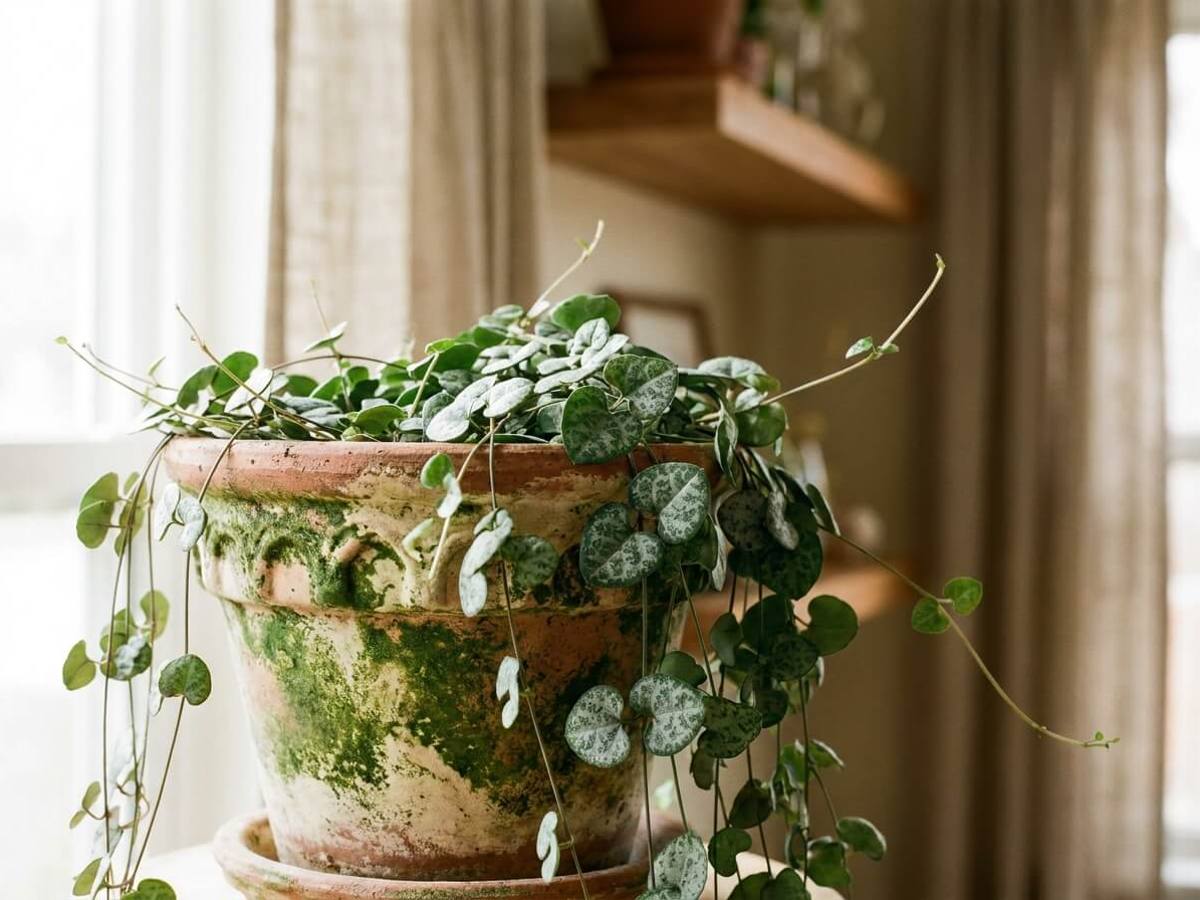
Ceropegia woodii is the much-loved string of hearts, a slender trailing succulent whose wiry purple stems are strung with pairs of silver-marbled, heart-shaped leaves. It is grown chiefly as a houseplant for hanging baskets, high shelves and plant stands, where its curtains of foliage can tumble well over a metre. Most curious of all are its flowers: small pink and maroon lanterns that work as temporary insect traps.
Growing conditions
Bright light is the single biggest factor in keeping string of hearts attractive. An east- or west-facing windowsill is ideal, as is a spot a metre back from a south-facing window. In dim corners the stems stretch, the leaves space out widely and the silver marbling fades to plain green.
Grow it in a gritty, sharply drained mix: two parts cactus and succulent compost to one part perlite, pumice or horticultural grit suits it well. A slightly acidic to neutral pH of around 6.0–6.5 is ideal, though the plant is not fussy. Terracotta pots help the compost dry quickly between waterings.
In the UK and northern Europe it is strictly an indoor or conservatory plant, though it enjoys a summer holiday outdoors in a sheltered, lightly shaded spot once nights stay above 12 °C. In frost-free Mediterranean or subtropical gardens it can be grown permanently outdoors in a raised bed or wall pocket.
How to plant Ceropegia
Pot or repot in spring, as light levels rise and the tubers break into active growth. Plants settle fastest when roots can run into fresh compost during the long days of April to June.
Set three to five rooted tubers evenly around a 12–15 cm pot, roughly 4–5 cm apart, so the surface fills quickly with stems rather than looking sparse.
Sit the tubers half-buried, with their tops just visible at compost level — burying them completely invites rot.
Mix a generous handful of grit or pumice into the compost, and never use a water-retentive multipurpose mix on its own.
Water in lightly, then wait until the compost is dry right through before watering again.
To propagate, lay a stem across a tray of damp compost and pin the aerial tubers down with a hairpin; alternatively root 10 cm cuttings with two nodes buried.
Ceropegia woodii displayed as a houseplant in a home interior
Care through the seasons
Spring: Growth resumes as days lengthen, so increase watering gradually and begin feeding monthly with a half-strength balanced or cactus fertiliser. This is the moment to repot congested plants, take cuttings and trim any bare, leggy stems back to a node to encourage branching. Trimmings root easily rather than going to waste.
Summer: Water thoroughly when the compost is completely dry, roughly every 10–14 days in warm weather, letting surplus drain away freely. Flower buds appear from midsummer, so leave them to open — the lantern blooms last several weeks. If stems become unmanageably long, coil them back over the pot surface where the nodes will root and thicken the display.
Autumn: Taper feeding off from September and stretch the intervals between waterings as light fades. Divide crowded tubers or pot up any rooted bulbils before the plant slows down. Check leaf axils for mealybug before the plant moves away from open windows.
Winter: Growth virtually stops; water only enough to stop the tubers shrivelling, perhaps once every three to four weeks. Keep the plant above 10 °C and well away from cold glass and draughts.
Best varieties to grow
A handful of selections offer different leaf shapes, colouring and vigour.
Ceropegia linearis subsp. woodii — the classic silver-marbled form, holder of the RHS Award of Garden Merit and the most reliable grower.
C. woodii ‘Variegata’ — cream, pink and green leaves on pink-flushed stems; slower growing and needs brighter light to keep its colour.
C. woodii ‘Silver Glory’ — larger, rounded leaves with broad silver centres and only a thin green margin, giving a far paler overall effect.
C. woodii ‘String of Spades’ — narrower, pointed, arrow-shaped leaves with crisp silver veining, useful for contrast in a mixed grouping.
Pests, diseases and common problems
Mealybug: White woolly specks hide in leaf axils and among tangled stems, causing sticky residue and stunted growth. Dab colonies with a cotton bud dipped in surgical spirit, then spray weekly with an organic soap-based insecticide until clear.
Tuber and root rot: Yellowing leaves, mushy stem bases and sudden collapse follow overwatering or heavy compost. Unpot immediately, cut away any soft tissue, and restart firm sections as cuttings in dry, gritty mix.
Leggy, bare stems: Long gaps between leaf pairs and faded marbling signal insufficient light. Move the plant closer to a window and prune the worst stems back by half in spring to force fresh branching from the base.
🌿 Nature & Garden Newsletter
Gardening tips, recipes & seasonal advice, twice a week.