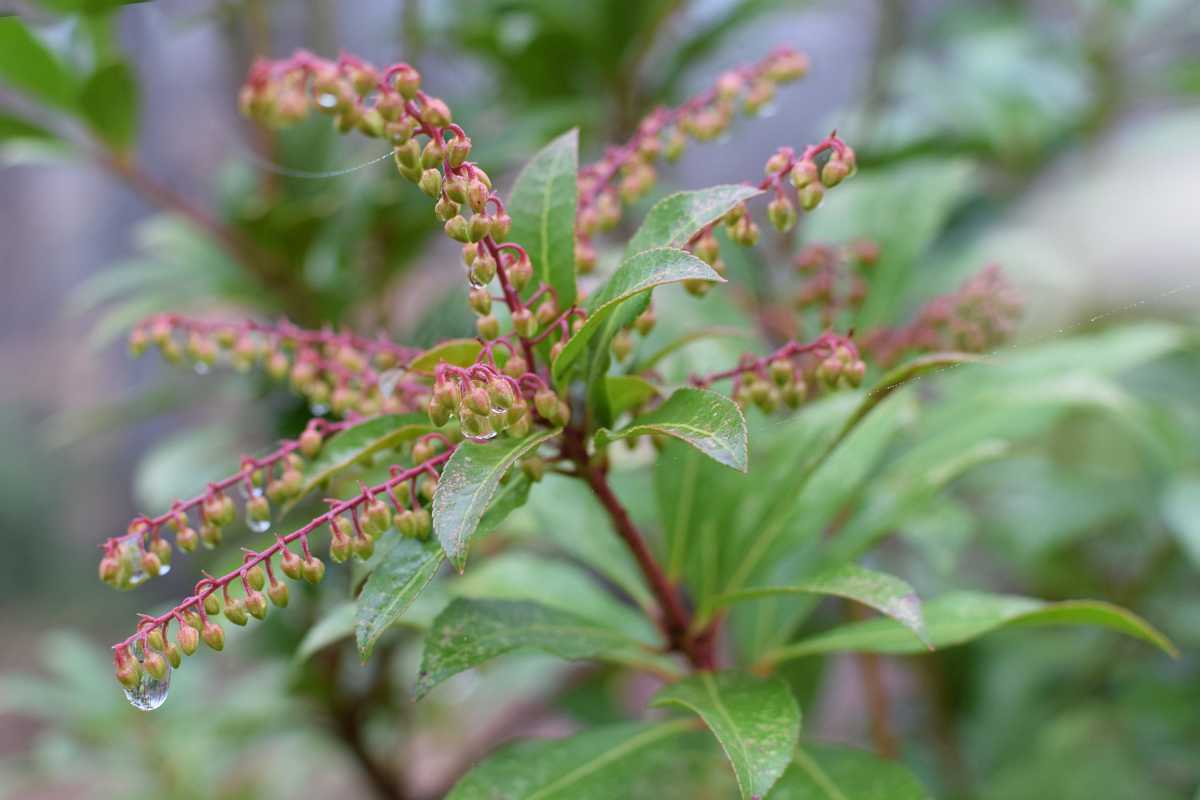
Clusters of small bell flowers open white through pink to red at the very start of spring, above bright red young leaves that settle to green on an evergreen frame. Andromeda (Pieris japonica) earns its place in hedges and shrub beds year-round; give it acidic heath-plant soil and part sun, and it stays eye-catching for four seasons.
| Name | Pieris |
|---|---|
| Family | Ericaceae |
| Type | shrub |
| Height | 10 to 16 feet (3 to 5 meters) |
| Climate | temperate |
| Exposure | part sun |
| Care | light pruning |
| Foliage | evergreen |
| Flowering | spring |
| Soil | heath plant |
This is one of the plant kingdom’s most ornamental shrubs ever.
Andromeda is planted in fall: that’s the best way to ensure proper root development. But it can also be planted up to spring as long as it is well watered.
If purchased in containers, it’s still good to plant in spring, simply remember to water more often at the beginning.
Once in the ground, best spread mineral-based mulch around its trunk so as to not influence ground acidity.
Beyond the well-known “Forest Flame”, nurseries offer several andromedas that differ mainly in the colour of their young shoots, their flowers and their final size. Here are the ones you are most likely to meet in a garden centre.
| Variety | Young growth | Flowers | Height |
|---|---|---|---|
| ‘Katsura’ | deep wine-red | rose-pink | 4 ft (1.2 m) |
| ‘Flaming Silver’ | red, then leaves edged silver-white | white | 4 to 5 ft (1.2 to 1.5 m) |
| ‘Mountain Fire’ | fiery red-bronze | white | 7 to 10 ft (2 to 3 m) |
| ‘Valley Valentine’ | bronze-green | deep maroon-red buds opening dark pink | 5 to 6 ft (1.5 to 2 m) |
| ‘Little Heath’ | pink-tinged, leaves margined cream | white, sparse | 2 to 3 ft (60 to 90 cm) |
| ‘Forest Flame’ | brilliant scarlet, fading through pink and cream to green | white, in drooping bunches | up to about 13 ft (4 m) |
Also called “Forest Flame”, this Pieris japonica shrub with bright red and green colors will lend your hedges and shrub beds a particularly eye-catching touch.
Its bunched flowers go from white to red with instances of pink.
They’ll add a very ornamental touch to your garden right at the start of spring.
It is recommended to water in case of dry weather.