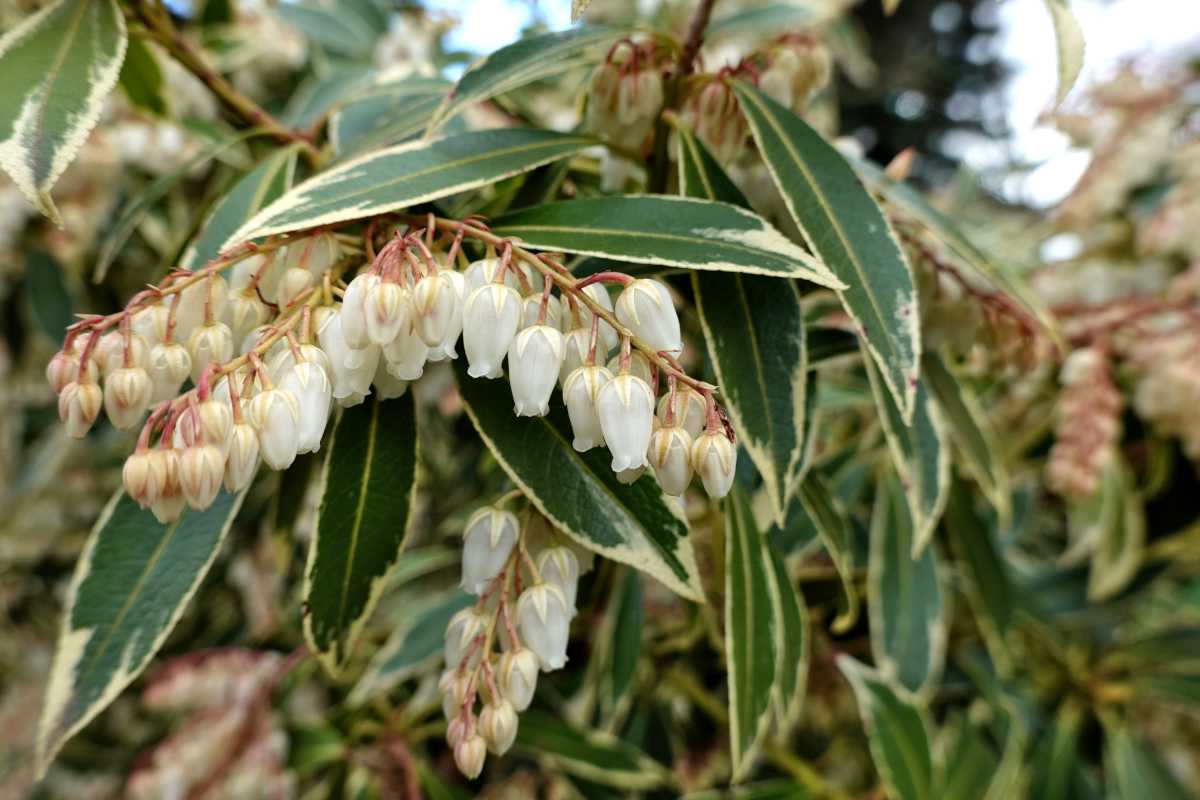
Bunched flowers shade from white through pink to red at the start of spring, above evergreen leaves spotted with brilliant pink, white and red. Japanese andromeda (Pieris japonica) suits hedges, garden boxes and terrace pots alike; grow it in heath soil and keep it watered in dry weather, and it holds interest in every season.
Pieris japonica at a glance
Name
Pieris japonica
Family
Ericaceae
Type
shrub
Height
10 to 16 feet (3 to 5 metres)
Climate
temperate
Exposure
part sun
Foliage
evergreen
Flowering
spring
Soil
heath soil
Care
light pruning
One appreciates its spring-blooming and its beautiful colorful evergreen leafage.
Planting Pieris japonica
Pieris japonica is planted in fall or spring for specimens purchased in containers.
Planting in fall is, as always, the best way to ensure proper root development, but still it can also be planted up to spring as long as it is well watered.
If purchased in containers, it’s still good to plant in spring, simply remember to water more often at the beginning.
Once in the ground, best spread mineral-based mulch around its trunk so as to not influence ground acidity.
Propagating Japanese andromeda
Making cuttings is the easiest and fastest method to propagate your Japanese andromeda.
Snip 6-inch (15 cm) cuttings off new growth (only partially hardened off) at the end of summer.
Remove lower pairs of leaves, keeping only one or two pair(s) of leaves.
If possible, dip the base of the cuttings in powdered rooting hormones.
Plant the cuttings in heath soil.
Keep the cuttings near light, but not in direct sunlight.
Keep substrate a little moist.
Protect cuttings from freezing in winter.
Transplant in the following spring.
Which Pieris japonica to choose
Beyond ‘Forest Flame’ and ‘Valley Valentine’, a handful of Pieris are sold almost everywhere. They differ mainly in final size, in the colour of the young shoots and in flower colour.
Which Pieris japonica to choose
Variety
Height
New growth colour
Flower colour
‘Katsura’
4–5 ft (1.2–1.5 m)
Wine red
Rose pink
‘Flaming Silver’
4–5 ft (1.2–1.5 m)
Red, maturing to white-margined green
White
‘Mountain Fire’
6–8 ft (2–2.5 m)
Fiery red-bronze
White
‘Little Heath’
2–3 ft (60–90 cm)
Pink-tinted on cream-edged leaves
White, sparse
‘Variegata’
5–6 ft (1.5–2 m)
Pink-flushed cream and green
White
‘Debutante’
2–3 ft (60–90 cm)
Pale green
Pure white, upright panicles
Potted Japanese andromeda
Pieris japonica or Japanese andromeda is a shrub that is particularly well suited to growing in a pot.
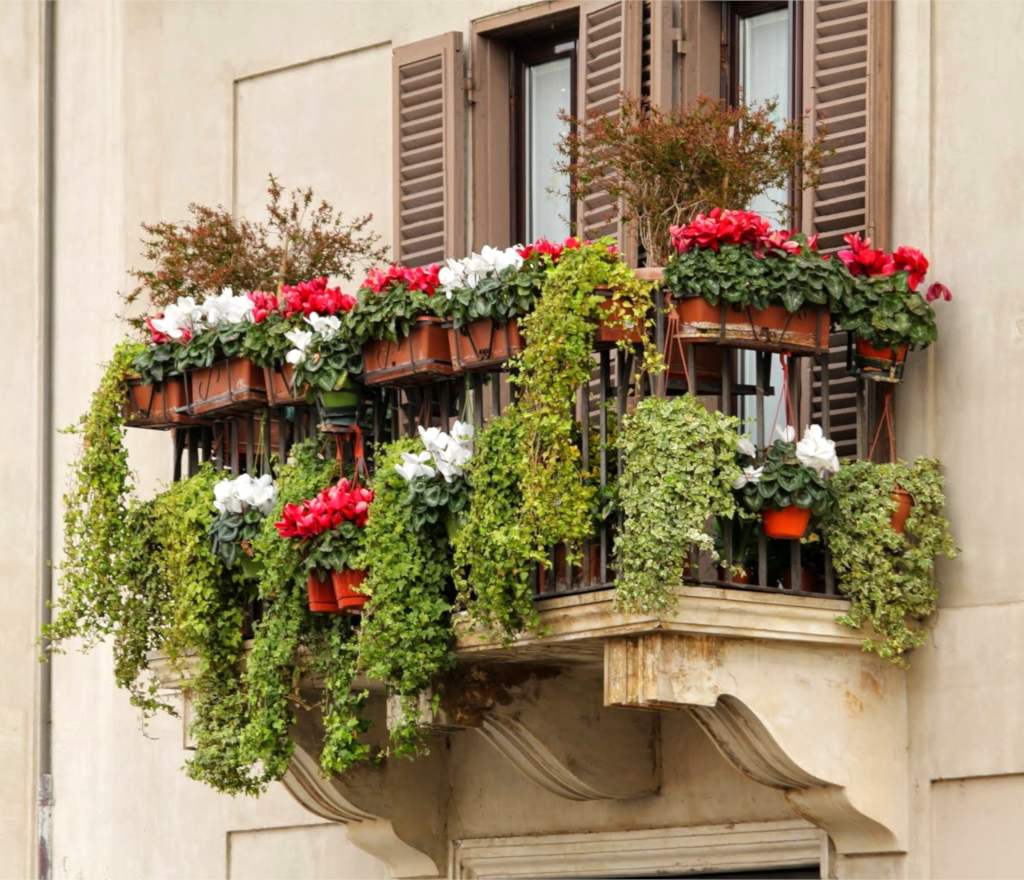
Thanks to its reduced breadth, more or less 5 feet (1.5 meters), and its evergreen foliage, it hits the nail to decorate a deck, balcony or terrace and arouses interest in winter, spring, summer and fall.
Ensure that the bottom of the pot has a hole in it to avoid stagnating water.
Prepare a drainage layer with clay pebbles or small rocks, to make water flow through to the bottom of the pot more easily.
Fill the pot exclusively with heath and plant your Japanese andromeda.
Mulch with pine bark, it will keep moisture in summer and protect from the cold in winter.
Water often from spring to fall, as soon as the surface soil is dry.
Learn more about Japanese andromeda
Flower bunches range from white to red through pink
Also called “Forest Flame”, this shrub with bright red and green colors will lend to your hedges a particularly ravishing touch.
Its bunched flowers go from white to red with instances of pink.
They’ll add a very ornamental touch to your garden right at the start of spring.
If you would like purple red flowers, choose the ‘Valley Valentine’ variety, it is a superb bright and colorful option.
This very beautiful persistent green foliage with spots of brilliant pink, white, and red in spring is an ideal shrub to decorate your garden as well as your garden boxes and pots for your terrace.
Smart tip about Japanese andromeda
It is recommended to water in case of dry weather to keep the soil cool.
Written by Gaspard Lorthiois | Loves helping out, especially when it comes to growing things. Worked in herbal medicine, runs a farm, and dabbles in tech. Master's degree and engineer.