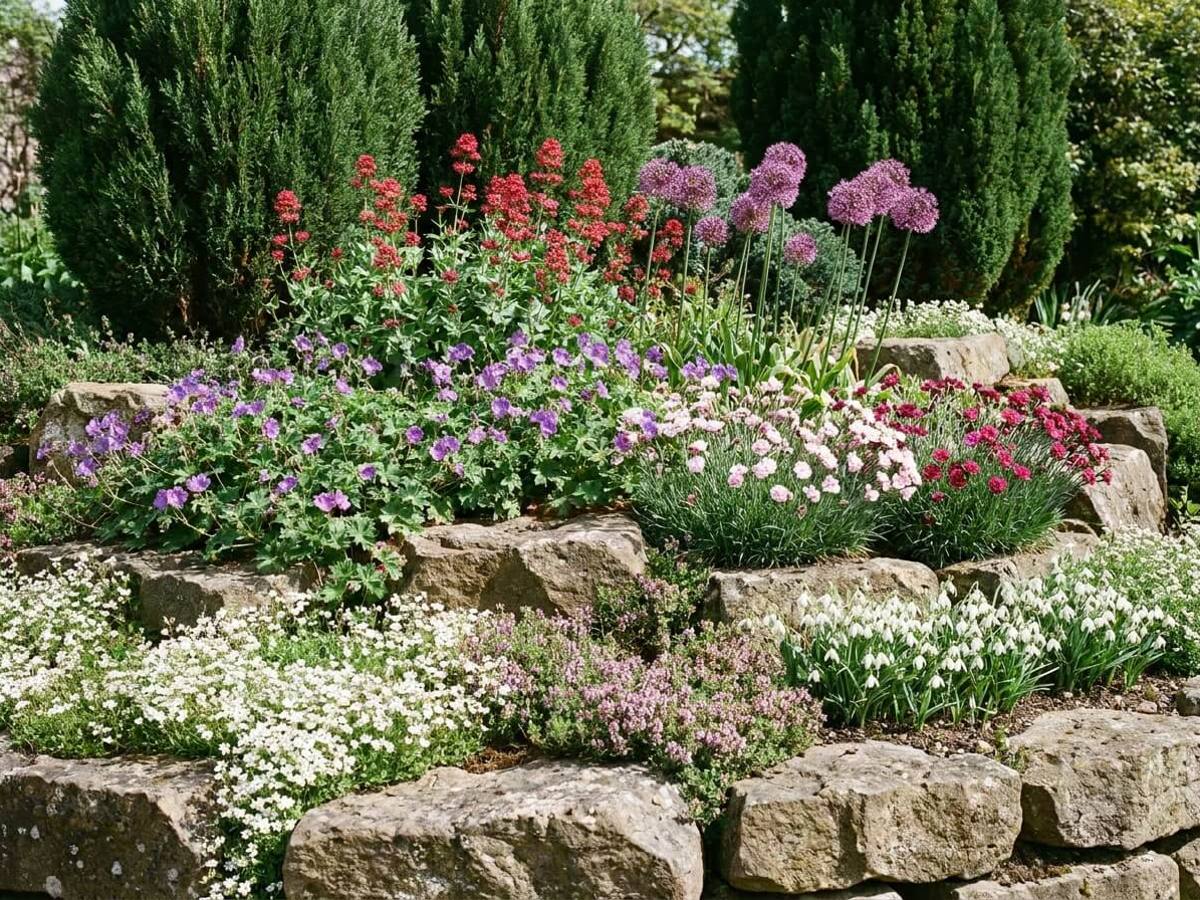
A rock garden in full sun is one of the brightest, driest corners you can garden in: stone soaks up heat all day and releases it at night, rainwater drains away through the gaps before roots can catch it, and the thin soil holds very little to feed on. That suits plants built for lean conditions, but it punishes anything thirsty or soft. A good spring scheme leans on low mats, gritty-soil specialists and a few taller spires, so the planting hugs the rock rather than flopping over it.
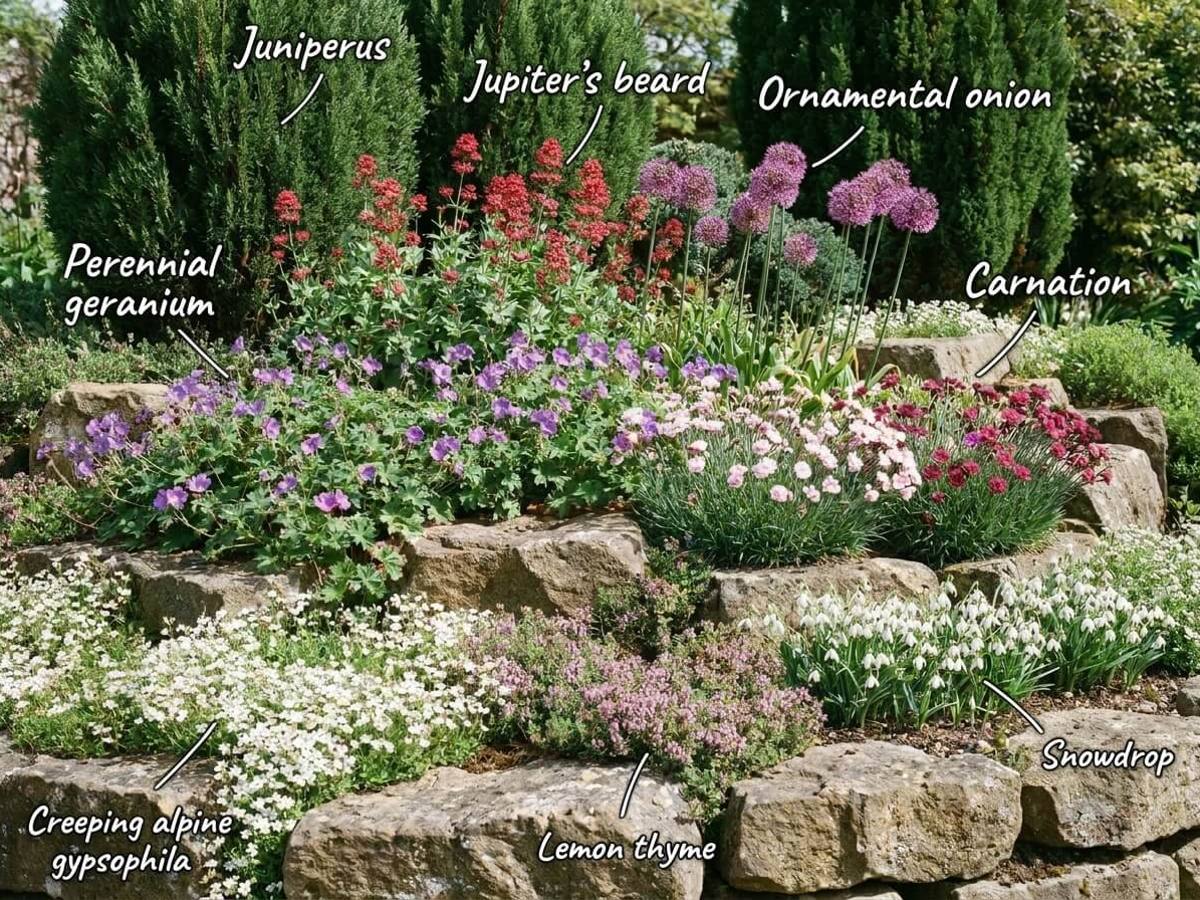
From back to front: Juniperus, Jupiter’s beard, Ornamental onion, Perennial geranium, Carnation, Creeping alpine gypsophila, Lemon thyme, Snowdrop.
Juniperus gives the scheme its backbone, holding shape and colour through every month of the year. Set it at the highest point of the rockery, where its needled, blue-green mass anchors the stone and gives the eye somewhere to rest. Because Juniperus is evergreen and slow to change, it makes a calm backdrop for everything that flowers briefly in front of it.
Jupiter’s beard is the tallest flowering plant here, sending up rounded heads of deep pink in late spring on upright, slightly fleshy stems. It thrives in the poorest, stoniest pockets and will even seed itself into crevices in a wall. Keep Jupiter’s beard towards the back, where its loose habit reads as height rather than untidiness, and deadhead it to keep the self-sowing in check.
Ornamental onion brings the vertical punctuation the scene needs in late spring: clean stems topped with globes of purple, lilac or white. Planted in the middle band, it rises straight through the low mats without crowding them. The foliage of ornamental onion yellows as the flowers open, so site the bulbs behind leafier neighbours that will hide the fading leaves.
Perennial geranium supplies the soft, mounded mass that stops a rock garden looking like a collection of separate specimens. Its deeply cut leaves make a low dome from mid-spring, studded with pink, mauve or violet saucers. Use perennial geranium as the link between the taller stems at the back and the flat carpets at the front, and shear it after the first flush for a tidier second showing.
Carnation is made for this situation: narrow grey-blue foliage that loves sharp drainage, and spicy-scented flowers from late spring. The grey tone cools down the pinks around it and looks particularly good against pale stone. Plant carnation at the edge of a ledge or along the top of a low wall, where the scent carries and the mat can spill a little.
Creeping alpine gypsophila turns into a haze of tiny white or pale pink flowers in late spring, spreading sideways over rock rather than upwards. That froth softens hard edges and joins up the gaps between the stronger shapes. Tuck creeping alpine gypsophila where it can tumble over a step or a boulder face, and give it the grittiest pocket you have.
Lemon thyme works as living paving at the front of the scheme, forming a dense, aromatic carpet that releases scent when brushed. The small leaves and fine texture contrast well with the broader foliage behind. Lemon thyme tolerates being walked on occasionally, so run it along the route you use to reach the back of the rockery.
Snowdrop opens the season weeks before anything else here, nodding white over bare gravel at the very front where you will see it from the path. It finishes and dies back before the summer mats fully close over, so it costs no space at all. Plant snowdrop in the cooler, slightly shaded pockets on the north side of larger stones, where the soil dries a little more slowly.
Place one or two Juniperus at the top of the slope, spaced well apart so each keeps its outline, then run a loose drift of five to seven Jupiter’s beard across the back in a broken line rather than a row. Set ornamental onion in groups of at least seven bulbs in two or three pockets through the middle band, each group tucked just behind a dome of perennial geranium planted in threes. Fill the front third with carnation and creeping alpine gypsophila in irregular clumps of three, let lemon thyme sweep along the lowest edge and any stepping stones, and scatter clusters of ten to fifteen snowdrop bulbs in the gaps between them. Mulch every planting pocket with 2–3 cm of grit to keep crowns dry and stop soil washing down the slope.
Late winter belongs to snowdrop against bare stone and the dark mass of Juniperus. Mid to late spring brings the main display: perennial geranium and carnation in flower, creeping alpine gypsophila frothing over the rocks, Jupiter’s beard rising behind, and ornamental onion floating its globes above the lot. Through summer the scheme reads mostly as texture — grey carnation foliage, fine lemon thyme carpets, cut leaves of perennial geranium — with Jupiter’s beard repeating if you deadhead it. By late autumn and winter the stone, the grit and the evergreen Juniperus carry the whole picture, and the aromatic lemon thyme mats stay green at your feet.