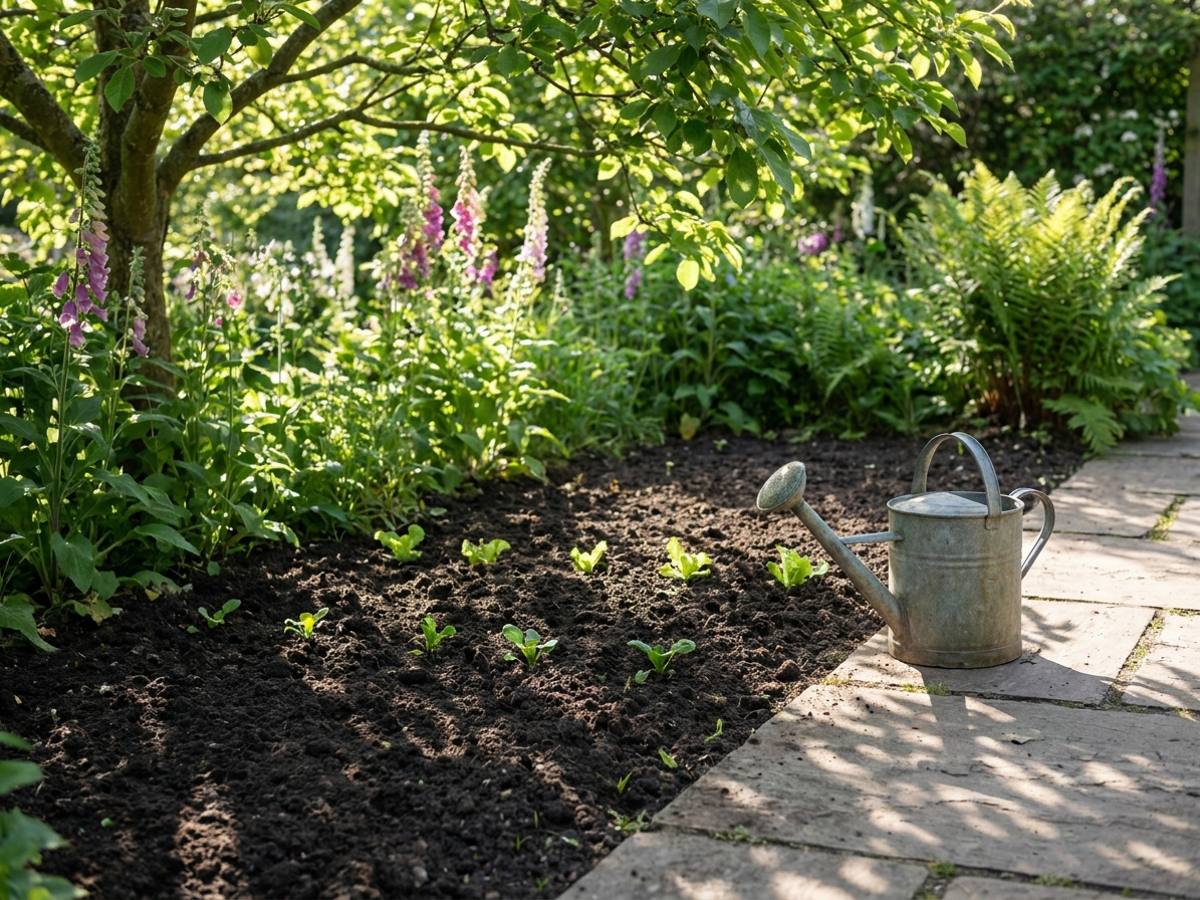
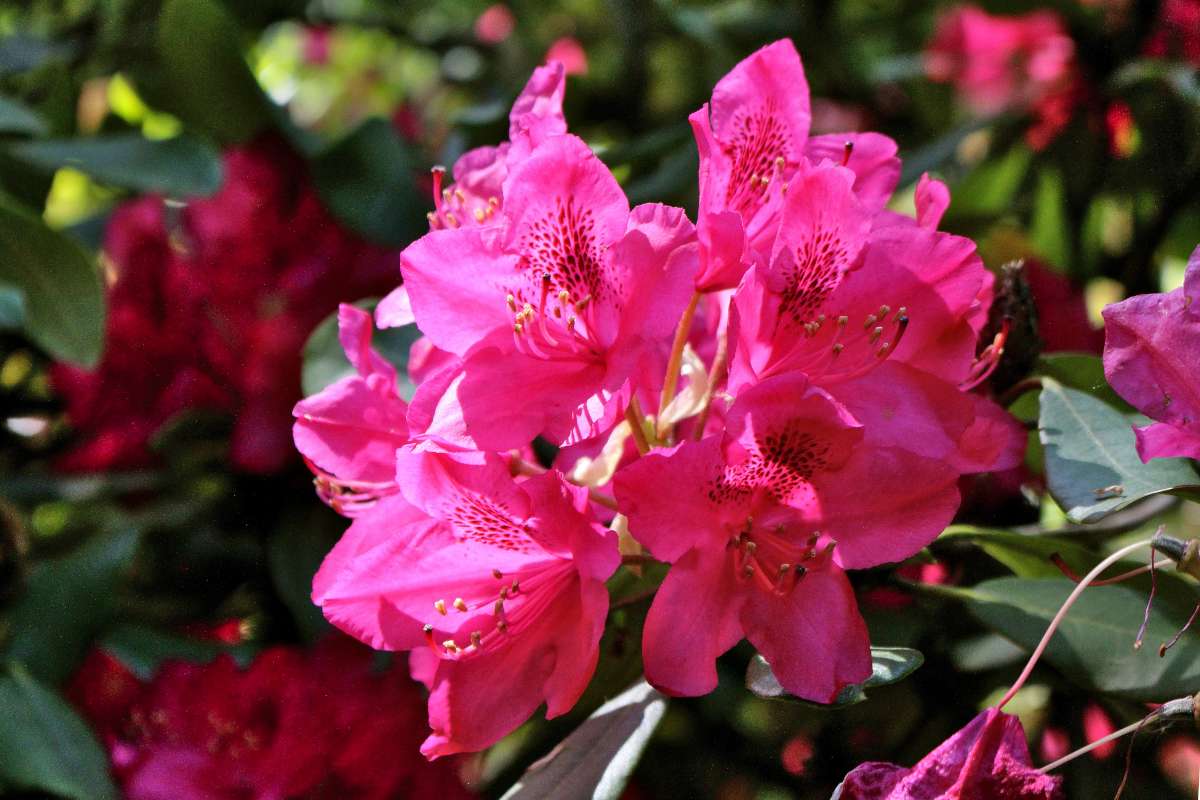
The strip along the north side of a fence or beneath the canopy of a deciduous tree gets a few hours of morning or late-afternoon light and little else. Soil there is often dry at the surface, laced with roots, and bare patches turn to mud or weeds by midsummer. A good scheme for this spot layers plants of different heights and leaf shapes so the ground is covered all year, with the main burst of flower timed for spring, while the trees overhead are still bare.
From back to front: Hosta, Bergenia, Bluebells, Perennial geranium, Winter heather, American Wintergreen, Ivy.
Set at the back of the bed, Hosta gives the scheme its largest leaves and its most generous mound of foliage, rising to knee height by early summer. It emerges late, in tight spears, which is exactly what you want: the spring flowers in front have finished their show by the time the leaves unfurl and take over. Keep it to the cooler, damper end of the strip, where the soil holds moisture longest.
Bergenia is the backbone of the planting, with thick, leathery, rounded leaves that stay put through winter and often flush bronze-red in cold weather. Its pink flower spikes open early in spring, ahead of almost everything else here, on short stems well clear of the foliage. Plant it just in front of and between the Hosta clumps, where the two leaf shapes — one glossy and solid, one ribbed and matt — set each other off.
Bluebells supply the spring haze that gives the whole carpet its character, sending up nodding blue flowers in the window when the canopy is still open and light reaches the ground. The foliage dies back after flowering and disappears entirely by midsummer, so it never competes for space. Thread it through the middle of the bed, letting it come up between the Bergenia and the emerging Hosta, which will close over the gaps the bulbs leave behind.
Perennial geranium is the weaver of the scheme, spreading into low cushions of deeply cut leaves that knit the separate clumps into one continuous surface. Flowering starts in late spring and carries on in waves, picking up the moment the Bluebells fade. It tolerates the dry root-filled soil under trees better than most, and it will lean happily into the Bergenia without smothering it.
Winter heather fills the long empty stretch from midwinter to early spring, flowering in dense pink and white spikes on compact evergreen hummocks. Place it towards the lighter end of the bed, where a little more sun reaches, and it will bloom at the same moment the Bergenia opens. Its fine needle-like foliage is the sharpest texture in the planting, a useful contrast to all the broad leaves behind it.
American Wintergreen hugs the ground at ankle height, with small glossy evergreen leaves and scarlet berries that hold through winter. It spreads slowly and politely, so it will not overrun the Perennial geranium beside it. Use it along the front edge where you walk past and can see the berries, and keep it in the shadier, more acidic pockets of the bed.
Ivy is the safety net: it covers the awkward corners where nothing else will root, including the dry shade right against the fence or trunk. Grown flat as ground cover rather than up a support, it stays low and evergreen and stops bare soil appearing in winter. Keep it to the edges and shear back any runner that climbs into the Hosta or crosses the American Wintergreen, as it will take ground if you let it.
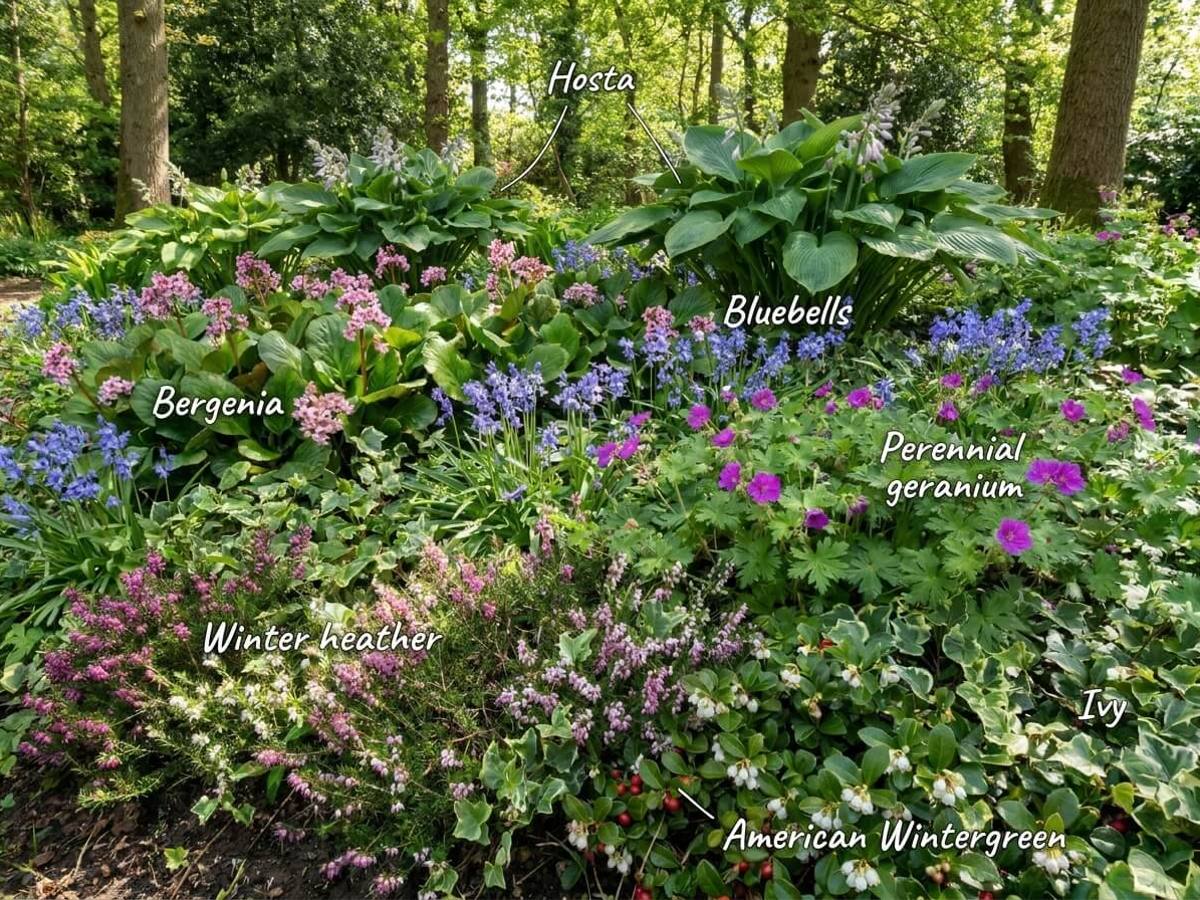
Work in a strip roughly 1.5 m deep. Set three to five Hosta along the back at about 70 cm apart, then a continuous band of Bergenia in front of them, spaced 40 cm, in groups of three or five rather than a single line. Plant Bluebells in drifts of twenty or more bulbs, 10 cm apart and 10 cm deep, scattered between those two bands in autumn. Fill the middle with Perennial geranium at 40 cm spacing, let it run the length of the bed, and place Winter heather in two or three groups of three at 30 cm spacing where the light is best. Edge the front with American Wintergreen at 30 cm, and tuck Ivy into the darkest corners only, two or three plants, pegged flat and trimmed each spring.
In late winter the bed reads as evergreen: Bergenia leaves tinged red, Winter heather in full flower, Ivy and American Wintergreen holding their gloss and berries. Spring brings the main event, Bergenia spikes followed by a wash of Bluebells, then the first Perennial geranium flowers as the Hosta spears push through. Summer is a green, layered carpet with the Perennial geranium still throwing out blooms, the Bluebells gone without trace, and the Hosta at full size. From autumn the Hosta dies back and the scheme returns to its winter skeleton of leathery, needled and glossy evergreens — never bare, which is the whole point.