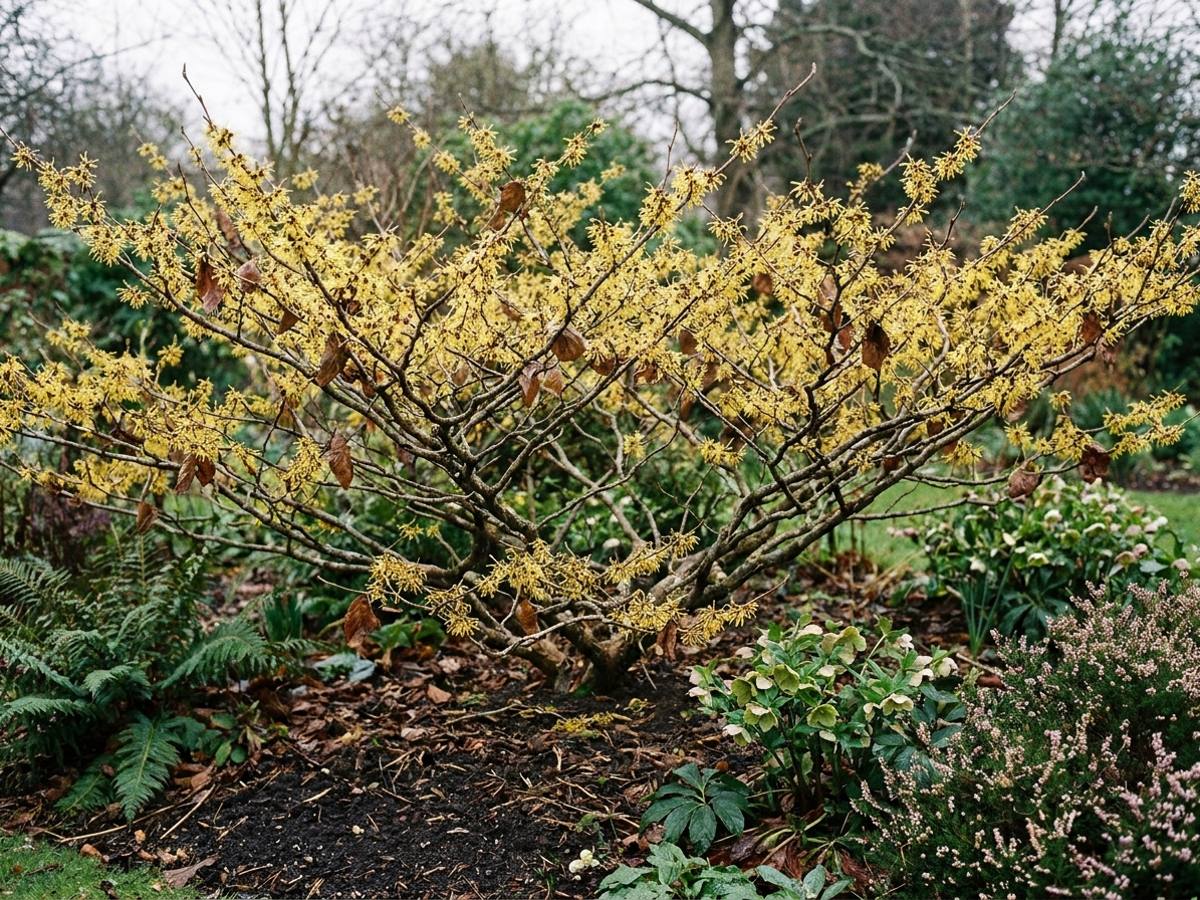
Chinese witch hazel is one of the great treasures of the winter garden, unfurling ribbon-like golden flowers on bare branches when little else dares to bloom. Its scent is the real prize — a warm, spicy-sweet fragrance that carries surprisingly far on cold, still air. Add butter-yellow autumn foliage and an elegant vase-shaped habit, and you have a shrub that earns its space twice over.
Chinese witch hazel flowers most freely in full sun, though it copes happily with light dappled shade beneath high-canopied trees. Deep shade produces sparse bloom and a leggy, drawn-out framework. Shelter from harsh, drying easterly winds helps the delicate petals last longer.
Soil matters more than most gardeners expect. This is a woodland-edge shrub that wants a deep, moisture-retentive but freely draining loam enriched with leaf mould or garden compost. It performs best in acid to neutral conditions, around pH 5.5–6.5, and will become chlorotic and stunted on thin, alkaline chalk soils.
Hardiness is rarely an issue — mature plants shrug off −20 °C, and the flowers themselves furl up in hard frost then reopen unharmed. In hot, dry summer climates, choose a north- or east-facing aspect where roots stay cool and moist.
Autumn is the ideal planting season, from October to early December, giving roots several months to settle before spring growth. Container-grown plants can go in at any frost-free time, but avoid midsummer unless you can water reliably.
Almost everything that decides whether a witch hazel thrives comes down to doing the right job at the right moment. This calendar sets out the four jobs that matter, and the one season when pruning is safe.
| Season | Main job | Prune? |
|---|---|---|
| Early spring (as the last flowers fade) | Feed with a balanced slow-release fertiliser or mulch with well-rotted compost; pull off any suckers from below the graft | Yes — the only safe window, immediately after flowering |
| Summer | One deep soak weekly in dry spells, especially for the first three or four years; keep the mulch topped up | No — flower buds for next winter are forming |
| Autumn to early winter | The best time to plant new specimens, or to peg down a low branch for layering; let fallen leaves lie as mulch | No — you would cut off next winter’s flower buds |
| Midwinter to late winter | Peak flowering: cut a few stems for the house and enjoy the scent; no winter protection needed | No |
Keep to this rhythm and the shrub asks for very little else.
Almost everything that decides whether a witch hazel thrives comes down to doing the right job at the right moment. This calendar sets out the four jobs that matter, and the one season when pruning is safe.
Keep to this rhythm and the shrub asks for very little else.
Spring: Once the last flowers fade in March, apply a balanced slow-release feed or a mulch of well-rotted compost around the root zone. This is the only sensible pruning window — remove crossing, dead or badly placed shoots immediately after flowering, before the leaf buds break. Watch for suckers arising below the graft and pull them off cleanly at the base.
Summer: Water deeply during dry spells, especially in the first three or four years; witch hazels are shallow-rooted and resent drought. A single thorough soak weekly beats frequent light sprinklings. Keep the mulch topped up to conserve moisture and suppress competition from grass.
Autumn: Enjoy the golden-yellow leaf colour, then let fallen leaves lie as a natural mulch. This is the best moment to plant new specimens or to peg down a low branch for layering. Avoid any pruning now — you would simply cut off next winter’s flower buds.
Winter: No protection is needed for established plants. Cut a few flowering stems for the house, where the scent fills a room, and be sure to site the shrub near a path or doorway so you can enjoy the fragrance on cold days.
Only a handful of true H. mollis selections are widely grown, and all are worth seeking out for scent above all.