A wide, open slope in full sun is one of the hardest places to furnish. The soil dries out fast, the light is unrelenting from morning to evening, and bare patches bake hard and crack before anything has a chance to knit together. The answer is a layered carpet: low, sun-loving plants of different heights and textures that overlap at the edges, cover the ground completely by late spring, and hold their shape once the flowers have gone.
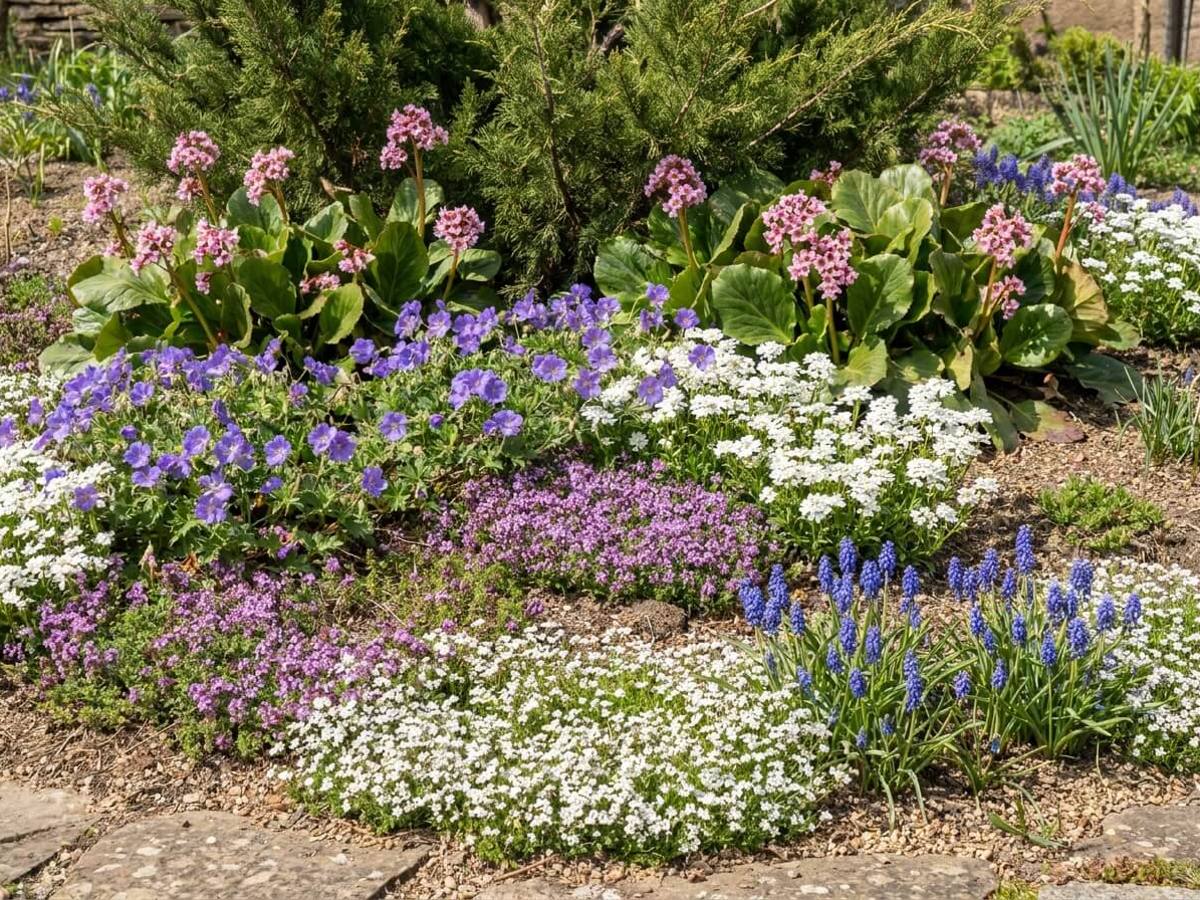
From back to front: Juniper, Bergenia, Perennial geranium, Candytuft, Thyme, Creeping alpine gypsophila, Grape hyacinth.
Start at the back with juniper, using the low, spreading forms rather than the upright ones. It gives the scheme its only real evergreen bulk, a horizontal cushion of blue-green needles that holds the eye steady while everything in front of it comes and goes. It asks for nothing but sun and sharp drainage, and its branches will lean forward over the plants below without ever smothering them.
Bergenia sits just in front, its broad, leathery, paddle-shaped leaves a deliberate contrast to the fine needles behind. The thick pink flower spikes come very early in spring, often before anything else has stirred, and they carry the scheme through those first mild weeks. The foliage stays solid all year and often takes on a reddish flush in cold weather, so the back of the planting never looks empty.
Perennial geranium is the connective tissue of the whole bed. Its divided leaves form generous low mounds that spill sideways, closing the gaps between the stiffer plants and smothering weeds as it goes. Flowering begins in late spring and keeps going in flushes, so it picks up exactly where the earliest plants leave off.
Candytuft brings the brightest moment of the spring display: dense domes of pure white smothering dark evergreen foliage, so thick you can barely see a leaf. It loves the dry, sunny, free-draining conditions that make this spot difficult, and it tumbles happily over a kerb or a low retaining edge. Planted beside the pinks and blues of its neighbours, the white lifts the whole scheme and stops it looking muddy.
Thyme takes over the front third as a true walkable carpet, grey-green and aromatic, hugging every dip and stone. Its small mauve-pink flowers open from late spring and bring bees to the planting in numbers. It tolerates being stepped on at the edges, which makes it the right choice where the bed meets a path.
Creeping alpine gypsophila adds a haze of tiny white or pale pink flowers on a flat mat of narrow foliage, softening the hard outline of the front edge. It thrives in poor, stony, sun-baked ground where richer plants sulk, so use it for the driest, meanest corners. Next to the denser cushions of thyme, its airy texture keeps the front of the bed from looking solid and heavy.
Grape hyacinth is the finishing layer, threaded through the gaps rather than planted in a block of its own. The short spikes of deep blue push up through the low mats in early spring and read as pools of colour against grey and green foliage. Once flowering is over the leaves yellow and vanish beneath the spreading carpet, so there is no tidying to do.
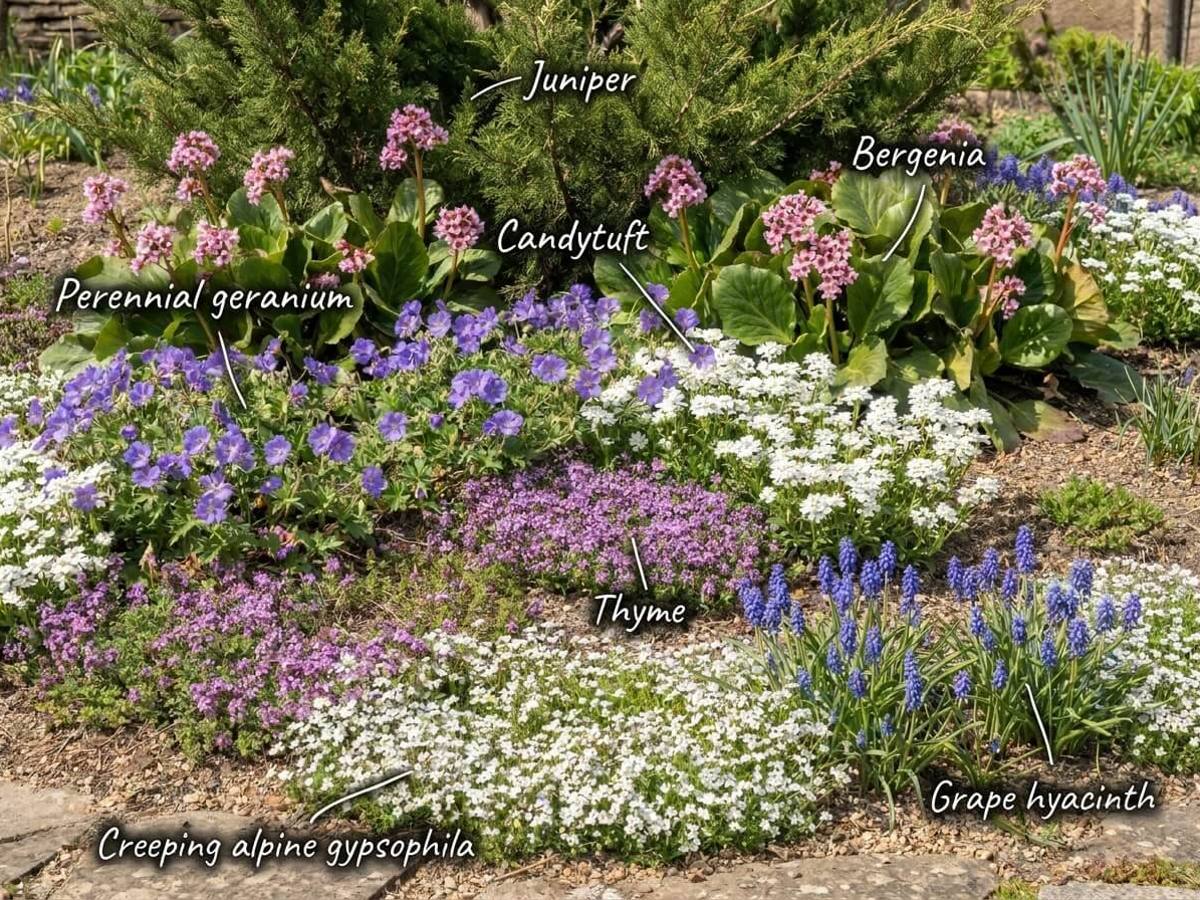
Set the juniper at the back, allowing at least 1 m between plants, as each one will spread far wider than it looks in its pot. Plant bergenia in groups of three to five, about 40 cm apart, in a loose drift rather than a line. Perennial geranium goes in front at 40 to 50 cm spacing, in groups of three, so the mounds meet by midsummer. Candytuft and thyme fill the front band at roughly 30 cm apart, with creeping alpine gypsophila tucked into the driest edges and over any low wall. Finally, push grape hyacinth bulbs in during autumn at 8 to 10 cm deep, in irregular clusters of ten or more, scattered between the front plants.
In late winter the bed reads as texture alone: juniper’s blue-green mass, the glossy leaves of bergenia and the tight evergreen cushions of candytuft and thyme. Early spring brings bergenia’s pink spikes and the blue of grape hyacinth, then candytuft turns the front white, and creeping alpine gypsophila follows with its pale haze. From late spring into summer, perennial geranium and thyme carry the colour and the bees, and the whole surface is covered. By autumn the flowers have gone, but the evergreen framework, the broad bergenia foliage and the spreading juniper keep the slope furnished until the cycle starts again.