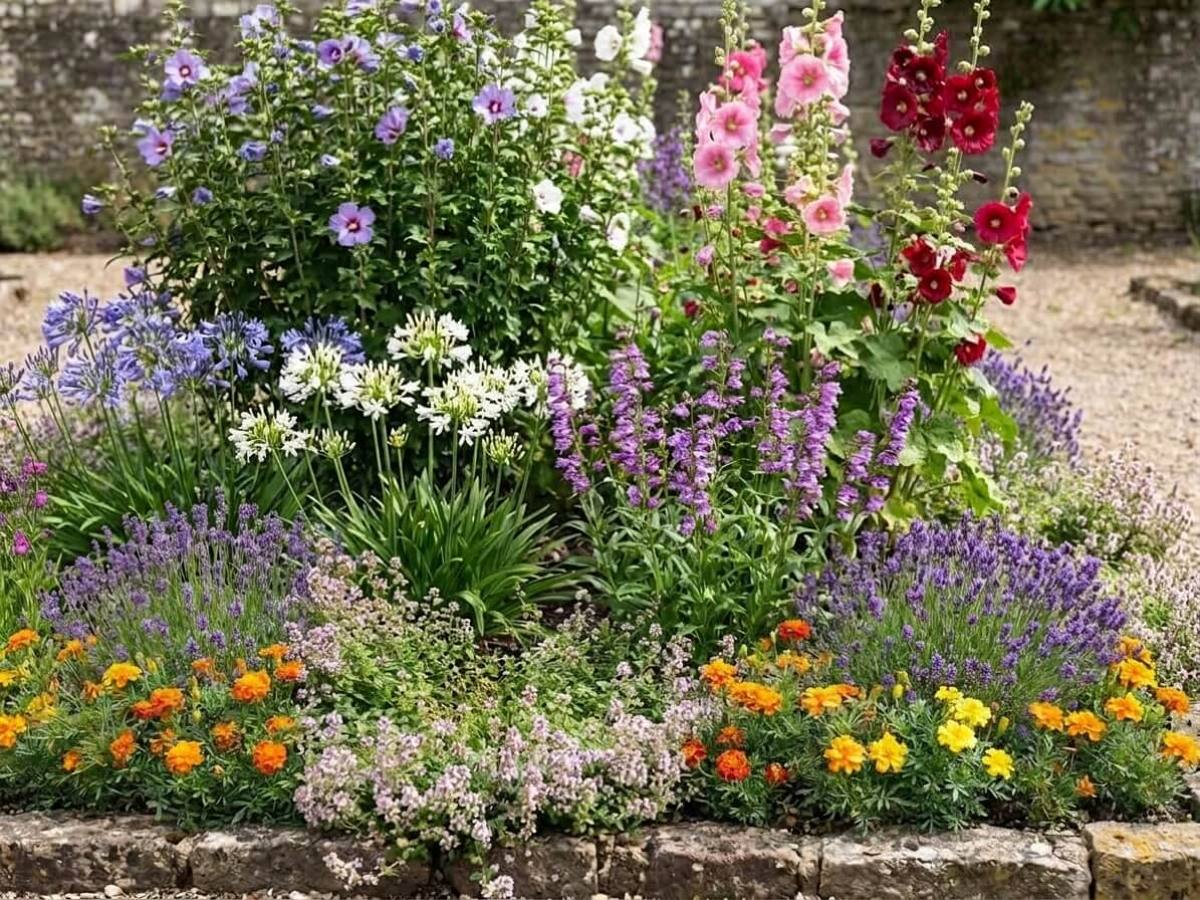
A bed that faces the sun from mid-morning to evening heats up fast, and the soil at the front edge dries hardest of all. Reflected warmth from a path or wall adds to it, so anything thirsty sulks by July — exactly when you want the bed at its best. The answer is to build the scheme around plants that actually enjoy the glare, stacking them by height so the tall, late performers screen the back and the drought-tolerant, aromatic ones hold the hot front edge.
From back to front: Althea, Hollyhock, Lily of the Nile, Beardtongue, Lavender, Marjoram, Marigold.
Use althea as the permanent backbone at the very back of the bed. It is a shrub, so it gives the scheme structure in winter when everything in front has died down, and it flowers from midsummer into early autumn with broad, open blooms. Its upright, slightly stiff habit is the perfect foil for the looser spires that come in front of it.
Plant hollyhock in a loose line just ahead of the shrub, where its tall flower stems can rise through and above the greenery. The vertical spires are the tallest flowering element in the scheme and carry colour high up, lifting the eye above the lower mounds. Because the stems are narrow and the leaves sit low, hollyhock takes up almost no ground space, so you can slot it tightly between the shrub and the next row.
Lily of the Nile works as the mid-height layer, sending long bare stems up to round flower heads in the heart of summer. The strap-shaped leaves form solid clumps that hide the bottom of the hollyhock stems, which can look bare by August. It thrives in full sun and resents soggy soil, which suits this bed exactly.
Set beardtongue in front of the agapanthus clumps for a long, steady run of tubular flowers through summer and often well into autumn. The habit is bushy and semi-see-through, so it softens the gap between the stiff clumps behind and the tight mounds ahead. It also keeps flowering after the hollyhock spires have finished, which keeps the middle of the bed alive.
A row of lavender takes the second-from-front position and gives the scheme its silver-grey tone. That cool foliage colour calms the brighter flowers behind it and stays attractive long after the flowering spikes have been cut back. Full sun, gritty drainage and a hard annual trim are all it asks for.
Tuck marjoram along the front edge beside the lavender, where it will spill slightly over the path. It flowers in summer with small clustered heads that bees work constantly, and the aromatic leaves are there to pick for the kitchen. Like lavender, it copes with the baked, dry strip at the bed’s edge where thirstier plants would fail.
Finish the front with marigold, planted fresh each year to fill any gaps along the edge. It flowers hard from early summer until the first frosts, in warm tones that pick up the heat of the site rather than fighting it. Being annual, it is the easiest part of the scheme to move around until you find the arrangement you like.
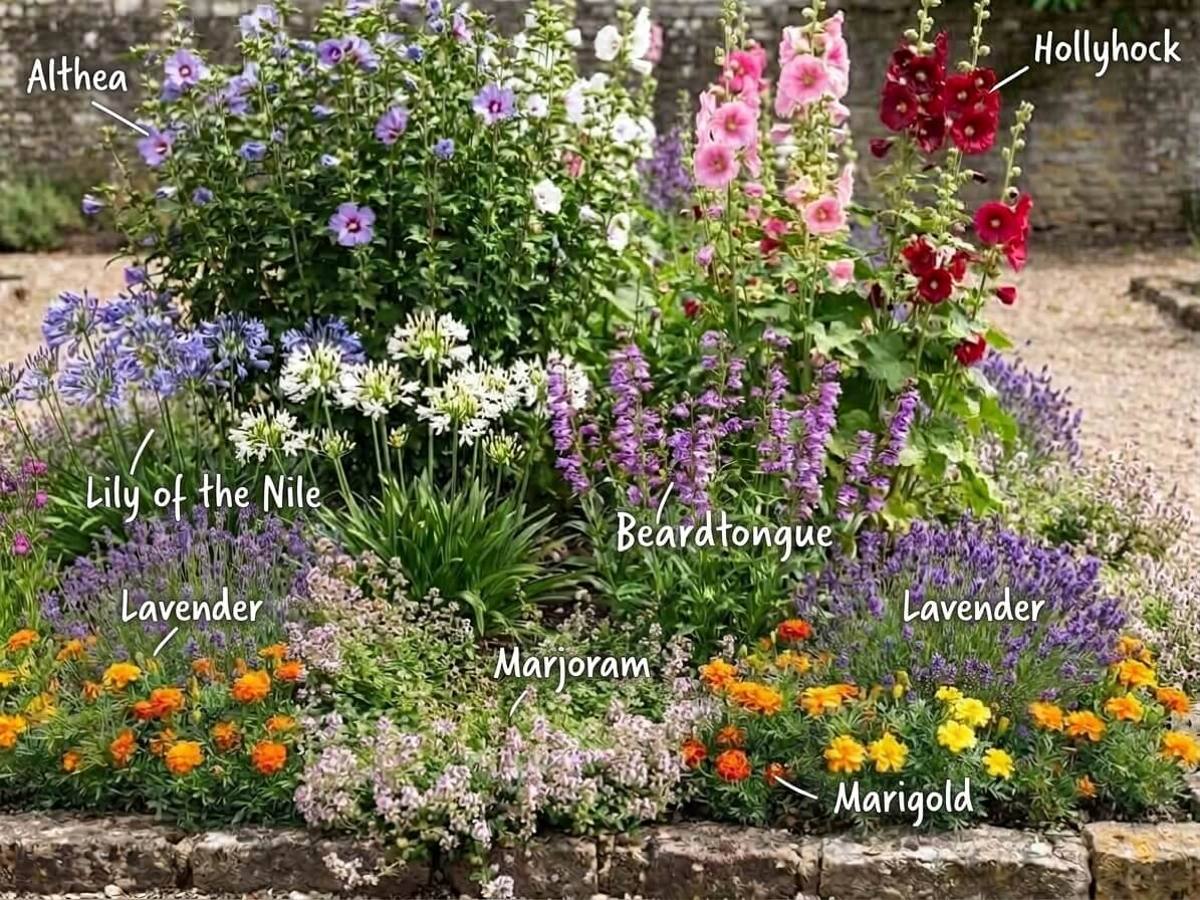
Give the althea a good metre of clear space at the back, as it will spread sideways over time. Plant the hollyhock in a staggered group of three or five directly in front of it, then set the lily of the Nile in two or three clumps of three, leaving around 40 cm between plants so the foliage knits without crowding. Beardtongue goes in groups of three at roughly 40 cm spacing, the lavender in a continuous row about 40 cm apart so the plants eventually touch, and the marjoram and marigold fill the last 30 cm strip at the front, tucked into any openings.
In spring the bed is mostly foliage: lavender mounds, emerging agapanthus straps and the first hollyhock rosettes, with the bare framework of the shrub behind. Early summer brings the marigolds and beardtongue into flower, then midsummer fires everything at once, with hollyhock spires, agapanthus heads, lavender and marjoram all going together. Late summer and autumn belong to the althea, beardtongue and marigold, and once frost arrives the shrub’s branch structure and the grey lavender mounds carry the bed through winter until it starts again.