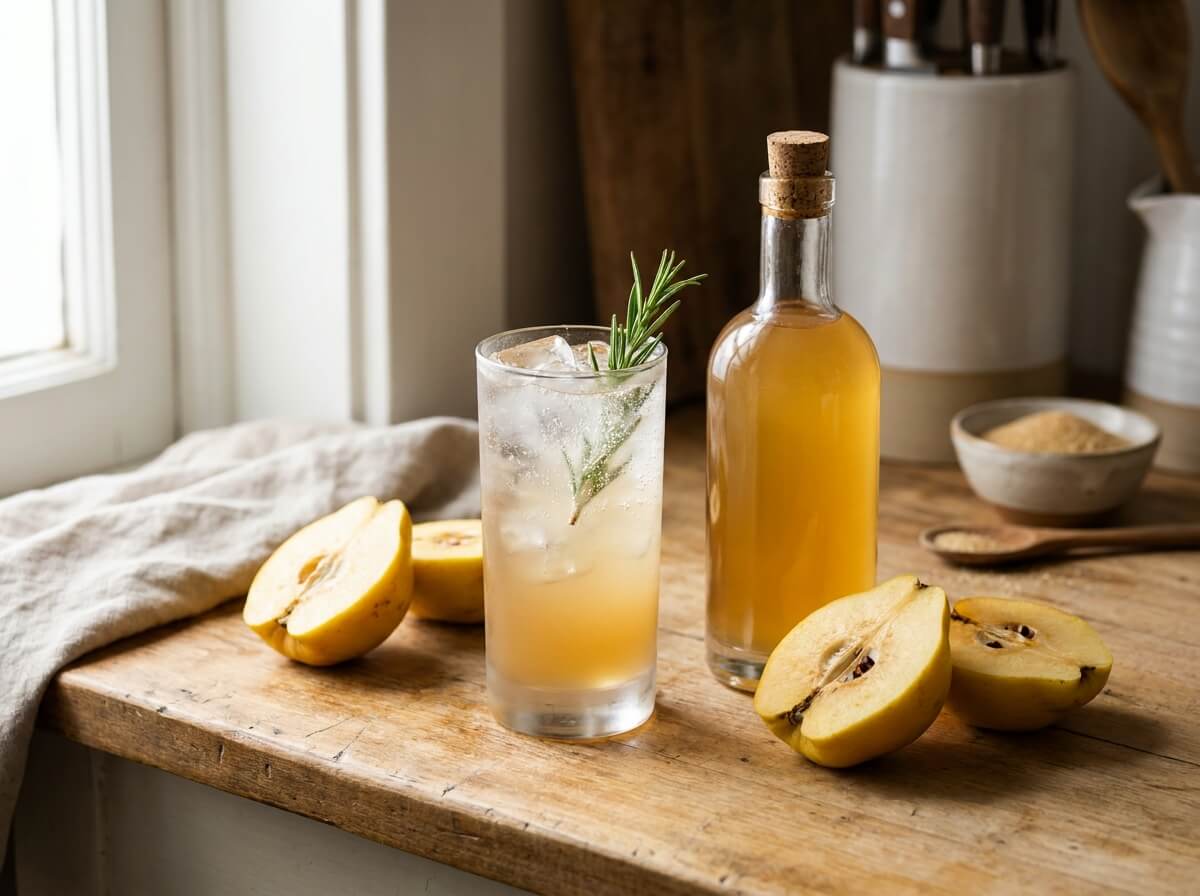
Quince clings to its branches long after the leaves have gone, the fruit turning from downy green to waxy gold through late October and November, perfuming a whole room from a bowl on the windowsill. Raw it is hard, tannic and inedible — but grated and buried in sugar, it gives up a syrup like pear and rose. Cut with bay-infused cider vinegar, it becomes a shrub: a keeping cordial that turns sparkling water into something with grip, and whisky into a long drink worth lingering over.
⏱ Prep 30 min🔥 Cook 10 min👥 Serves Makes about 3 cups (700 ml) concentrate, roughly 20 drinks📊 Level Medium
Ingredients for 4 people
2 large ripe quinces, about 1 lb 5 oz (600 g) — or 3 firm, under-ripe pears plus 1 tart apple
1½ cups (300 g) granulated or caster sugar
¼ cup (85 g) runny honey, something floral rather than dark
¼ tsp (1.5 g) fine sea salt
4 fresh bay leaves, or 3 dried
1 tsp (3 g) black peppercorns
Pared zest of 1 unwaxed lemon, in wide strips, no white pith
1¼ cups (300 ml) apple cider vinegar, 5% acidity
To serve: sparkling water or soda, well chilled
To serve: ice, plus a sprig of rosemary or thyme
Optional: 1½ fl oz (45 ml) bourbon, rye or gin per cocktail
The Recipe
Rub each quince hard with a dry cloth to strip off the grey fuzz, then wash and dry. That down traps a resinous bitterness and holds dust from the orchard — skipping it leaves a faint turpentine note in the finished shrub.
Coarsely grate the quinces, skin and all, straight down to the core, then discard the stony core and pips. The skin carries the highest concentration of the fruit’s aroma compounds, so peeling throws away the point; the pips release mucilage that would turn the syrup slimy. Work fast — cut quince oxidises to rust-brown within minutes.
Tip the grated fruit into a bowl with the sugar, honey and salt and mix with your hands until every shred is coated and glossy. Pack it into a clean jar and press down firmly. Do not add the vinegar yet — acid firms pectin and locks the juice inside the cells, so the sugar must do its osmotic work first. Do not skip this order.
Cover and refrigerate for 48 hours, stirring twice a day. You are waiting for a visible change: the pulp collapses, drops by about a third in volume, and sits in a pool of clear amber syrup. If you still see dry sugar crystals after two days, give it another 12 hours.
Meanwhile, bruise the bay leaves between your palms until they smell green and medicinal, and crack the peppercorns under the base of a pan. Warm them with the lemon zest and the vinegar to 140 °F (60 °C) — steam rising, surface trembling, no bubbles. Boiling vinegar drives off acetic acid as a harsh vapour and stews the bay into something bitter. Take it off the heat, leave 10 minutes, then cool completely and strain.
Strain the macerated quince through a fine sieve set over a bowl, letting it drip for 15 minutes. Press the pulp only lightly with the back of a spoon — crushing it forces through starch and tannin that cloud the shrub and leave a chalky finish on the tongue.
Stir the cooled spiced vinegar into the quince syrup, bottle, and refrigerate for at least one week, shaking daily. On day one it tastes like two separate things, sweet and sour side by side; by day seven the sharp edge has rounded and the bay has settled underneath the fruit. It peaks at three to four weeks.
To serve cold, pour 1 fl oz (30 ml) shrub over ice and top with 5 fl oz (150 ml) sparkling water — a 1:5 ratio. Stir until the glass frosts and add a rosemary sprig, slapped once against your hand to wake the oils. For a cocktail, use 1:3 shrub to soda with 1½ fl oz (45 ml) bourbon or gin.
For a hot version on a cold evening, stir 1 fl oz (30 ml) shrub into 6 fl oz (175 ml) hot (not boiling) water with a strip of lemon zest. Keep the water below 175 °F (80 °C) so the quince aromatics stay in the cup instead of escaping as steam.