Home » Recipes » Drinks » Blackberry and Bay Shrub with Lime and Sparkling Water
Blackberry and Bay Shrub with Lime and Sparkling Water
0
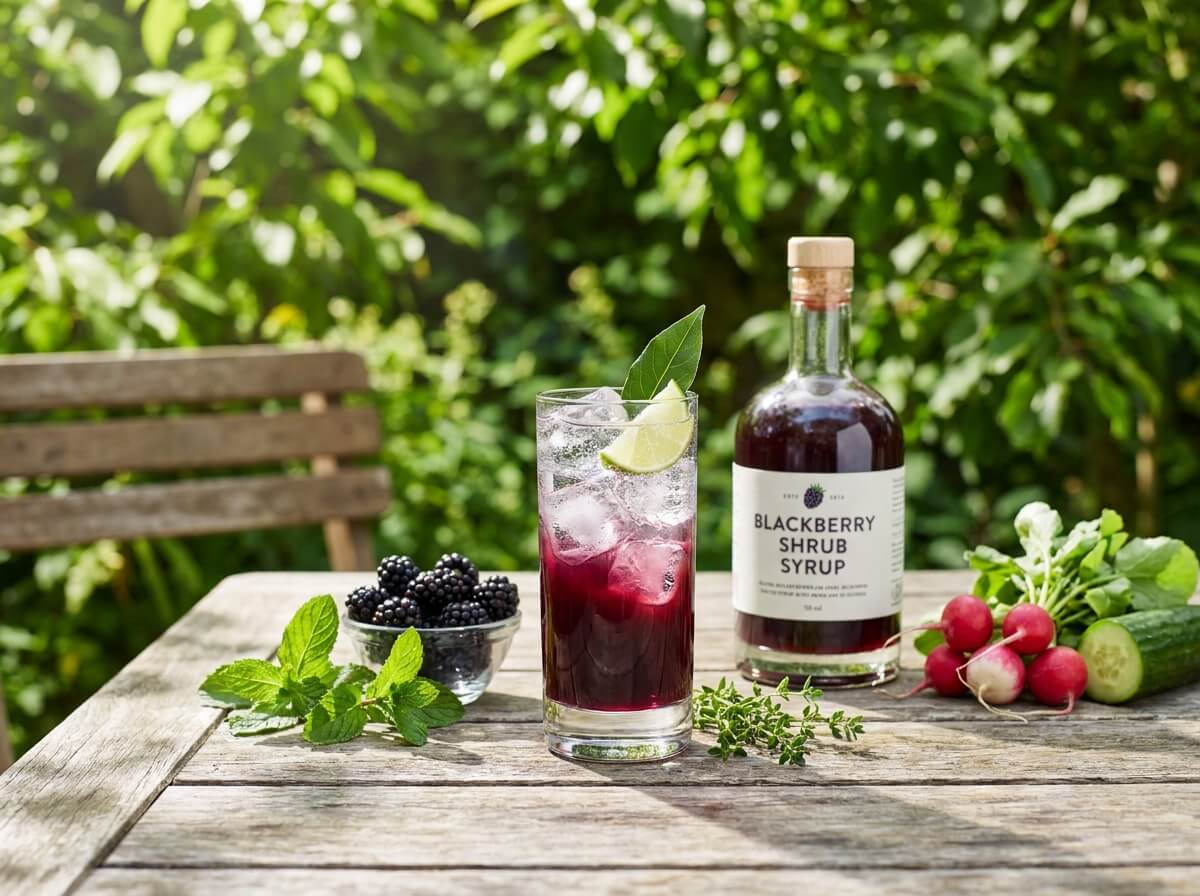
Brambles plant themselves: a cane arches over, roots where its tip touches soil, and by early September the hedge is heavy with fruit turning from red to matte, dusty black. The berry at the tip of each cluster ripens first and carries the most sugar — pick those. Macerated cold with bruised bay and raw cider vinegar, they become a shrub syrup that keeps for months and gives a glass of soda real backbone.
⏱ Prep 25 min (plus 48 hours cold maceration and 5 days resting)🔥 Cook 5 min👥 Serves makes about 3 cups (700 ml) syrup, enough for 14 tall glasses📊 Level Easy
Ingredients for 4 people
4 cups (500 g) ripe blackberries, or mulberries, loganberries or black raspberries
2 cups (400 g) granulated or caster sugar
6 fresh bay leaves (*Laurus nobilis*), or 3 dried
6 black peppercorns, cracked
¼ tsp (1.5 g) fine sea salt
1½ cups (350 ml) raw, unpasteurised apple cider vinegar
2 tbsp (30 ml) red wine vinegar (optional, for depth)
1½ fl oz (45 ml) gin, vodka or shochu per glass (optional)
Extra bay leaves and whole berries, to garnish
The Recipe
Sort the berries and discard any with grey fuzz or hard red drupelets — one mouldy berry carries enough spores to turn the whole jar in a warm kitchen. Do not wash them unless they are visibly dirty; surface water dilutes the syrup and washes off the wild yeasts that give a raw shrub its faint sparkle.
Tip the berries into a wide non-reactive bowl (glass or ceramic, never bare aluminium, which reacts with acid and tastes metallic) and crush about half of them against the side with a wooden spoon. Leave the rest whole: crushed fruit gives you juice fast, whole fruit releases slowly over two days and keeps the flavour layered rather than jammy.
Bruise the bay leaves by pressing them firmly with the flat of a knife until you can smell them from arm’s length — that snap of eucalyptus and pine is the oil cells rupturing. Do not shred them; large pieces are far quicker to strain out. Add the bay, cracked peppercorns, sugar and salt to the fruit and stir until the berries are coated in grit.
Cover with a plate and refrigerate for 48 hours, stirring twice a day. The sugar draws juice out by osmosis until the fruit collapses into a dark, glossy slurry — this is why the recipe is not cooked. Heat would give you jam flavour; cold maceration keeps the bright, slightly green edge of raw blackberry intact. Do not skip the stirring, or undissolved sugar will sit in a sludge at the bottom.
Strain through a fine sieve set over a bowl, pressing the pulp only gently with the back of a ladle. Hard pressing forces seed tannin and pectin through and gives a cloudy, faintly bitter syrup that never settles clear. You should have roughly 1½ cups (350 ml) of deep purple juice.
Check for undissolved sugar by rubbing a drop between your fingers; if it feels gritty, warm a quarter of the juice in a small pan to no more than 122 °F (50 °C) — warm to the fingertip, never steaming — stir until smooth, then return it to the rest. Now whisk in the cider vinegar and the red wine vinegar. Never boil vinegar: acetic acid is volatile and boiling drives off both the sharpness and the fruity top notes, leaving a flat, dull syrup.
Funnel into a clean bottle, seal, and rest in the refrigerator for at least 5 days, ideally 2 weeks. Taste on day one and again on day seven and you will understand why: the raw vinegar’s nose-prickle fades, the bay steps forward, and the whole thing knits into one flavour instead of three arguing.
To build the drink, fill a tall glass with large ice cubes (small cubes melt fast and water the shrub down before you reach the bottom), pour over 1½ fl oz (45 ml) of shrub, squeeze in a lime wedge and top with about 5½ fl oz (160 ml) of well-chilled sparkling water. Stir once, lifting from the bottom to the top rather than swirling, to keep the carbonation. Garnish with a bay leaf and a single berry.