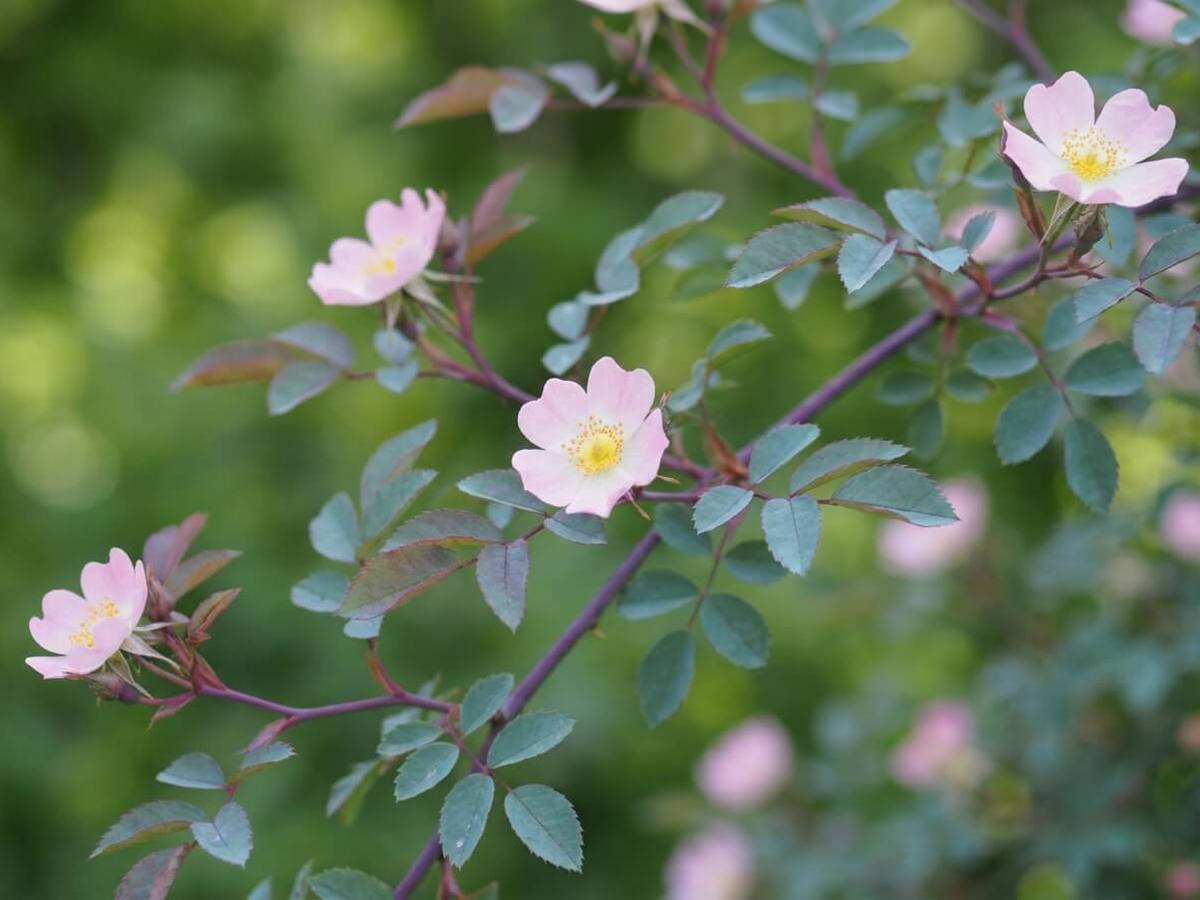
Rosa glauca is grown as much for its foliage as its flowers: slender, arching plum-red stems clothed in small leaves of smoky grey-purple that look as though they have been dusted with violet. In early summer it carries sprays of simple cerise-pink flowers with white eyes, followed by clusters of glossy red hips that hang on well into winter. It is one of the very few roses that earns a place in a border purely for its colour contrast, sitting beautifully with silver artemisias, blue geraniums and dark-leaved shrubs.
Growing conditions
Give Rosa glauca as much sun as you can: six hours or more a day produces the deepest purple tones and the heaviest crop of hips. It copes with light or dappled shade, but the leaves shift towards grey-green and the arching stems stretch and flop. Shelter is not needed — this is a mountain species from the Alps, Pyrenees and Carpathians, thoroughly used to wind and cold.
Soil is rarely a limiting factor. It thrives on heavy clay, thin chalk, sand and stony ground alike, provided drainage is reasonable and the site is not waterlogged in winter. A pH anywhere from 5.5 to 8.0 suits it, and it needs far less feeding than a modern hybrid tea.
Hardiness is exceptional, which makes it a useful choice for cold inland gardens and exposed northern sites. In hot, humid summer climates give it good air movement to keep the foliage clean.
How to plant Rosa
Bare-root plants are best set out between November and March whilst dormant, so the roots establish before spring growth begins. Container-grown shrubs can go in at any time the ground is workable, though autumn planting gives the strongest first season.
Space plants 1.5–2 m apart for a specimen shrub, or 90 cm–1.2 m for an informal hedge where stems should knit together.
Rosa glauca is usually grown on its own roots — plant at the same depth it grew in the nursery; if a graft union is visible, bury it 5 cm below the surface.
Fork a bucketful of garden compost or well-rotted manure into the planting area, and dust the roots with mycorrhizal fungi before backfilling.
Water in with at least 10 litres, then mulch 5–7 cm deep, keeping the mulch clear of the stems.
Propagate by sowing cleaned seed in autumn in pots left outdoors to stratify, by hardwood cuttings in late autumn, or by lifting rooted suckers in winter.
Rosa glauca growing in a naturalistic garden border
Care through the seasons
Spring: Scatter a handful of balanced organic rose fertiliser or pelleted manure around the base in March and top up the mulch. Resist heavy nitrogen feeding — lush, over-fed growth is greener and softer than the plum-tinted shoots you want. Watch for aphids clustering on the new tips as temperatures climb.
Summer: Established shrubs are notably drought-tolerant and seldom need watering after their first two summers. Do not deadhead: every faded flower left on the plant becomes an autumn hip. Water new plantings deeply once a week in dry spells rather than little and often.
Autumn: This is the season the shrub earns its keep, with red hips against yellowing leaves. Remove any suckers appearing away from the crown by pulling rather than cutting, and mulch with compost once the leaves have dropped. Collect ripe hips in October if you want to raise seedlings.
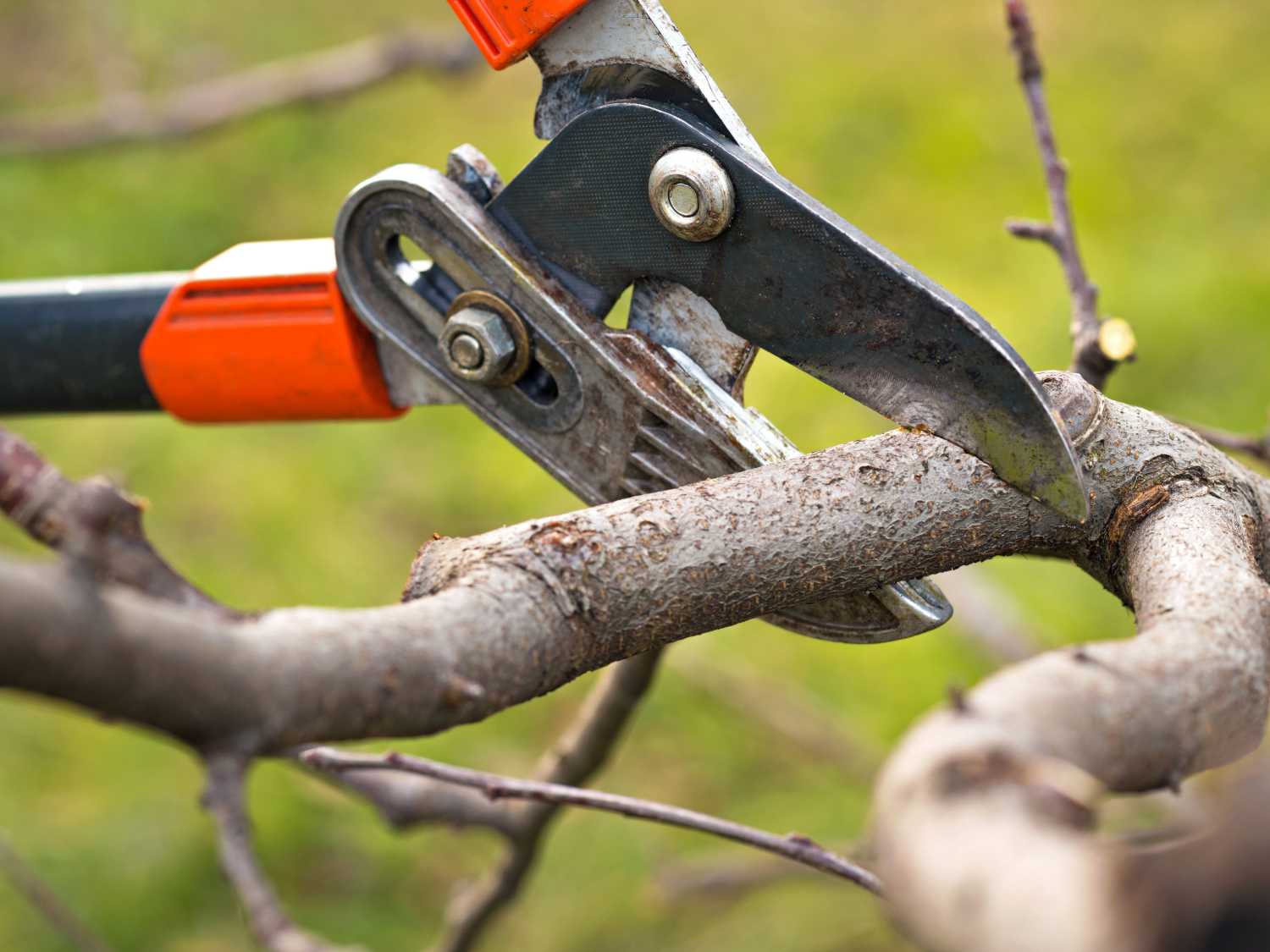
Winter: No protection is needed anywhere in Britain or northern Europe. Prune in late winter, taking out one in three of the oldest stems at the base to keep the shrub furnished with colourful young growth.
Best varieties to grow
Very few selections exist — the wild species is so good that breeders have largely left it alone — but these are worth seeking out.
Rosa glauca (species form) — holder of the RHS Award of Garden Merit and still the best choice for foliage colour and hips.
Rosa ‘Carmenetta’ — a hardy Canadian hybrid of R. glauca and R. rugosa raised in the 1920s, larger and tougher with similar grey-purple leaves.
Rosa ‘Sir Cedric Morris’ — a seedling of R. glauca that became a vast grey-leaved rambler with scented white flowers and tiny orange hips, for large trees and old walls only.
Rosa moyesii ‘Geranium’ — not a form of R. glauca but the natural companion, offering scarlet flowers and flagon-shaped hips on a shrub of similar habit.
Pests, diseases and common problems
Aphids: Dense colonies on soft spring shoots and flower buds, sometimes with sticky honeydew. Squash by hand or dislodge with a jet of water; ladybirds and blue tits usually take care of the rest if you avoid spraying.
Rose rust: Bright orange pustules on leaf undersides in damp summers, worst on crowded plants. Collect and bin fallen leaves, thin congested stems to improve airflow, and avoid overhead watering.
Rose leaf-rolling sawfly: Leaflets rolled tightly downwards into tubes in early summer. Pick off and destroy affected leaves; damage is cosmetic and the shrub grows through it without treatment.
🌿 Nature & Garden Newsletter
Gardening tips, recipes & seasonal advice, twice a week.