When moss appears on a lawn or in the grass, it often can be traced to one or two simple causes that are easy to correct. Before splurging on poisonous chemical moss killers, look into things like mowing, dethatching, exposure, watering, air circulation, lawn topdress and even soil fertilization. Changing your habits might be all that’s needed to remove moss from your lawn!
How to remove moss from the lawn
Cut too short, grass weakens and moss takes over
It seems simple, but all your efforts should aim to favor growth of grass itself, instead of moss. This is the key to the best long-term results against moss.
Lawn grass needs sun. It is important to cut branches off overhanging trees that make shade too dark (thinning them). Shade hinders proper lawn grass growth.
Also, follow the simple basic rules below and you yourself will be your garden’s most powerful moss killer!
Where conditions suit grass, rake out dead moss and overseed the bare patches in spring or early autumn, but first address causes such as deep shade, compaction or poor drainage.
Under trees where you cannot thin enough branches, reseed with a shade-tolerant mix based on fine fescues rather than ryegrass.
Mow the lawn on a regular basis
Mowing must be performed at least once a week in spring and every two weeks in summer.
Don’t mow any shorter than 1¼ to 1½ inches (3 to 4 cm).
If you mow any lower, your lawn grass will have trouble growing whereas moss will have ideal growing conditions.
Never take off more than a third of the blade height in a single pass, and raise the mower if the grass has got away from you.
Blunt mower blades tear grass rather than slicing it cleanly, leaving ragged tips that lose moisture and brown off, which can give the lawn a dull, whitish cast after mowing.
Fertilize the lawn
Moss can survive easily with few nutrients. Lawn grass cannot.
The shorter your lawn, the more it needs nutrients to grow. Keep it taller.
Find time-release fertilizer and spread it evenly in spring and fall. Fresh lawn topdressing with compost is a great time-release fertilizer.
This will stimulate lawn grass growth instead of moss.
Another solution to fertilize is the use of fermented tea.
Check the soil pH before feeding, since most lawn grasses grow best between about 6 and 7; moss, however, usually signals shade, compaction or poor drainage rather than acidity alone.
Where a test shows the lawn is strongly acid, a dressing of garden lime applied in autumn or winter will raise the pH and tilt conditions back towards the grass.
Spread compost topdressing thinly enough that the grass blades still show through.
Make the air circulate to repel moss
A moss-less lawn is, more than anything, a lawn where the air circulates well!
There are special devices like spiked shoes for smaller surfaces or needle-equipped engine-powered contraptions to riddle the lawn with tiny holes. This process can be done anytime during the year.
Aerate when the soil is damp rather than baked hard, since dry ground simply resists the spikes.
A hollow-tine aerator pulls out small plugs of soil instead of only pressing holes into it, and that relieves compaction far more lastingly on heavy clay.
Brush sharp sand or fine topdressing into the fresh aeration holes to keep the channels open and improve surface drainage, which reduces the persistently damp, compacted conditions that favour moss.
Dethatching removes moss from the lawn
It helps eliminate superficial and thus least vigorous roots from the lawn grass. These weak roots tend to weave a thick mat along the surface that retains moisture, blocks air circulation, and is very inviting for moss spores.
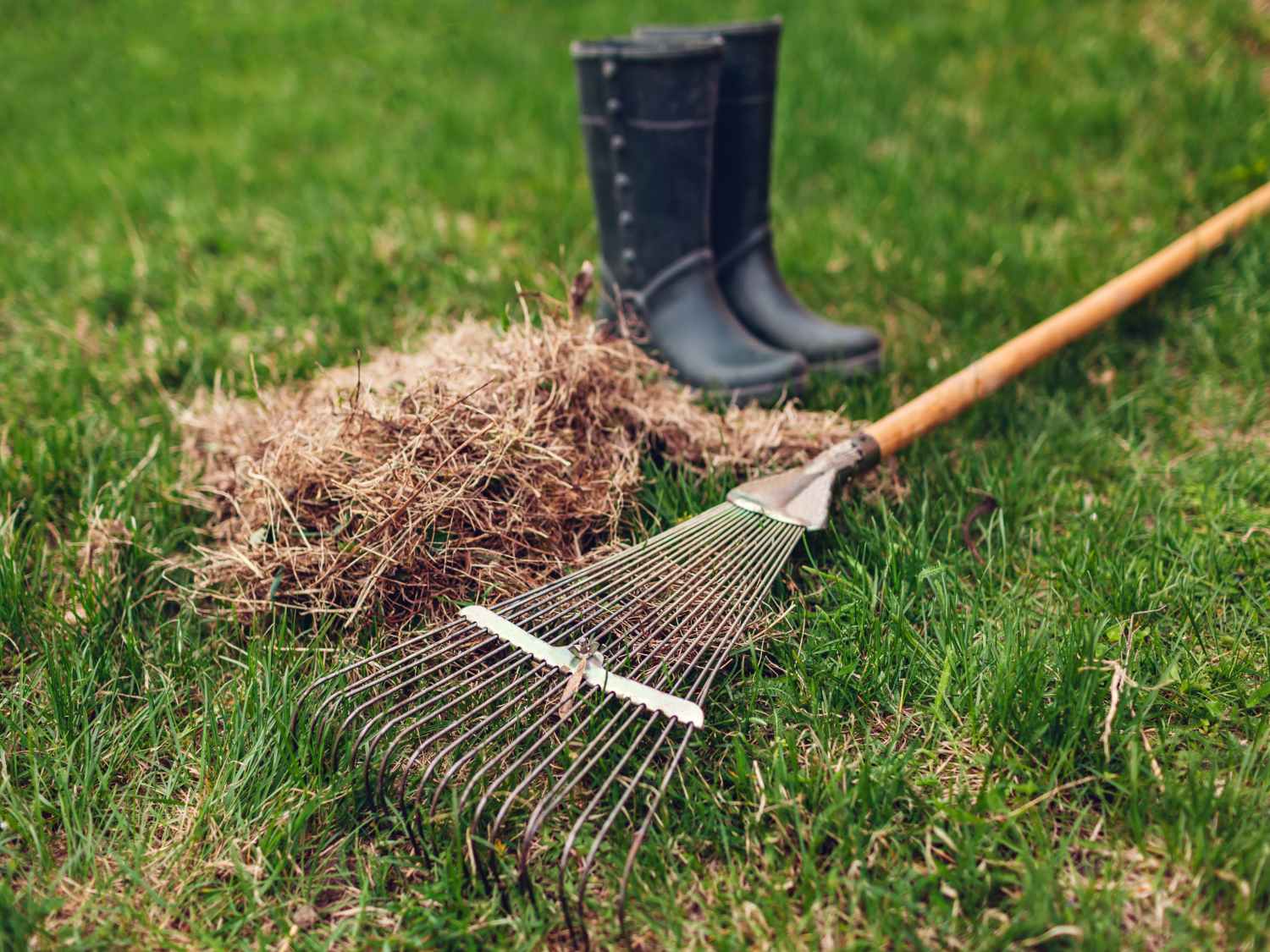
Refer to our guidance on how to dethatch your lawn, a step that can be performed one or two times a year.
Dethatch only while the grass is actively growing, so the turf can close the gaps the blades tear open.
Set the dethatcher blades so they just graze the soil surface rather than gouging into it, since settings that dig in can tear up turf and damage grass roots.
Oversow bare patches promptly, since dense turf leaves less room for moss to establish — but also address the underlying causes, such as shade, compaction, poor drainage or low fertility.
Moss control methods compared
Every one of these actions works by tipping the balance back in favour of the grass rather than the moss. Use the table to see which cause you are correcting, and how often the job needs doing.
Moss control methods compared
Action
What it corrects
When to do it
Thin overhanging branches
Shade that holds the grass back
Whenever shade becomes too dark
Mow, but no shorter than 3–4 cm (1¼–1½ in)
Grass cut so low that moss has the upper hand
Once a week in spring, every two weeks in summer
Time-release fertiliser or compost topdressing
Poor nutrition, which moss tolerates and grass does not
Spread evenly in spring and autumn
Spiked shoes or a needle-equipped machine
Poor air circulation in the turf
Anytime during the year
Dethatching
A thick surface mat of weak roots holding moisture
One or two times a year
Moss-inhibiting products
Moss appearing in the first place
Last resort, from a garden store
Taken together, these habits make you the lawn’s most effective moss killer.
Moss killing products
Lastly, there are very effective moss-inhibiting products that will prevent moss from appearing altogether. You can find these in your local garden store.
Once the treatment has blackened the moss, rake or scarify it out, as standard lawn-care guidance advises clearing the dead material to leave the surface open for overseeding and new grass growth.
Iron sulphate stains paving, stone edging and clothing, so keep it off hard surfaces and hose down any splashes straight away.
Measure the dose and spread it evenly, ideally with a wheeled spreader, because over-application can scorch the grass, leaving yellow or brown burnt streaks where the fertiliser was applied too heavily.
Overseed the bare patches after removing moss, but also address the underlying causes—shade, compaction, poor drainage, low fertility or acidic soil—since moss tends to return wherever grass struggles to thrive.
Images: 123RF: Mariia Boiko; Pixabay: Bernd Wälz, Petra
Written by Gaspard Lorthiois | Loves helping out, especially when it comes to growing things. Worked in herbal medicine, runs a farm, and dabbles in tech. Master's degree and engineer.