Growing Knautia macedonica: care tips and planting advice
0
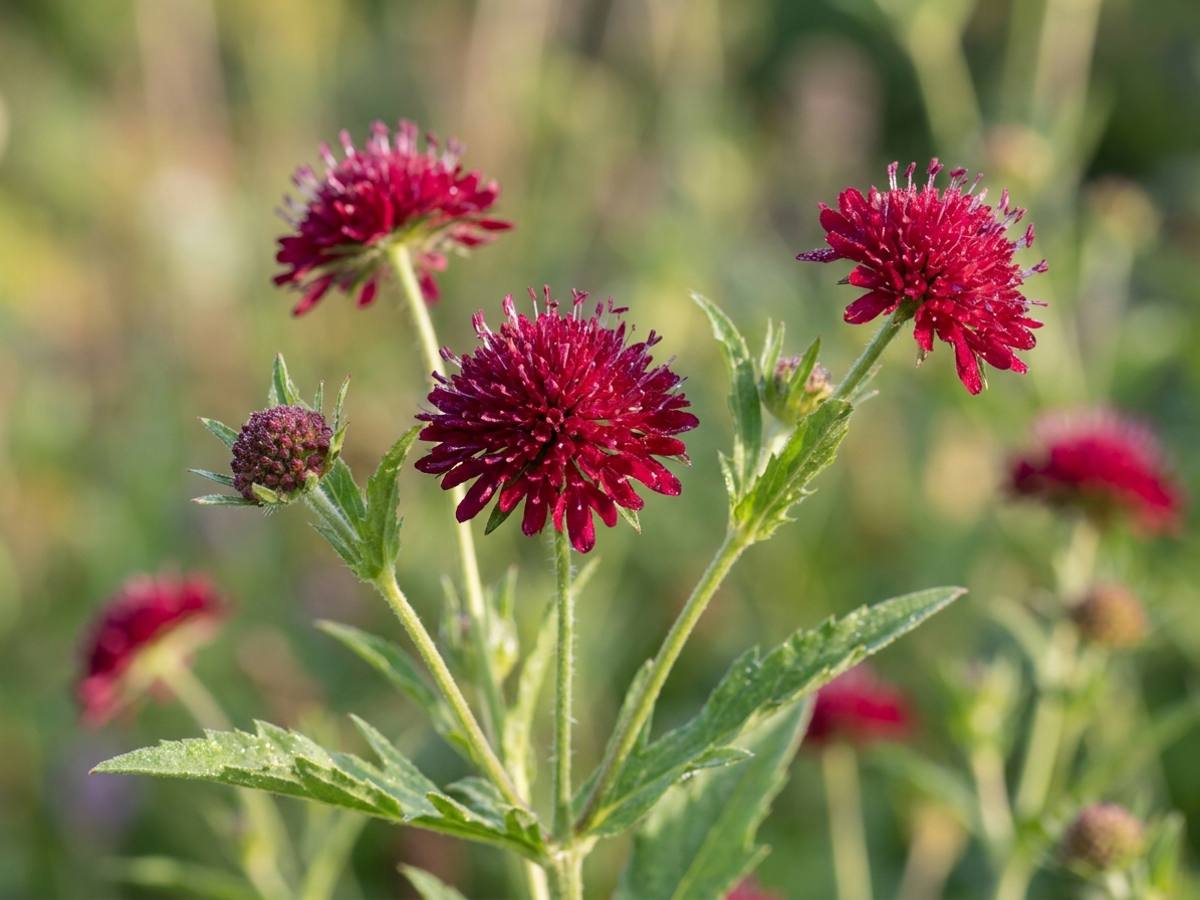
Few perennials thread through a border quite as artfully as Knautia macedonica, whose wiry, branching stems carry small pincushion flowers of deep crimson-maroon from midsummer until the first frosts. It is a mainstay of naturalistic and prairie-style planting, weaving between grasses and umbellifers without ever bullying its neighbours. Bees and butterflies adore it, and the long, generous flowering season makes it one of the hardest-working plants in a sunny border.
Growing conditions
Give Knautia the sunniest spot you can spare — at least six hours of direct sun a day. In shade or crowded positions the stems stretch, flowering thins and the plant flops untidily onto its neighbours. An open site with good air movement also helps keep mildew at bay.
Sharp drainage matters far more than fertility. This is a plant of dry Balkan meadows and limestone hillsides, so it thrives on light, stony, sandy or chalky soils with a neutral to alkaline pH. Heavy clay is workable if you dig in grit and coarse organic matter, but rich, damp soil produces soft, lax growth and short-lived plants.
It is fully hardy across the UK and northern Europe, coping with temperatures down to around −20 °C. Winter wet, not winter cold, is what kills it — in high-rainfall regions, plant on a slope, a raised bed or a gravel garden.
How to plant Knautia
Plant pot-grown specimens in spring, from March to May, so the roots establish through the growing season. Autumn planting is possible on free-draining soil, but on cold or heavy ground spring is far safer.
Spacing: set plants 45–50 cm apart; the airy, branching habit fills gaps quickly and crowding encourages mildew.
Depth: plant so the crown sits exactly level with the soil surface — burying it invites rot.
Soil preparation: fork over the planting area and add horticultural grit to clay; skip the manure, as too much richness weakens the stems.
Watering in: water thoroughly at planting, then keep the soil just moist for the first six weeks only.
Propagation: divide established clumps in spring, take basal cuttings in April, or sow seed at 15–18 °C in spring — self-sown seedlings are common and easily transplanted.
Knautia macedonica growing in a naturalistic garden border
Four ways to make more Knautia
Knautia is easy to increase, and the method you choose depends on what you already have. All four routes are worked in the same half of the year.
Four ways to make more Knautia
Method
When
Best for
Division
Early to mid-spring
Clumps that have grown congested after three or four years
Basal cuttings
Mid-spring
Taking material from the new rosettes of hairy, lobed leaves
Seed sown under cover
Spring, at 15–18 °C
Raising plants in quantity
Self-sown seedlings
Move or hoe off in spring
Free plants, with the surplus easily removed
Whichever route you choose, spring is the season that does the work.
Care through the seasons
Spring: New rosettes of hairy, lobed leaves appear from March. Clear away any remaining old stems, mulch lightly with garden compost keeping it clear of the crown, and resist feeding — a hungry plant flowers better and stands up straighter. If plants have grown congested after three or four years, lift and divide them now.
Summer: Flowering begins in June and continues relentlessly if you deadhead. Snip spent blooms back to a side bud every week or two, which prolongs the display and limits self-seeding. Established plants are notably drought tolerant and need watering only in prolonged dry spells; overwatering does more harm than a dry summer ever will.
Autumn: Flowering often persists into October, so delay tidying. Leave a proportion of seedheads for goldfinches and overwintering insects, then cut stems back to about 10 cm once they blacken. Avoid heavy mulching over the crown, as trapped moisture is the main cause of winter losses.
Winter: The plant dies back to a low evergreen or semi-evergreen basal rosette and needs no protection in most gardens. On heavy soils, a collar of grit around the crown helps shed excess wet.
Best varieties to grow
The wild species is superb, but a handful of selections offer different heights and colours.
Knautia macedonica ‘Mars Midget’ — a compact form at 45–50 cm with the same deep crimson flowers, ideal for smaller borders and front-of-bed positions.
Knautia macedonica ‘Melton Pastels’ — a seed-raised mixture in shades of pink, salmon, lilac and claret, lovely in cottage and meadow schemes.
Knautia macedonica ‘Thunder and Lightning’ — grown for its cream-variegated foliage beneath ruby-red blooms; slower and slightly fussier about drainage.
Knautia macedonica ‘Red Knight’ — a reliable, richly coloured selection with an especially long flowering season and strong stems.
Pests, diseases and common problems
Powdery mildew: white dusty patches on leaves in hot, dry, still weather. Improve spacing and air flow, water at the base rather than overhead, and cut affected growth back hard in midsummer to force clean regrowth.
Aphids: clusters on soft flower stems that distort buds and leave sticky honeydew. Blast off with a jet of water or squash by hand; a garden rich in ladybirds and hoverflies rarely needs more.
Flopping and root rot: stems collapsing outwards, or plants failing over winter, almost always signal soil that is too rich or too wet. Add grit, stop feeding, and support with pea sticks in spring; move the plant to a drier position if the problem repeats.