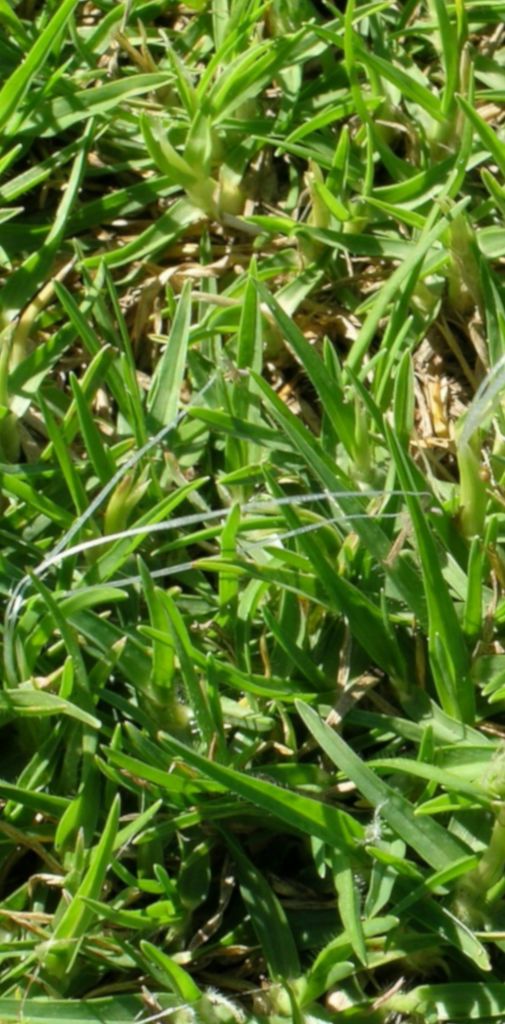
Left unmown, kikuyu knits itself into a thick evergreen mat four to six inches deep, creeping outwards on strawberry-like runners that root wherever a node touches soil. Kikuyu grass (Pennisetum clandestinum) can replace a traditional lawn or feed grazing stock, but only in full sun where winters stay mild — meet that and watering becomes almost unnecessary.
| Name | Pennisetum clandestinum |
|---|---|
| Synonym | Cenchrus clandestinus |
| Family | Poaceae |
| Type | grass |
| Height | 2 to 4 inches (5 to 10 cm) |
| Exposure | full sun |
| Soil | ordinary |
| Foliage | evergreen |
| Moisture | dry to swampy (all) |
Extremely easy to care for and with quick growth and spread, this turf plant is perfect to replace grass in a lawn or dress a bare patch up.
Take note, though, that you’ll need to live in a region where the climate is mild in winter.
In spring, sow in much the same manner you would any type of grass used for traditional lawns.
Kikuyu grass is very easy to propagate through cuttings or simply by transplanting it.
Kikuyu turf also sends runners out as it spreads, like strawberries. Planting kikuyu runners is very easy and all you need to do is layer a grass node into a nursery pot. It will sprout roots and spread from there. You can also direct the runners to maximize coverage since secondary runners will appear and make the plot denser.
Kikuyu can be started from seed, from a piece of rhizome, or from the runners the turf sends out as it creeps. Here is what each method asks of you.
| Method | Best time | What you plant | Watering at the start |
|---|---|---|---|
| Sowing seed | Early spring to late spring | ⅓ to ½ oz (10 to 12 g) of seed to a square yard (1 m²) | Water regularly until seeds sprout, then a few weeks more; germination takes 10 to 14 days |
| Rhizome cutting or transplant | Mid-spring to late spring | A portion of the rhizome dug out and settled in where you want it | Water often at the beginning |
| Runners (stolons) | Whenever the turf is sending runners out | A grass node layered into a nursery pot, or runners directed across the plot | Keep moist while roots form, as for cuttings |
Whichever route you take, growth is slow at first and then very fast indeed.
Note that if left untouched, kikuyu grass will grow into a thick mat several inches thick (4 to 6 inches or about 10 to 15 cm).
Rake up the clippings: any node left lying on the soil can root.
Mow kikuyu low and often, roughly 20–40 mm, to curb its vigour and thatch; its strong stolons and rhizomes let it recover from scalping, though severe scalping can leave temporary brown patches.
Run a strimmer or a half-moon edger along beds, paths and borders, since the runners creep over low edging and root on the far side.
Kikuyu doesn’t absolutely need fertilizer. It will grow well in any type of soil.
Only fertilize spots that need support. If you fertilize your whole lawn, you’ll simply end up with much more mowing to do!
Kikuyu grass gives you a solution against dry spells, foot traffic and watering.
Used for decades in Mediterranean regions in places where foot traffic was high, this grass native to tropical areas is slowly gaining popularity. It is definitely a very interesting alternative to traditional lawn grasses.
Extremely easy to care for and with quick growth and spread, this plant is perfect for gardens located in areas where the climate is rather hot in summer and mild in winter.
Its resilient rhizomes overcome drought very easily and also cope well with otherwise difficult spots such as coastlines.
For farms and homesteads, kikuyu is a great grass for grazing animals, since it grows back quickly and copes well with trodding. Animals can walk all over it with their heavy hooves and it will bounce back quickly. Cows, goats, and lambs love eating kikuyu grass for fodder. Nutrient analysis shows that kikuyu is more nutritious than alfalfa. As with many grasses, it developed an affinity to the droppings of grazing animals, and this results in interesting poop mounds in fields and pastures.
To sum it up:
However, apart from these numerous advantages, kikuyu grass does present several disadvantages:
Note: in some places, Kikuyu is invasive. You should not plant it. Check with your local agriculture office first.
Because the runners creep sideways into beds and under paths, keep a spade-cut edge or a deep barrier along borders to stop kikuyu escaping.
Kikuyu spreads from stolon fragments, since a single node can take root, so while ordinary mower clippings are mostly leaf blade and usually safe, dry out or hot-compost any material containing runners.
Its dense mat builds up thatch over time, so scarify or dethatch when the turf starts to feel spongy underfoot.
Although native to the entire East Africa area, kikuyu grass was first studied and imported to the USA from Kenya, in the center of that region. The US Department of Agriculture acclimated kikuyu grass in North America a little over a century ago, in 1915. Interest in it was spurred by the fact that it is well-suited to golf terrains, especially the wide spans of rough. It doesn’t need much watering, and copes well with dry air, which made it ideal for California at the time.
Australian strands of the grass, however, were originally sourced from the Belgian Congo in 1908 (present-day Congo). Government customs intercepted a packet of unmarked seeds sent from there for quarantine. A local botanist grew the plant to identify it. He then collaborated with an Australian university to make the new, amazing grass available throughout the continent as fodder and lawn material.
As a result, sometimes the plant’s origin is said to be Uganda – right in the middle of Congo and Kenya!
The “Kikuyu” people, a prominent tribe that excelled in agriculture and had deep knowledge of nature, inspired the name for the plant.
Since then, landscapers have sown it in many areas around the planet. Sometimes it even spreads so fast, it has become invasive!
Even though it rarely produces flowers and seeds, kikuyu grows very quickly through rhizome (or root) propagation. Moreover, in many mild and cool climates, temperatures are never hot enough to trigger blooming. This characteristic helps control its invasiveness a bit. Indeed, no dormant seeds will sprout back, as long as all roots and rhizomes are diligently pulled out.
Note that you might confuse this grass with St Augustine (which you’ll find under the name Stenotaphrum secundatum in horticulture stores). St Augustine grass is thinner-leaved and doesn’t resist drought or foot traffic well.
Crushed blades of kikuyu grass are slightly astringent. You can apply them on small cut wounds to help stop blood flow.
Kikuyu grass is an excellent barrier to block spread of weeds!
Kikuyu will smother any other weed that might grow on a lawn, like clover for instance.
Credits for images shared to Nature & Garden (all edits by Gaspard Lorthiois):
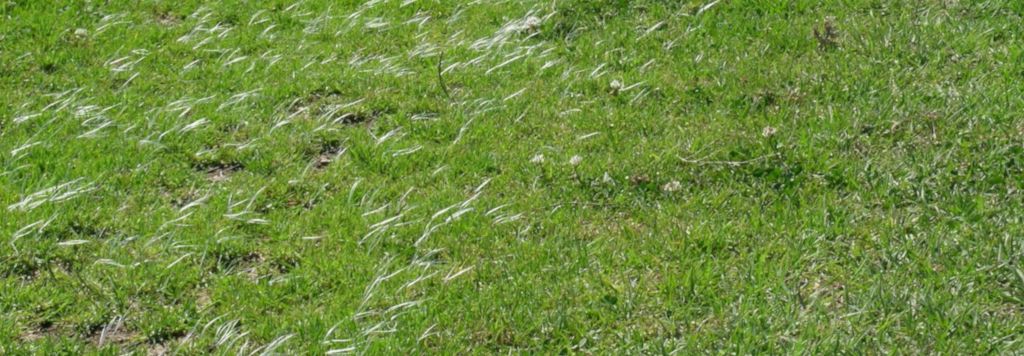
Close-up of kikuyu grass by Harry Rose ★ under © CC BY 2.0
Kikuyu grass lawn by Harry Rose ★ under © CC BY 2.0