
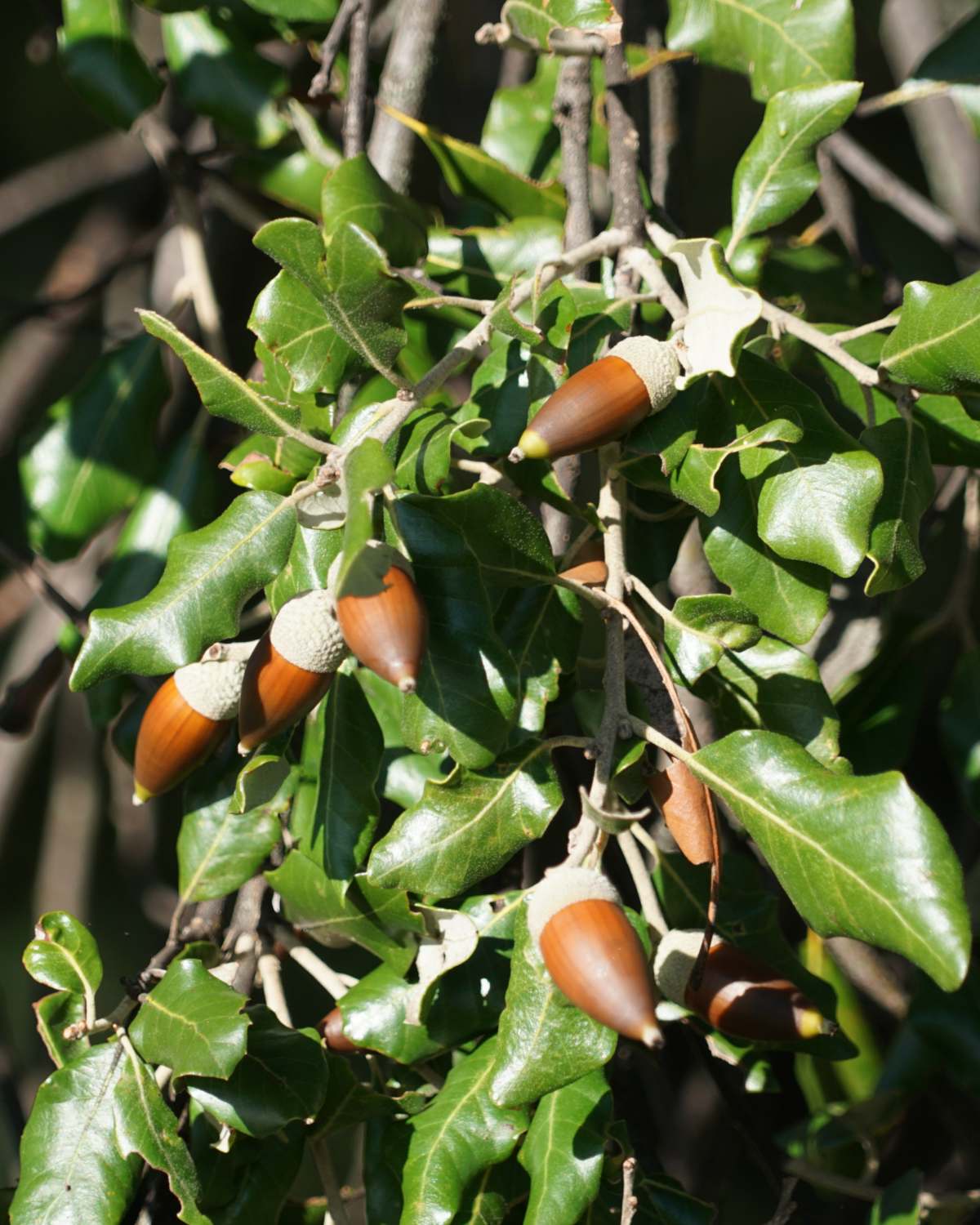
Small leathery leaves, glossy dark green above and whitish underneath, stay on the branches right through winter. Native to the Mediterranean, evergreen oak (Quercus ilex) makes a manageable shade tree of 30 to 50 feet that even shrugs off sea spray — give it full sun and well-drained soil and it asks for almost nothing.
| Name | Quercus ilex |
|---|---|
| Family | Fagaceae |
| Type | tree |
| Height | 30 to 50 feet (10 to 15 meters) |
| Exposure | full sun |
| Soil | well drained, rather chalky |
| Foliage | evergreen |
| Flowering | April to May |
| Harvest | September-October |
It’s a variety of oak tree usually found around the Mediterranean.
Evergreen oak is preferably planted in fall, before the first frost spells. The best timing is in the middle of November.
It is also possible to plant evergreen oak in spring if purchased in a container, but then you must be in a position to water it all summer long the first year.
Choose an isolated place, not too near the house because this oak can grow to be quite sizeable when fully mature. It is, however, on the smaller side for oak.
Although evergreen oak growth is usually a slow grower, growth accelerates if planted in the appropriate manner and watered often.
To really speed up its growth, just cut off flowers in spring and acorns after that, so that all the sap and nutrients are directed towards your evergreen oak’s growth.
This is a tree that requires virtually no care at all, when correctly settled in.
For this to happen, you must ensure the best planting environment and regular watering over the first year after planting.
Evergreen oak doesn’t need to be pruned, but it helps to remove dead branches regularly.
On the plus side, evergreen oak does cope very well with any type of pruning, so you can shape it as tall and as wide as you wish. Although you shouldn’t go about hatracking trees, this species won’t suffer from it in the least.
Since evergreen oak does have a very nice silhouette, do try to keep it while pruning.
Timing is what makes the difference between a slow, sulking tree and one that settles in quickly. Here are the jobs the article describes, and the window for each.
| Job | Best timing | Key point |
|---|---|---|
| Planting a bare-root or standard tree | Autumn, ideally mid-November | Get it in the ground ahead of the first frosts |
| Planting a container-grown tree | Spring | Only if you can water right through the first summer |
| Pruning and shaping | End of winter or autumn | Any type of cut is tolerated; keep the natural silhouette |
| When not to prune | Frost spells and hot summer weather | Avoid cutting if freezing may follow within days |
Removing dead branches is the only regular task once the tree is established.
Evergreen oak, or Quercus ilex, is a species of the oak family, liked for its evergreen, cute-shaped, shiny leathery leaves that are dark green on the topside and whitish on the underside.
Evergreen oak is native to all around the Mediterranean area. Its hardiness, down to 5°F (-15°C) explains why it also survives along the Atlantic coast.
When not in the Mediterranean area, it will definitely need a lot of sun.
A common presence in scrublands together with juniper and Aleppo pine, evergreen oak also helps stabilize sand dunes along the Atlantic coast. Indeed, its powerful root system lets it dig deep for water. It is thus very good at reinforcing fleeting, crumbling soils such as dunes and gravel-like slopes.
In places like Corsica, evergreen oak acorns are fed to pigs which gives local meat a distinctive and famous taste.
Lastly, evergreen oak is also is also used to grow truffles.
Evergreen oak is particularly resistant to most diseases, insects and pests. It has an incredibly long lifespan, in some cases estimated to be over 1,500 or even 2,000 years.
Evergreen oak is ideal to hide yourself from your neighbors, without climbing so high, but check local regulations because it must usually be planted at least 6 ½ feet (2 meters) from the property marker.
Your comment is awaiting moderation.
I have a wall at the bottom of my lane with about 30 ft longth and 25 feet wide of clay.
I would like to plant Quercus ilex evergreen oak in the middle of the clay. But someone said the roots would distroy my wall.
I am trying to plant trees native to Ireland.
Thanks for your help