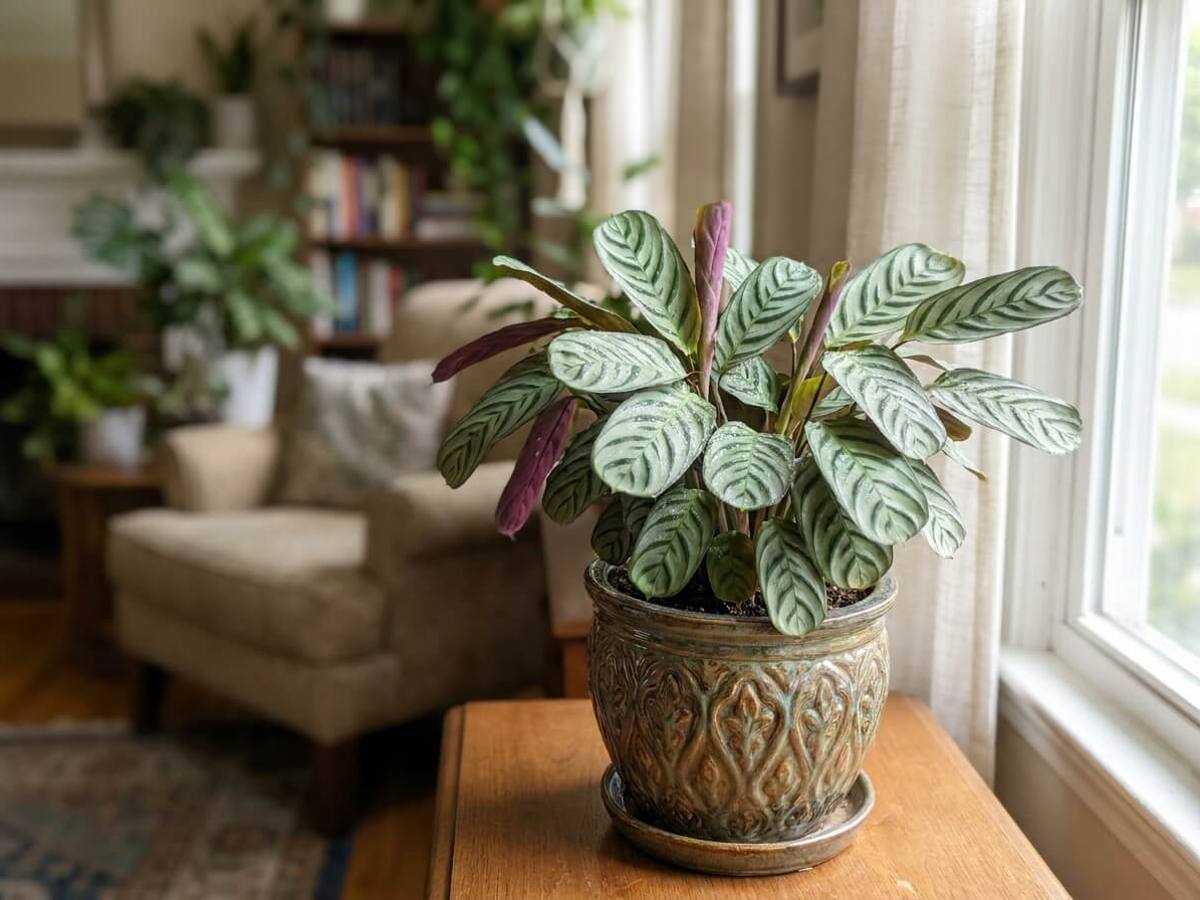
Ctenanthe burle-marxii is a low, spreading foliage plant from the Brazilian Atlantic forest, grown for leaves that look as though someone has painted dark green herringbone stripes onto pale silver-green silk. Indoors it forms a dense, ground-covering clump that softens the base of taller houseplants, whilst in frost-free gardens it makes a handsome shade carpet. Its most endearing habit is nyctinasty: the leaves lift and fold upwards each evening, then relax again by morning.
Growing conditions
This is a forest-floor plant, and it behaves like one. Give it bright but filtered light — an east-facing windowsill, or a metre or so back from a south-facing window behind a sheer curtain. Direct midday sun bleaches the silver banding to a dull yellow and scorches the leaf edges within days.
Soil should be open, humus-rich and moisture-retentive at the same time. A mix of two parts peat-free multipurpose compost to one part fine orchid bark and one part perlite gives the balance it wants. It prefers a slightly acidic to neutral pH, roughly 5.5–6.5, and dislikes limy, free-draining chalk soils outdoors.
Warmth and humidity matter more than anything else: aim for 18–26 °C and relative humidity above 55 per cent. In cool temperate regions treat it strictly as a houseplant or conservatory subject; only in frost-free subtropical gardens can it be grown outdoors year-round, in deep shade beneath trees.
How to plant Ctenanthe
Plant or repot in mid-spring, just as light levels rise and new shoots begin to unfurl from the rhizome. Root disturbance at this point is recovered from quickly; the same operation in autumn often leads to months of sulking.
Spacing: set plants 40–50 cm apart in a shade bed so the clumps knit together within two seasons without competing for moisture.
Depth: keep the rhizome just below the surface, with the crown and leaf bases sitting level with the compost — burying the crown invites rot.
Soil preparation: fork in generous leaf mould or composted bark before planting; this holds moisture whilst keeping air around the fine roots.
Watering in: water thoroughly with tepid rainwater and let the surplus drain away completely, never leaving the pot standing in a saucer of water.
Propagation: divide established clumps in late spring, teasing off sections with at least three leaves and a length of rhizome, then keep them warm, shaded and humid for a fortnight.
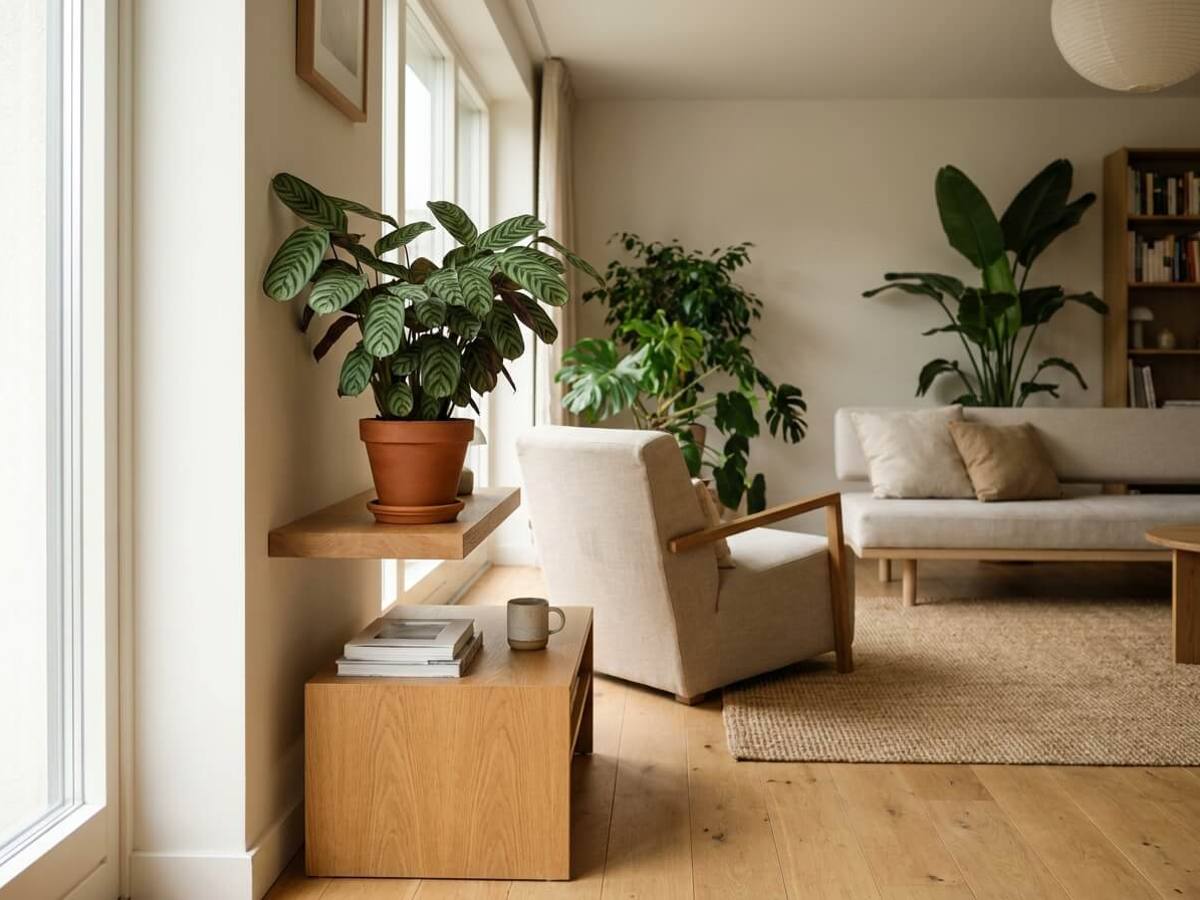
Ctenanthe burle-marxii displayed as a houseplant in a home interior
Care through the seasons
Spring: Resume regular feeding as new leaves appear, using a balanced liquid houseplant feed at half strength every third watering. This is the moment to divide congested clumps or move plants up one pot size. Remove any leaves that browned over winter by cutting the stalk right back to the base.
Summer: Keep the compost evenly moist but never sodden — check by pushing a finger 2 cm in and watering when it feels barely damp. Mist in the morning, stand the pot on a tray of damp expanded clay, or group plants together to raise local humidity. Shade from strong glass-magnified sun, and watch for red spider mite during hot, dry spells.
Autumn: Reduce feeding from mid-September and taper watering as growth slows. Bring any plants summering outdoors back under cover well before night temperatures fall below 12 °C. Top-dress with fresh compost rather than repotting, and clean dust from the leaves so they make the most of weaker light.
Winter: Growth virtually stops; water sparingly, allowing the top third of the compost to dry between waterings, and keep the plant away from radiators, draughty doors and cold window glass.
Best varieties to grow
Few named cultivars exist, but the selections below — plus two closely related ctenanthes often sold alongside — cover the range of foliage effects.
Ctenanthe burle-marxii ‘Amagris’ — the most widely sold form, with notably pale, almost silver-grey leaves and crisp dark green chevrons.
Ctenanthe burle-marxii ‘Obscura’ — darker, deeper green overall with a subtler fishbone pattern and strongly purple leaf undersides.
Ctenanthe lubbersiana ‘Golden Mosaic’ — a taller relative, to 75 cm, splashed irregularly with butter-yellow; useful for a brighter corner.
Ctenanthe setosa ‘Grey Star’ — upright, large-leaved and silvery, good where you want height rather than a spreading carpet.
Pests, diseases and common problems
Red spider mite: fine stippling, dull bronzed leaves and gossamer webbing between leaf stalks, worst in dry heated air. Raise humidity sharply, rinse the undersides of leaves weekly and introduce Phytoseiulus persimilis as a biological control.
Brown, crisp leaf margins: usually caused by low humidity, or by fluoride and salts in tap water accumulating at the leaf edge. Switch to rainwater or cooled boiled water, and flush the compost through thoroughly every couple of months.
Root and rhizome rot: yellowing lower leaves, a sour-smelling compost and collapse at the base, caused by cold, waterlogged compost. Unpot, cut away blackened rhizome with a sterilised blade, repot into fresh gritty mix and keep warmer and drier until recovery.