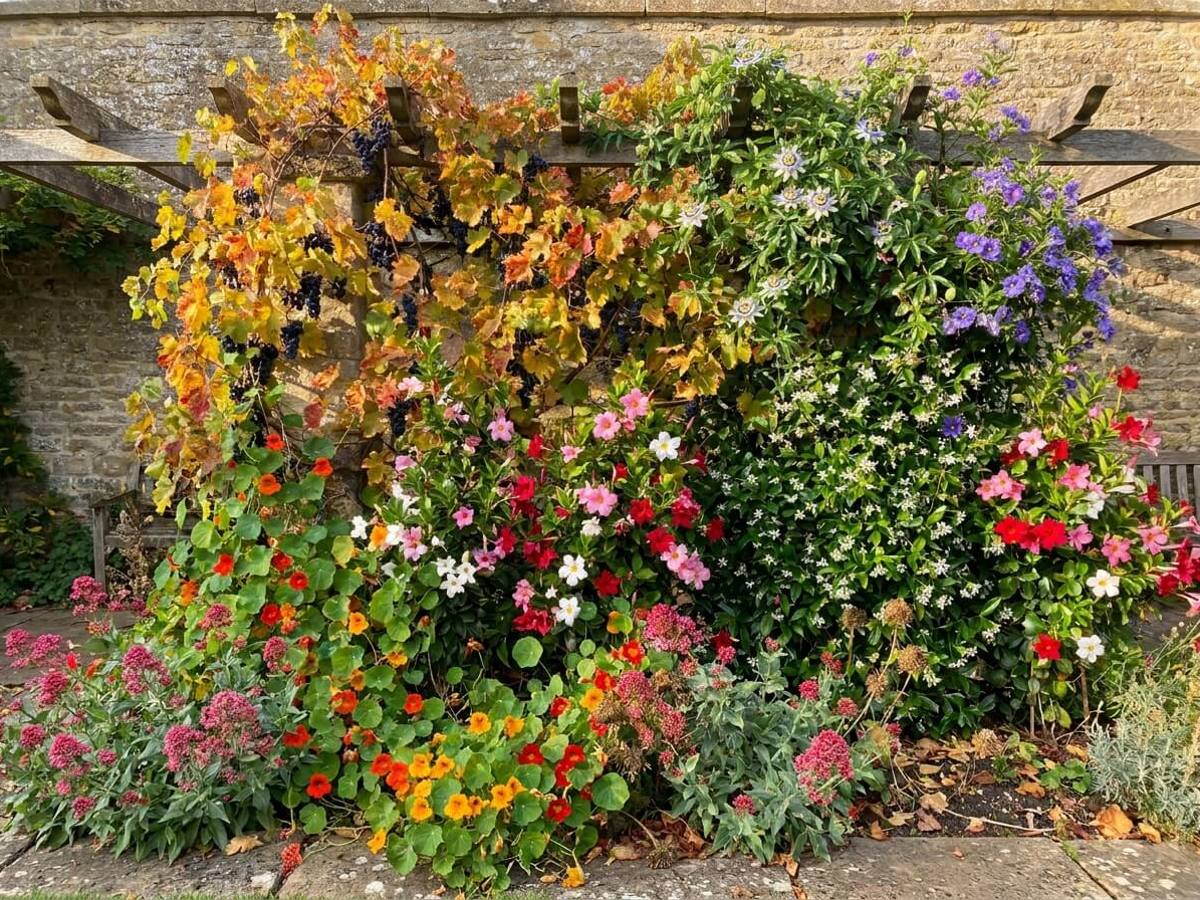
A south-facing wall or an open pergola in full sun is one of the hottest, driest spots a garden offers. The brickwork or timber stores heat all day and releases it at night, the soil at the foot of the wall sits in a rain shadow, and by late summer most climbers have flowered themselves out and look tired just as the light turns golden. A good autumn scheme layers plants that keep going until the first frosts, backed by something with foliage or fruit that earns its place when the flowers finally stop.
From back to front: Grapevine, Blue Passion flower, Solanum, Star jasmine, Mandevilla and dipladenia, Climbing nasturtium, Devil’s beard.
Start with the Grapevine as the permanent framework over the top of the pergola or along the highest wires on the wall. Its broad leaves cast useful shade through the summer heat, then colour to amber, russet and crimson through autumn while bunches hang below the canopy. Because it is pruned hard each winter, it never smothers the lighter climbers trained beneath it, and the bare winter framework lets low sun reach the plants below.
Trained up the warmest section of the wall, Blue Passion flower carries its intricate blue and white blooms right through autumn, often alongside egg-shaped orange fruits. The fine, deeply lobed leaves read as texture rather than mass, so it contrasts well with the broad hand of the grapevine above. Give it its own panel of wires rather than letting it twine into its neighbours, as its tendrils grab anything within reach.
For sheer length of flowering, Solanum is hard to beat on a hot wall, producing clusters of starry flowers from early summer until the frosts cut it back. Its growth is loose and scrambling, so it fills the awkward gaps between more rigid climbers and softens the hard edge where wall meets pergola post. Set it to one side of the Blue Passion flower so the two sets of star-shaped blooms echo each other without competing for the same wires.
Star jasmine is the evergreen anchor of the scheme, clothing the lower two-thirds of the wall with glossy dark leaves that stay put all winter. Its main flush is early, but in autumn the foliage takes on bronze and red tints that pick up the colour of the grapevine overhead. Use it to cover the stretches of wall that the deciduous climbers leave bare from November onwards.
Grown in large pots at the foot of the pergola posts, Mandevilla and dipladenia bring trumpet flowers in hot pink, red or white that keep opening steadily until the nights turn cold. The thick, waxy leaves look fresh at a point in the season when many climbers have gone shabby. Pots mean you can move them into shelter before the first frost, which is the only practical way to keep them from one year to the next in a cold garden.
Sow Climbing nasturtium in late spring and it will scramble up through the lower climbers, saving its best display for late summer and autumn when the heat eases. The round, blue-green leaves and hot orange, yellow and red flowers fill gaps that no permanent planting could occupy. It asks for poor, unimproved soil, which suits the dry strip at the base of a sunny wall perfectly.
At the very front, Devil’s beard edges the planting with clouds of pink or white flowers on wiry stems. Cut it back after the first flush and it repeats generously into autumn, tying the base of the wall to the path or paving. It seeds itself happily into cracks and gravel, which is exactly what you want where the soil runs dry and thin.
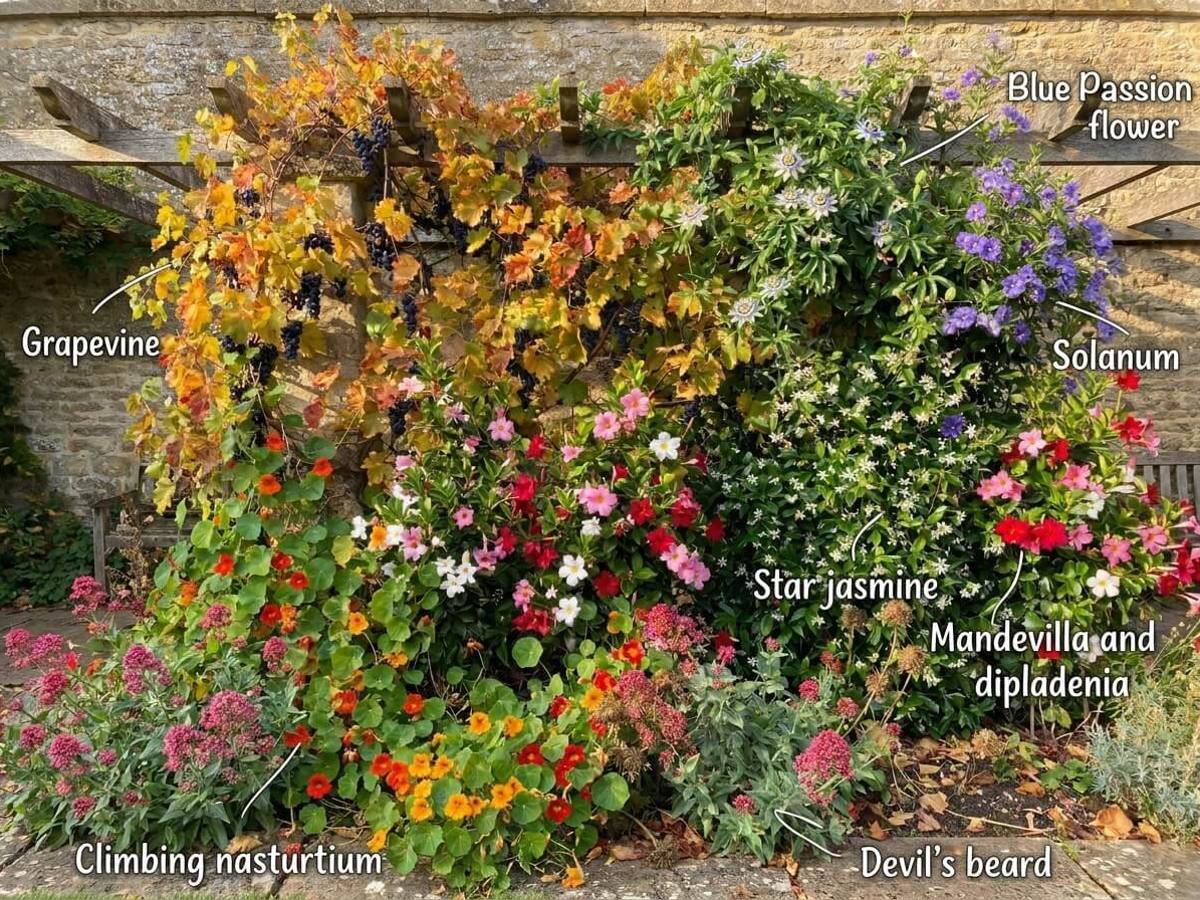
Plant the Grapevine first, about 40 cm out from the wall or beside a main pergola post, and train it along the top of the structure. Space the Blue Passion flower and Solanum roughly 2 m apart along the wall, each with its own panel of wires or trellis, with Star jasmine set between and in front of them at around 1.5 m intervals to cover the lower wall. Stand the pots of Mandevilla and dipladenia at the base of two or three pergola posts, sow Climbing nasturtium in small groups of three or four seeds at the foot of the climbers in late spring, and plant Devil’s beard in drifts of three to five along the front edge, 40 cm apart.
In spring the Star jasmine holds the wall together while the Grapevine breaks bud and the Devil’s beard opens its first flowers. Early summer brings the scented flush of Star jasmine and the first flowers on Solanum and Blue Passion flower, with the Mandevilla and dipladenia pots coming into their own as the heat builds. Autumn is the peak: passion flowers and their orange fruits, trumpet flowers still opening, Climbing nasturtium pouring through the lower growth, a second wave of Devil’s beard, and the Grapevine turning red above it all. Once the frosts arrive the annuals go and the pots move under cover, leaving the evergreen Star jasmine and the pruned framework of the Grapevine to carry a clean, structural outline through winter.