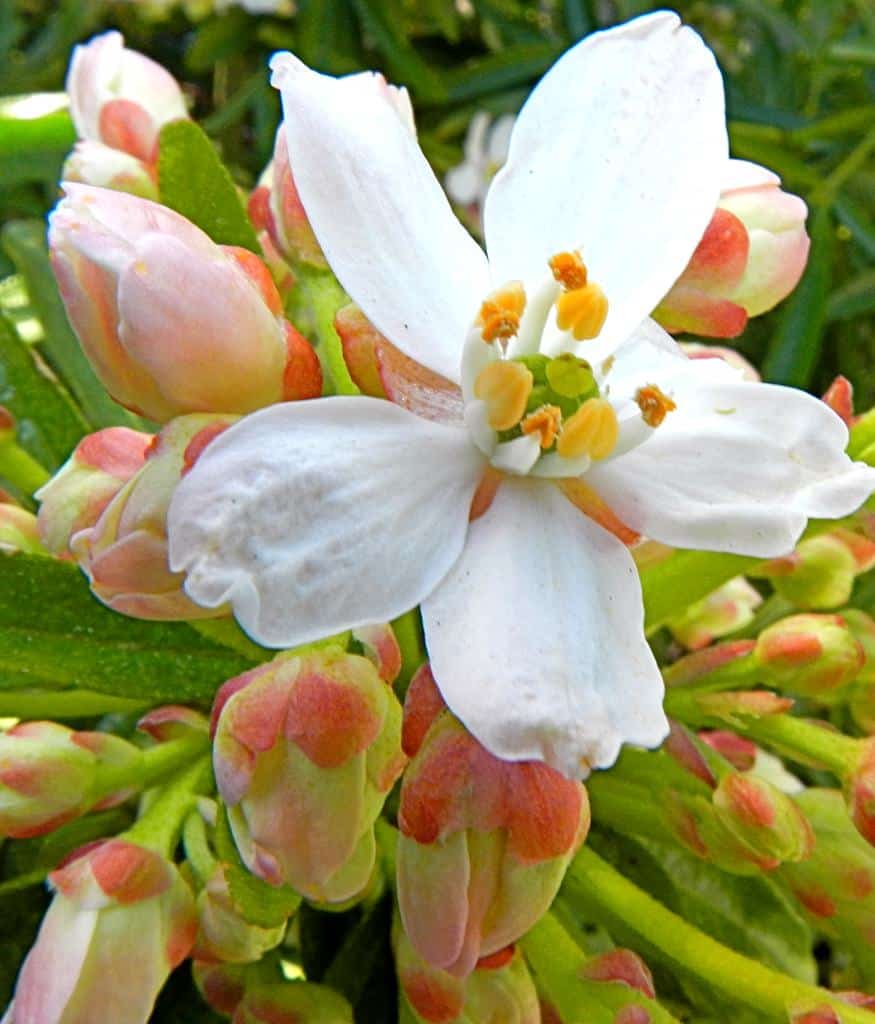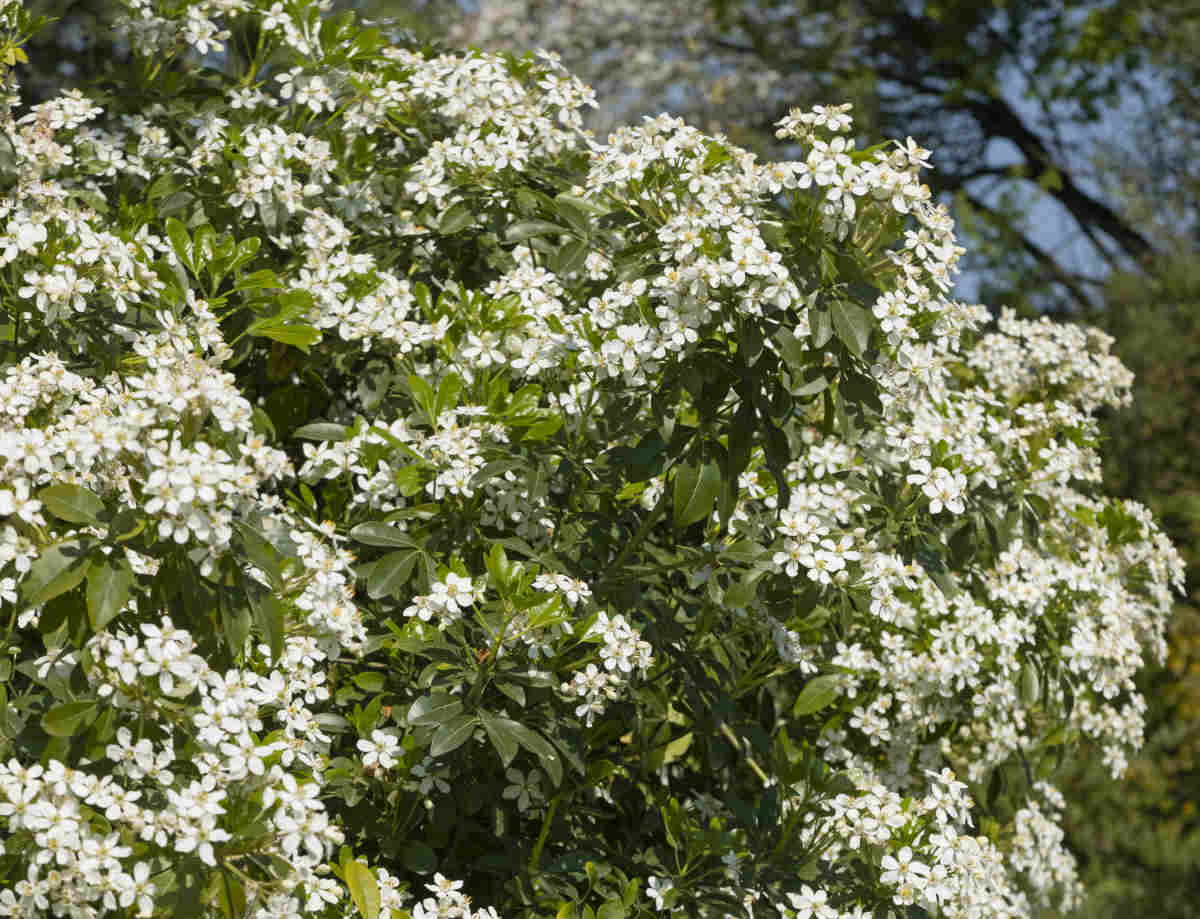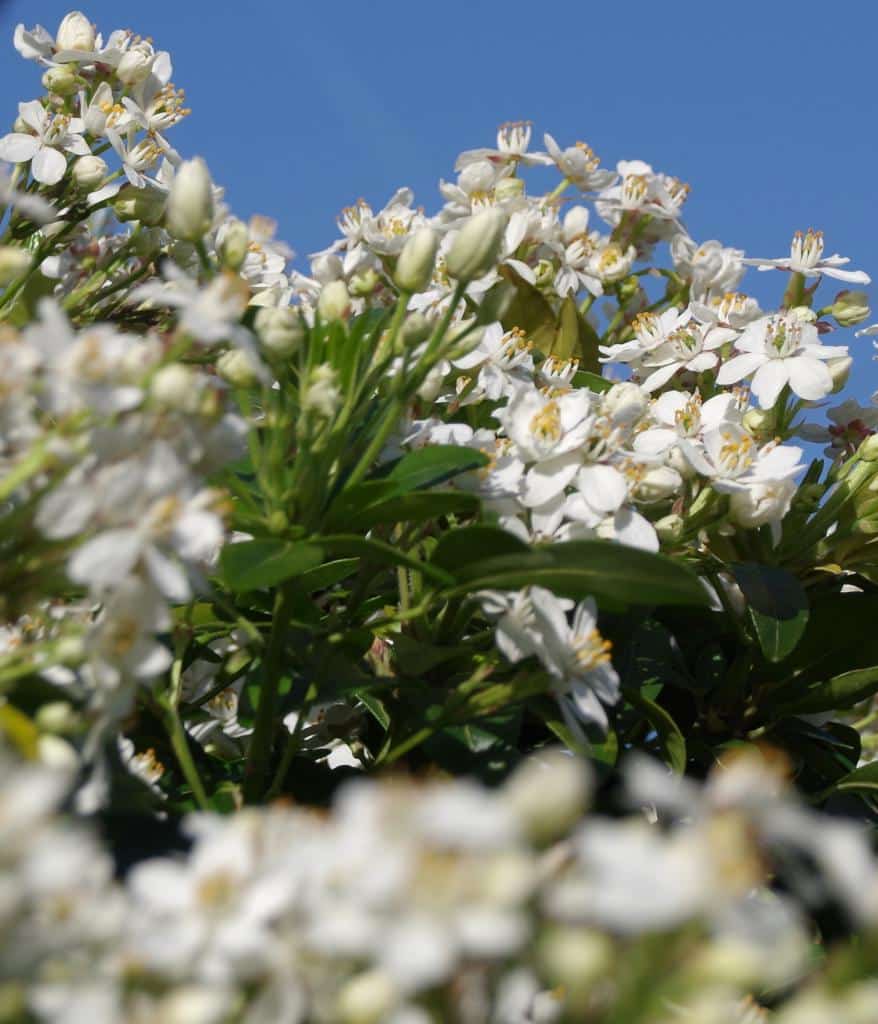
Small white flowers scented like orange blossom cover a dense mound of evergreen leaves from April to June. The Mexican orange blossom (Choisya ternata) works equally well as a hedge, a flower bed shrub or a pot on a terrace, and asks for little more than full sun to bloom generously.
| Name | Choisya ternata |
|---|---|
| Family | Rutaceae (Rue family) |
| Type | shrub |
| Height | 6 to 10 feet (2 to 3 meters) |
| Exposure | full sun |
| Foliage | evergreen |
| Flowering | April to June |
Here are our tips to spur nice growth and spectacular blooming.
It is preferable to plant Choisya ternata in spring or in fall rather than in winter when freezing might risk damaging your shrub.
If purchased in a pot or in a container, planting is also possible anytime during the year while avoiding frost spells and high temperatures.
Right from the start, especially if you’ve planted in spring or summer, water abundantly and regularly, albeit without flooding the roots of the shrub.
Choisya ternata resents waterlogged ground, so pick a free-draining spot and work grit or coarse sand into heavy clay before planting.
Choisya ternata, whether standalone, part of a hedge or in a flower bed doesn’t require any particular pruning.
But it is often nice to succeed in giving it a nice shape, especially when it is part of a hedge.
Cut a leggy, bare-based plant hard back into old wood, as Choisya resprouts willingly.
Cuttings are the best way to propagate your Choisya ternata. This will ensure its traits are preserved (blooming, leaf size, growth habit).
Choisya ternata varieties such as ‘Aztec Pearl’ or ‘Sundance’ and others make for very easy growing and it has the advantage of never growing taller than 6 to 10 feet (2 to 3 meters) tall, which means regular pruning isn’t necessary.
Here are commonly available Choisya ternata varieties (click on the image to be brought to the page):
Garden centres stock a handful of Mexican orange blossoms that differ mainly in leaf colour, leaf shape and bulk. This table sets the common ones side by side so you can match the plant to the spot.
| Variety | Foliage | Flowers | Size band | Best for |
|---|---|---|---|---|
| ‘White Dazzler’ (Londaz) | Fine narrow green leaflets | Masses of white, scented | Dwarf to medium | Containers, low informal hedge |
| ‘Aztec Pearl’ | Narrow dark green leaflets | Pink-flushed buds, white flowers | Medium | Airy texture, sun or part shade |
| ‘Sundance’ grown clipped | Yellow, dense after clipping | Few, white | Medium | Low formal gold hedge, prune after flowering |
| ‘Aztec Gold’ | Narrow golden-yellow leaflets | White, scented | Dwarf to medium | Year-round colour in small gardens |
| ‘Sundance’ | Bright yellow, greener in shade | White, sparse | Medium | Light against dark shrubs; shelter from scorch |
| ‘Goldfingers’ (Limo) | Slender bright yellow leaflets | White, scented | Dwarf to medium | Pots and gravel plantings in sun |
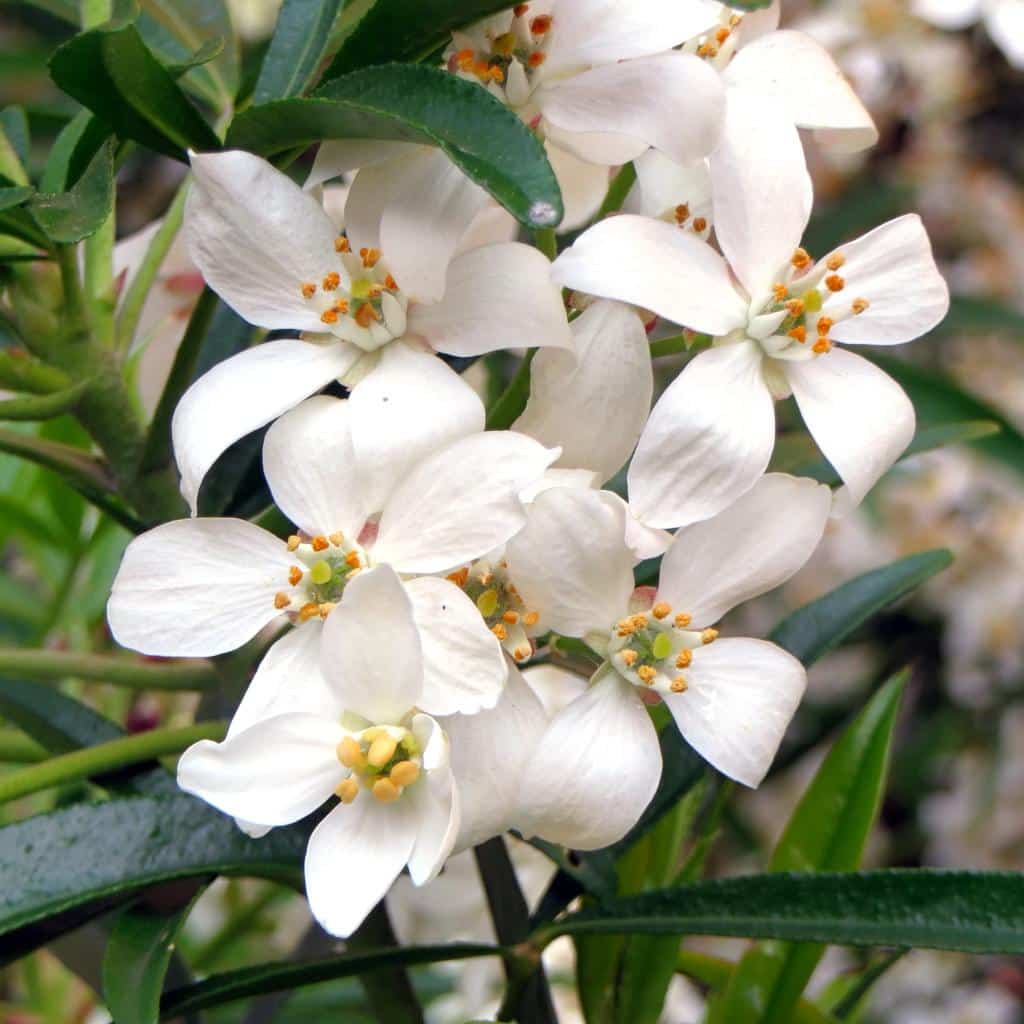
A very beautiful shrub with a fragrance that is close to that of orange trees, a dense shape and magnificent blooming, Choisya ternata, also called Mexican orange tree or Mexican orange blossom is native to that North American country.
Even if you let the shrub grow without ever pruning it, it will never grow higher than 10 feet (3 meters) high.
The flowers, similar to those of the orange tree, are very fragrant. This shrub adapts very well to growing directly in the soil, and also to growing in pots on a terrace or balcony.
Apart from the planting and the following weeks, there is no need to water excessively because the Choisya ternata tree doesn’t need it.
Every task this shrub asks for has its own moment in the year, and getting the timing wrong mostly costs you flowers. Here is the whole cycle at a glance.
| Task | When | What to do |
|---|---|---|
| Planting in the ground | Spring or autumn | Avoid winter, when freezing may damage the shrub |
| Planting a potted plant | Any time of year | Skip frost spells and spells of high temperature |
| Watering | Planting time and the weeks after | Water abundantly and regularly, without flooding the roots |
| Pruning | June, after flowering | Never at the end of winter, or the blooming suffers |
| Taking cuttings | August | Cut 4 to 6 inch (10 to 15 cm) stems, keep only the top third of leaves |
| Transplanting rooted cuttings | The following spring | Move on to a larger pot or plant out in the ground |
Keep to this rhythm and the shrub needs almost nothing else from you.