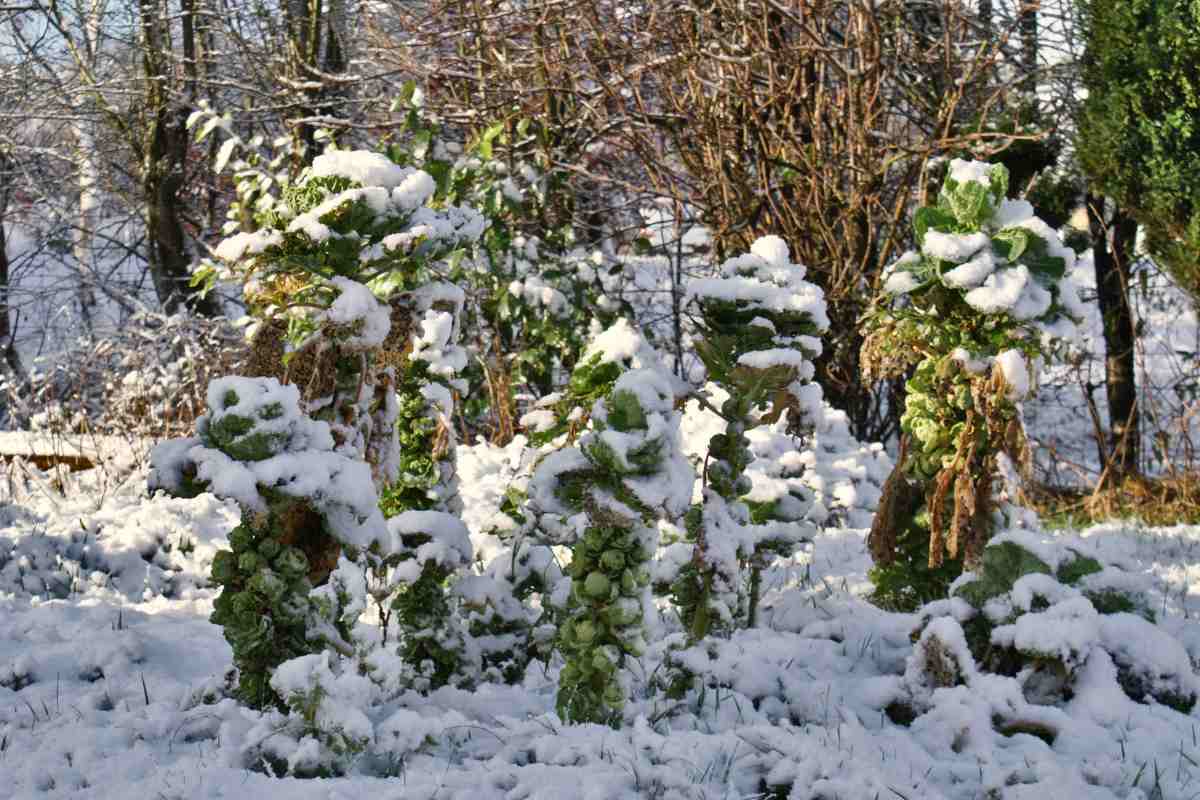
Winter is a season often associated with cabbages and cauliflowers… why not make the most of the season and add brussel sprouts to the list! Here is how to make sure you can harvest Brussels sprouts in winter.
Read also:
The key to being able to harvest brussel sprouts in fall, winter and spring is to stage your sowing. Don’t sow all your seeds at once! Ideally, you would sow brussels sprout seeds in at least three batches:
Of course, adding intermediate batches is even better, every fortnight. It will ensure you always have perfectly ripe brussels sprouts to harvest at any date from fall through winter to spring. But three batches is already a very good organization!
For sowing in early spring (fall harvest):
For sowing in mid-spring (winter harvest)
For sowing in late spring and later (end of winter, spring harvest)
Usually, the latest possible date to sow brussels sprouts and have them survive and bear sprouts is late summer.
Staging the sowing is what spreads the picking across the cold months. Each batch is sown differently and comes ready at a different point in the year.
| Sowing time | Where and how to sow | Next step | Harvest window |
|---|---|---|---|
| Early spring | Trays or nursery pots, indoors | Thin or repot to individual pots in mid-spring, then plant out once frosts have passed | End of summer into autumn |
| Mid-spring | Individual nursery pots | Thin and transplant to the growing bed after the last frost, in late spring | Autumn into winter |
| Late spring or later | Sown directly in the ground, in seed holes or along a row | Thin a month later, removing the least vigorous seedlings | Winter through to the following spring |
| Late summer at the very latest | Any method, as a final catch-up batch | Plants still have time to establish and form sprouts | Late season harvest |
Adding intermediate batches every fortnight simply fills the gaps between these three.
Varieties differ mainly in when they come ready and how long they stand through the cold, which is exactly what matters when you are picking in winter. The table below sets out the sprouts most often found on seed racks and in mainstream catalogues.
| Variety | Main harvest season | Sprout colour | Particular strength |
|---|---|---|---|
| Bosworth F1 | Mid to late | Green | Reliable cropper on exposed plots |
| Trafalgar F1 | Late | Green | Sweet flavour for midwinter picking |
| Long Island Improved | Mid to late | Green | Classic heirloom, compact habit |
| Jade Cross F1 | Early to mid | Green | Compact plants, heavy early set |
| Evesham Special | Mid | Green | Old British sort, long picking period |
| Churchill F1 | Early | Green | First sprouts of the season |
| Crispus F1 | Mid | Green | Clubroot resistance |
| Rubine | Late | Red-purple | Strong nutty flavour, looser sprouts |
Winter is a cold month, and you don’t want to spend more time outdoors than is necessary. Learn to identify when your brussels sprouts are ready so you’re not disappointed when you go out!
Except for extremely small or large brussels sprouts varieties, a good indicator of ripeness is the size. A ripe sprout is a little over an inch across (3 cm). For quick reference, take a ping-pong ball or a golf ball out with you. Any sprout that’s more or less the same size can be picked.