A rock garden in full sun is a hard place to be a plant: thin, gritty soil, fast drainage, heat reflected off every stone, and wind that dries leaves before the roots can catch up. By late summer, many rockery schemes have gone quiet, leaving a slope of handsome rock and not much else. A good autumn scheme leans on tough, sun-loving perennials that hold their shape through drought, then open their flowers just as everything else is winding down.
From back to front: Yarrow, Aster, Sage, Perennial geranium, Erigeron, Armeria, Gentiana.
Yarrow gives the scheme its back wall: flat-topped flower heads held well above fine, feathery foliage, carried on stems that stay upright in poor, stony ground. Left uncut after the summer flush, it will push a second, looser set of heads into autumn, and the dried heads that remain are worth keeping for their shape. Its horizontal flower plates are a useful contrast to everything rounded and mounded further forward in the bed.
Aster is the engine of the autumn display here, covering itself in daisy flowers in blue, violet, pink or white exactly when the rock garden needs colour most. Choose compact, bushy forms for a rockery rather than the tall border types, and plant them where the stones hold a little extra moisture at the root. Set behind the lower mats, the Aster reads as a cushion of colour rather than a line of stems.
Sage brings the evergreen weight that stops the scheme collapsing once the flowers fade. The grey-green, slightly woolly leaves sit beautifully against bare rock, take full sun without flinching and stay presentable all winter. Its matt texture also calms the busy flower shapes of the Aster and Yarrow on either side.
Perennial geranium knits the middle of the planting together, spreading into low, leafy cushions that smother gaps between stones. Many forms keep producing flowers in flushes into autumn, and the foliage of several takes on red and bronze tints as the nights cool. It is the plant that makes the scheme look furnished rather than dotted.
Erigeron flowers for an extraordinarily long season, sending out small white-to-pink daisies from early summer until the first real frosts. It self-seeds into joints and crevices, softening hard edges and steps without ever becoming heavy. Use it where the Sage and Perennial geranium meet the path, so the transition from bed to stone disappears.
Armeria forms tight hummocks of narrow, grassy evergreen leaves topped by round pink or white flower heads on wiry stems. It is thoroughly at home in dry, sharply drained grit, and a well-fed plant will repeat into autumn after a summer trim. The neat globes give a third flower shape alongside the plates of the Yarrow and the daisies of the Aster and Erigeron.
Gentiana belongs right at the front edge, where its deep, saturated blue autumn trumpets can be seen close up against pale stone. It is low, slow and particular, so give it a pocket of cool, gritty, well-drained soil that never bakes completely dry. Nothing else in the scheme matches that blue, and it is worth the extra care to have it flowering in October.
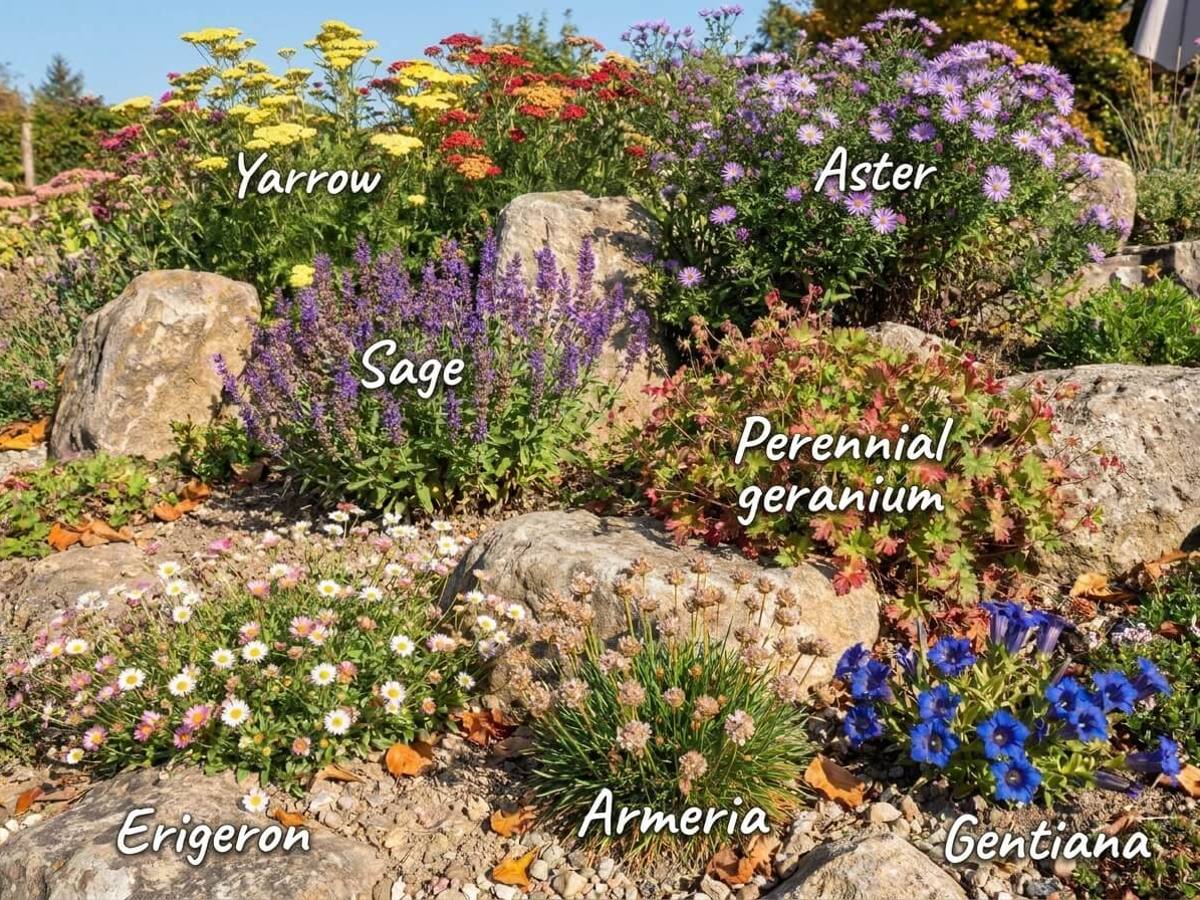
Work from the top of the slope down. Put three to five Yarrow at the back, 40–50 cm apart, with a drift of five to seven Aster just below them at around 40 cm spacing so they form one mass rather than separate clumps. Set three Sage in a loose triangle in the middle band, 50 cm apart, as evergreen anchors, and fill between and below them with five or more Perennial geranium at 35–40 cm. Along the front, alternate groups of three Armeria at 25 cm with patches of Erigeron tucked into crevices, and reserve the coolest, best-drained front pocket for three Gentiana planted 20 cm apart, where you will walk past them.
In spring the bed is mostly texture: grey Sage, grassy Armeria tufts, fresh Perennial geranium leaves and the ferny shoots of Yarrow, with the first Erigeron daisies opening by late spring. Summer brings the Yarrow plates, Armeria globes and a long run of Perennial geranium and Erigeron flower, while the Aster builds quietly in the background. Autumn is the peak: Aster in full colour, Gentiana blue at the front, Erigeron still going and Perennial geranium foliage turning. Through winter, leave the dried Yarrow heads standing and let the evergreen Sage, Armeria and bare rock carry the picture until the cycle starts again.