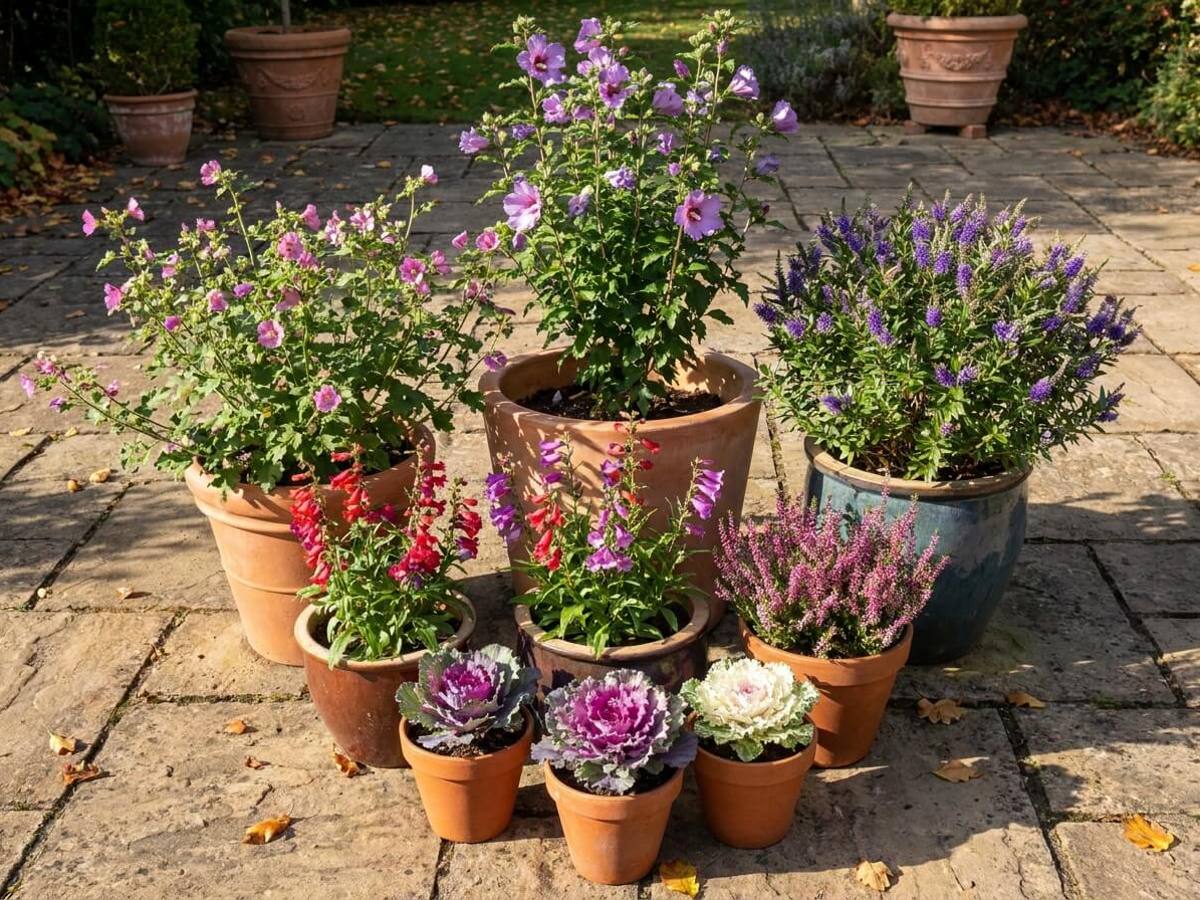
A patio or balcony that faces full sun is the brightest spot you own and the harshest. Pots heat up fast, roots dry out by mid-afternoon, and by September the summer bedding that carried you through July has gone leggy and tired. A good autumn scheme leans on woody plants that keep their shape, late-flowering perennials that peak just as the light turns gold, and one or two low, fresh things at the front to replace what has finished.
Pot by pot, tallest first: Hibiscus Althea, Cape mallow, Hebe, Beardtongue, Winter heather, Ornamental cabbage.
Hibiscus Althea is the backbone of the group and the only plant here that gives you real height, carrying wide open flowers on upright woody stems well into autumn. In a large pot it will stand about shoulder height, which is enough to break up a blank wall or a balcony railing without blocking the light. It loves the heat that bounces off paving, and because its canopy is open rather than dense, the pots set around its feet still get the sun they need.
Cape mallow throws out small pink mallow flowers almost without pause from spring until the first real cold, and in a sunny, sheltered corner it often keeps going past October. Its growth is airy and twiggy, with tiny leaves, so it reads as a soft cloud next to the heavier flowers above it. Place it just in front and slightly to one side of the tallest pot and the two bloom shapes echo each other at different scales.
Hebe brings the one thing the rest of the scheme lacks: a tidy evergreen dome that looks deliberate even with nothing in flower. Many types send up bottlebrush spikes in late summer and keep producing into autumn, and the neat ranked leaves hold their colour right through the cold months. Set it where the group needs weight and calm, between the loose Cape mallow and the lighter things at the front.
Beardtongue is the autumn worker of the set, sending up slim spires of tubular bells that carry on long after most perennials have given up, often until the first hard frost. The vertical spikes cut through the rounded shapes around them and give the middle of the group some movement in the wind. It is happiest in full sun with free-draining compost, so a pot suits it better than heavy border soil.
Winter heather takes over exactly as the rest begins to fade, opening its tiny bells from late autumn and holding them for months. Low, spreading and fine-textured, it sits at knee height and softens the hard rim of the taller pots. It is the insurance policy of the scheme: whatever the weather does in November, this one will still have colour.
Ornamental cabbage goes right at the front, where its ruffled rosettes of cream, pink or deep purple do the job of flowers without being flowers. The colour actually deepens as the nights get cold, so it improves through October and November while everything behind it slows down. Its broad flat form is the perfect full stop under all those upright stems and spikes.
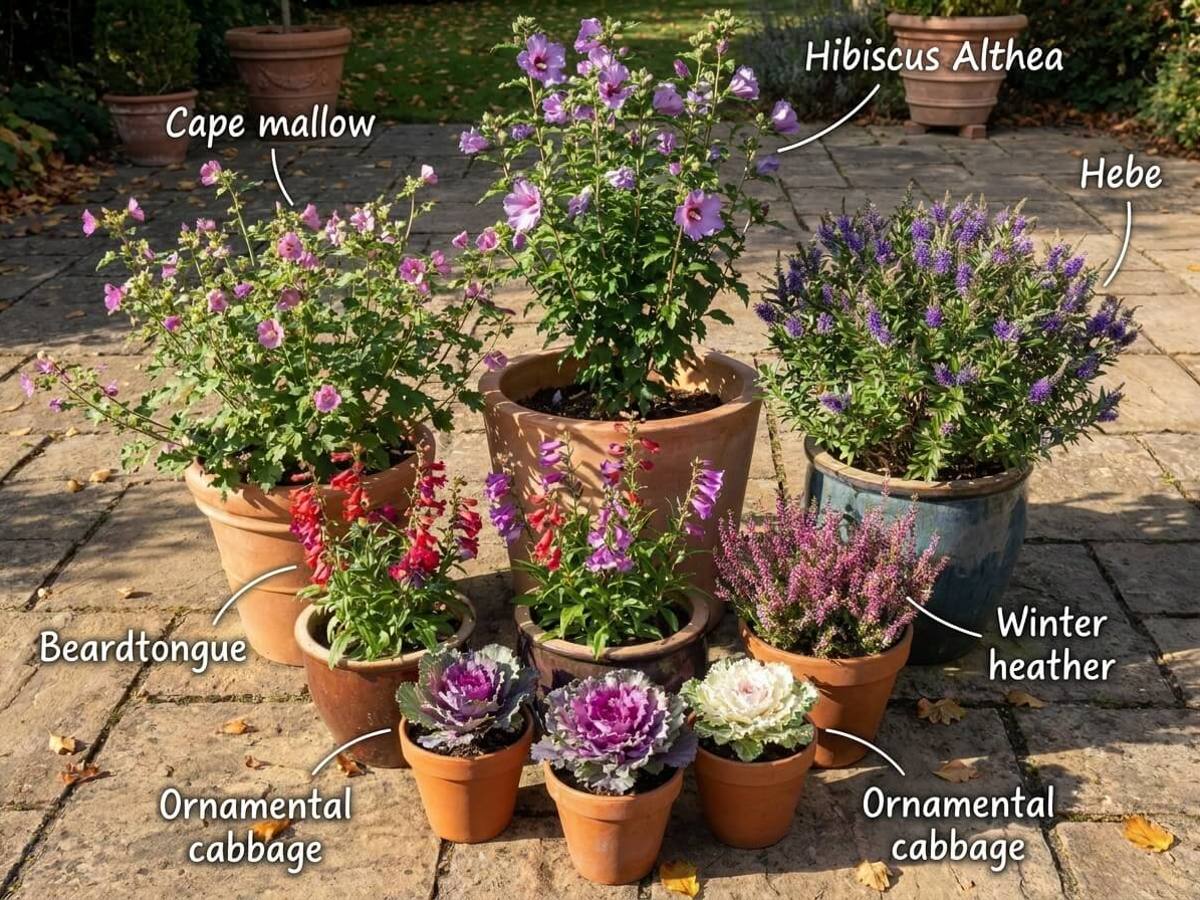
Give Hibiscus Althea a pot of about 50 cm across and stand it at the back, in the corner, where it can lean into the wall; water it deeply twice a week in warm weather and once a week from October. Cape mallow needs its own 40 cm pot in front of it, watered every two or three days in summer heat and weekly once growth slows. Hebe takes a 35 cm pot and Beardtongue a 30 cm pot, both set on the middle line, each watered twice a week while in flower. At the front, plant three Ornamental cabbage together in a 30 cm bowl, which they will fill completely, and keep Winter heather in its own 25 cm pot so you can control its compost and watering separately; both want a drink every two or three days, as shallow pots dry out fastest.
In spring the group is mostly green and structural, with Hebe and Winter heather holding the shape while Cape mallow starts its first flush and Beardtongue pushes up new stems. Summer is the loud season: Hibiscus Althea in full flower above, Cape mallow and Beardtongue carrying the middle, Hebe spiking in late summer. Autumn is the point of the whole scheme, with the last Hibiscus Althea blooms overhead, Beardtongue still going, and the freshly planted Ornamental cabbage colouring up at your feet. In the dead of winter nothing much is happening except Winter heather in flower and the evergreen mass of Hebe, and that is enough to stop the corner looking abandoned until the cycle starts again.