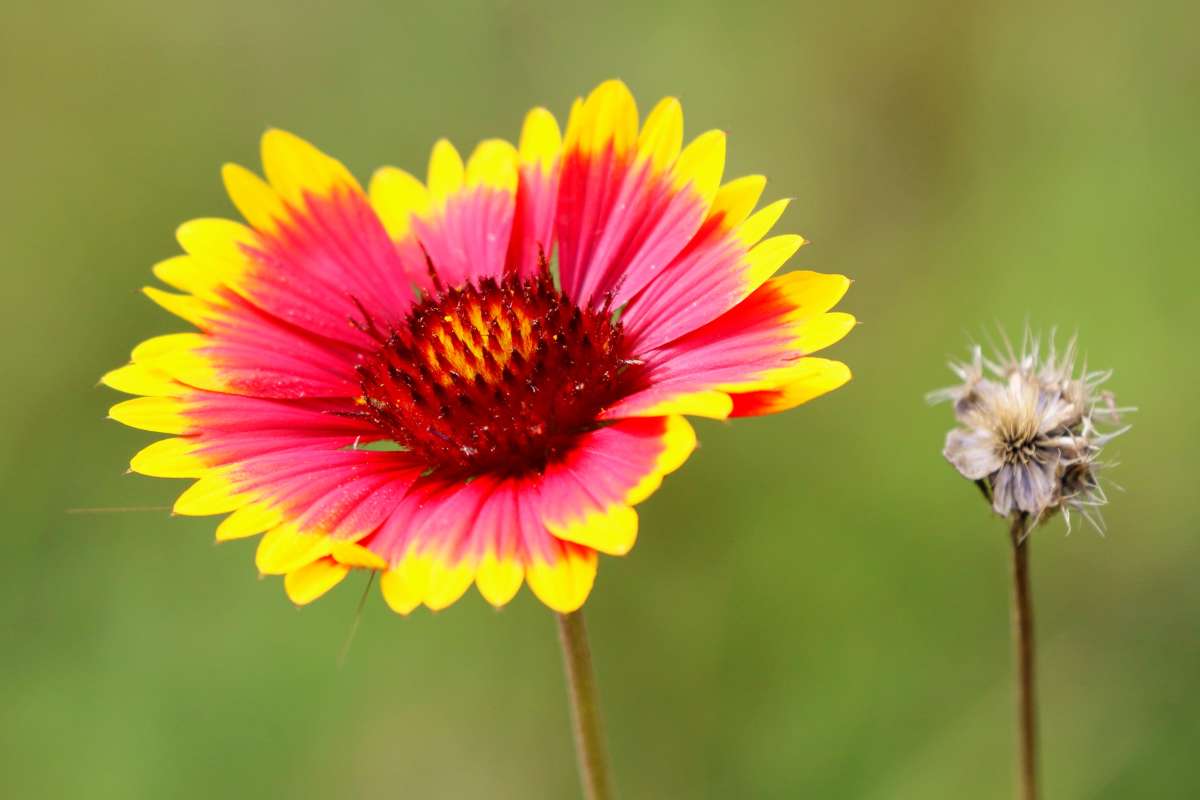
Red and yellow daisy heads blaze above low clumps 12 to 28 inches tall, opening from early summer right through early autumn. Gaillardia (Gaillardia x grandiflora) lights up flower beds, edges and garden boxes on a terrace or balcony; give it full sun and light, well drained soil and flowers come easily.
| Name | Gaillardia x grandiflora |
|---|---|
| Family | Asteraceae |
| Type | Perennial |
| Height | 12 to 28 inches (30 to 70 cm) |
| Exposure | Full sun |
| Soil | Ordinary |
| Flowering | early summer to early autumn |
| Care | Easy |
All summer long, this flower bestows us with warm and bright colors that make it a very ornamental plant.

For plants purchased in nursery pots or containers, preferably choose to plant in spring in a blend of earth and special “flower plant” or geranium soil mix.

It’s also an option to perform direct sowing in late spring or early summer, you’ll succeed with ease!
Simply collect the seeds from the little capitulum pods when they’ve wilted away.
Gaillardia can be bought as a young plant, sown straight into the ground, or raised from seed you have saved yourself. Each route has its own moment in the year.
| Method | When | How | Spacing and position |
|---|---|---|---|
| Nursery pots or containers | Spring | Plant in a blend of earth and special “flower plant” or geranium soil mix | 16 to 20 inches (30 to 40 cm) apart, in full direct sun |
| Direct sowing | late spring or early summer | Sow straight where the plants are to grow; success comes easily | A spot receiving a lot of direct sun, in light, well drained soil |
| Seed you have collected | Sow anew in spring | Gather seed from wilted capitulum pods, dry it and keep it in an envelope over winter | Same sunny, light and well drained ground |
Whichever route you take, full sun remains the deciding factor for abundant flowers.

Gaillardia is a perennial in mild and warm climates but can be grown as an annual in colder climates.
Add granulated flower plant fertilizer in spring, this should ensure you get a very beautiful blooming.

Since beautiful year-long bunches of flowers are quite hard to get in consecutive years, you must cut the plant back short at the end of summer, thus sacrificing the fall blooming.
This will ensure that proper reserves will have been collected by the plant and it will bloom well in the following year.
Gaillardia est very hardy in that it resists diseases.
Most gaillardias sold in garden centres belong to a handful of well-known cultivars and seed series, separated mainly by flower colour, petal shape and how compact the clump stays. The table below sets out the ones you are most likely to find, to help match a variety to a border, an edge or a pot.
| Variety | Flower colour | Flower form | Habit | Best use |
|---|---|---|---|---|
| ‘Arizona Apricot’ | Apricot to soft yellow | Single daisy | Dwarf, compact | Pots, pastel schemes |
| ‘Mesa Yellow’ | Clear yellow | Single daisy | Medium, bushy | Bedding, borders, cutting |
| ‘Dazzler’ | Orange-red with yellow tips | Single daisy | Medium | Sunny borders |
| ‘Mesa Peach’ | Peach and cream | Single daisy | Medium, bushy | Soft colour borders |
| ‘Oranges and Lemons’ | Peachy orange with yellow tips | Single daisy | Medium | Borders, cut flowers |
| ‘Arizona Sun’ | Red with gold rim | Single daisy | Dwarf, compact | Containers and edging |
| ‘Burgundy’ | Deep wine red | Single daisy | Medium | Borders, cut flowers |
| ‘Mesa Bright Bicolour’ | Red with yellow edge | Single daisy | Medium, bushy | Mixed borders |
| ‘Goblin’ | Red with yellow petal tips | Single daisy | Dwarf | Edging, pots, front of border |
| ‘Mesa Red’ | Rich red | Single daisy | Medium, bushy | Bedding blocks |
| ‘Fanfare’ | Red centre, yellow trumpet tips | Fluted, tubular petals | Medium | Feature planting, pots |
| ‘Tokajer’ | Warm apricot-orange | Single daisy | Medium to tall | Prairie-style borders, cutting |
This perennial hosts radiant colors in hues of red and yellow, very warm and bright. They make an extraordinary pairing for the various greens that other plants have to offer.
In flower beds and along edges, and also in garden boxes, your terrace, garden or balcony will be lit up with these sparks of color.
If your gaillardia don’t grow back after winter, usually it is because they’ve succumbed to freezing. Certain gaillardia varieties are thus considered to be annuals.

The Gaillardia genus belongs to the large Asteraceae family. The name “gaillardia” itself was christened by the famous botanist Auguste Denis Fougeroux de Bondaroy in 1786 as an homage to one of his friends, the magistrate and amateur botanist Gaillard de Charentonneau.
Gaillardia is also the flower symbol of the Saguenay-Lac-St-Jean region of Quebec, and of Wallonia in Belgium.
When you are treating the plant or hope to boost its blooming, use local, natural products that respect the environment.