A rock garden in full sun is the hottest, driest, sharpest-draining corner of the whole plot. Thin soil over stone heats up fast, holds almost no water, and burns off anything soft-leaved by mid-July, just when you want the display at its peak. The answer is to plant things that treat those conditions as a reward rather than a hardship: grey, narrow or fleshy foliage, deep roots that chase moisture into the crevices, and a succession of flowers that carries the scheme right through high summer.
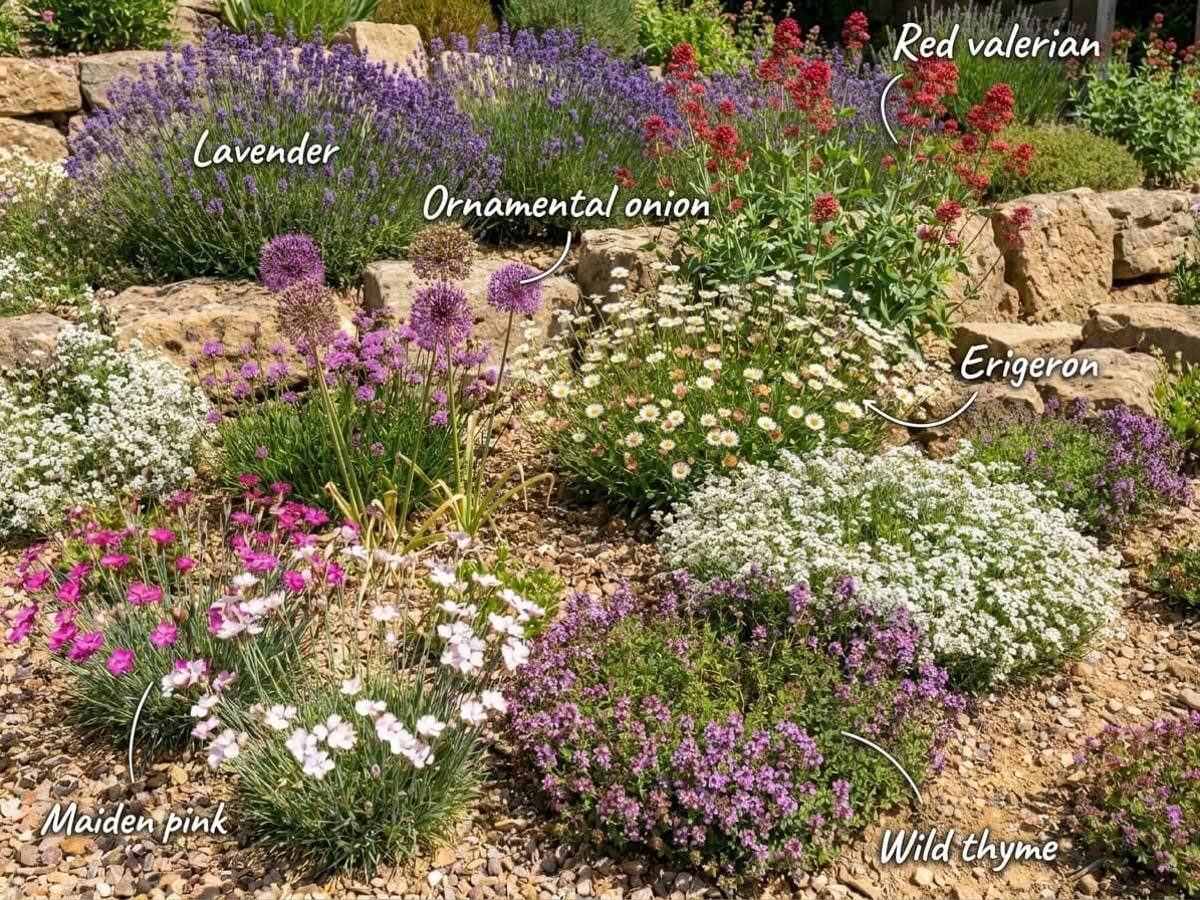
From back to front: Lavender, Red valerian, Ornamental onion, Erigeron, Maiden pink, Creeping alpine gypsophila, Wild thyme.
Set at the back or at the top of the slope, Lavender gives the scheme its backbone: a dome of silver-grey foliage roughly knee-high that holds its shape all year. The blue-purple spikes open in midsummer and stay handsome even as they fade to brown. Its mounded, matte texture is the perfect foil for the looser, wirier plants below it, and it never floods out its neighbours the way a greedy shrub would.
For height and movement behind the low carpet, Red valerian sends up leafy stems topped with dense heads of carmine or pale pink from late spring well into summer. It is the plant that will colonise a wall joint or a gap between two boulders without any help from you. Keep it towards the back and shear it after the first flush, or it will seed itself through the finer plants in front.
Drifted between the mounds, Ornamental onion adds vertical punctuation: bare stems lifting round violet or lilac pompoms clear above everything else in early summer. The leaves yellow and collapse just as the flowers open, which is exactly why you plant it among the carpeting plants — they hide the mess. The dried seed heads can be left standing well into autumn for structure.
In the middle ground, Erigeron provides the long haul: small daisies opening white and ageing to pink, produced more or less non-stop from early summer until the first frosts. It spills softly over stone edges and steps, softening hard lines without hiding them. Its airy, fine-textured growth sits well against the solid grey dome of Lavender and knits the heavier clumps together.
Towards the front edge, Maiden pink forms a tight, dark green mat that disappears under bright pink flowers in early and midsummer. The mat is dense enough to suppress weeds in the gravel, which matters on a sunny slope where bare soil bakes and crusts. Plant it where it can run up against warm stone, which it appreciates, and let it meet Erigeron at the edges.
At the very front, Creeping alpine gypsophila throws a haze of tiny white or pale pink flowers over a flat cushion of narrow foliage in early summer. That cloud of white is what stops a hot pink-and-purple scheme becoming too rich and heavy. It is happiest tumbling over the lip of a retaining wall or down the face of a rock, so give it an edge to fall from.
Filling the gaps between paving, steps and stones, Wild thyme makes a flat, aromatic carpet smothered in mauve-pink flowers in midsummer and alive with bees. It will take light foot traffic, which no other plant here will, so use it on the paths and stepping stones. Its scent on a hot afternoon ties the whole planting back to Lavender at the top of the slope.
Start at the top or back with three Lavender plants spaced about 60 cm apart, so they eventually touch but keep their individual domes. Put two or three clumps of Red valerian in the deepest crevices behind and between them, then scatter Ornamental onion bulbs in groups of five to seven, 15 cm apart, through the middle of the scheme. In front, plant Erigeron in threes at roughly 40 cm spacing, then edge the whole thing with Maiden pink and Creeping alpine gypsophila at about 30 cm, placing the gypsophila wherever there is a drop to spill over. Finish by tucking small plugs of Wild thyme 20 cm apart into every path joint and gravel gap, and mulch the entire bed with 3–5 cm of grit so crowns stay dry in winter.
In spring the bed is mostly texture: grey Lavender domes, dark green Maiden pink mats and the emerging leaves of Ornamental onion. Early summer brings the first wave — Ornamental onion pompoms, Red valerian, Maiden pink and the white haze of Creeping alpine gypsophila — followed in midsummer by Lavender and Wild thyme, when the whole slope hums. Erigeron carries the colour alone into autumn, by which time the dried seed heads of Ornamental onion and the faded Lavender spikes are doing the work. In winter nothing flowers, and the scheme rests on evergreen cushions, silver foliage and the stone itself, which is reason enough to place your best rocks carefully at the outset.