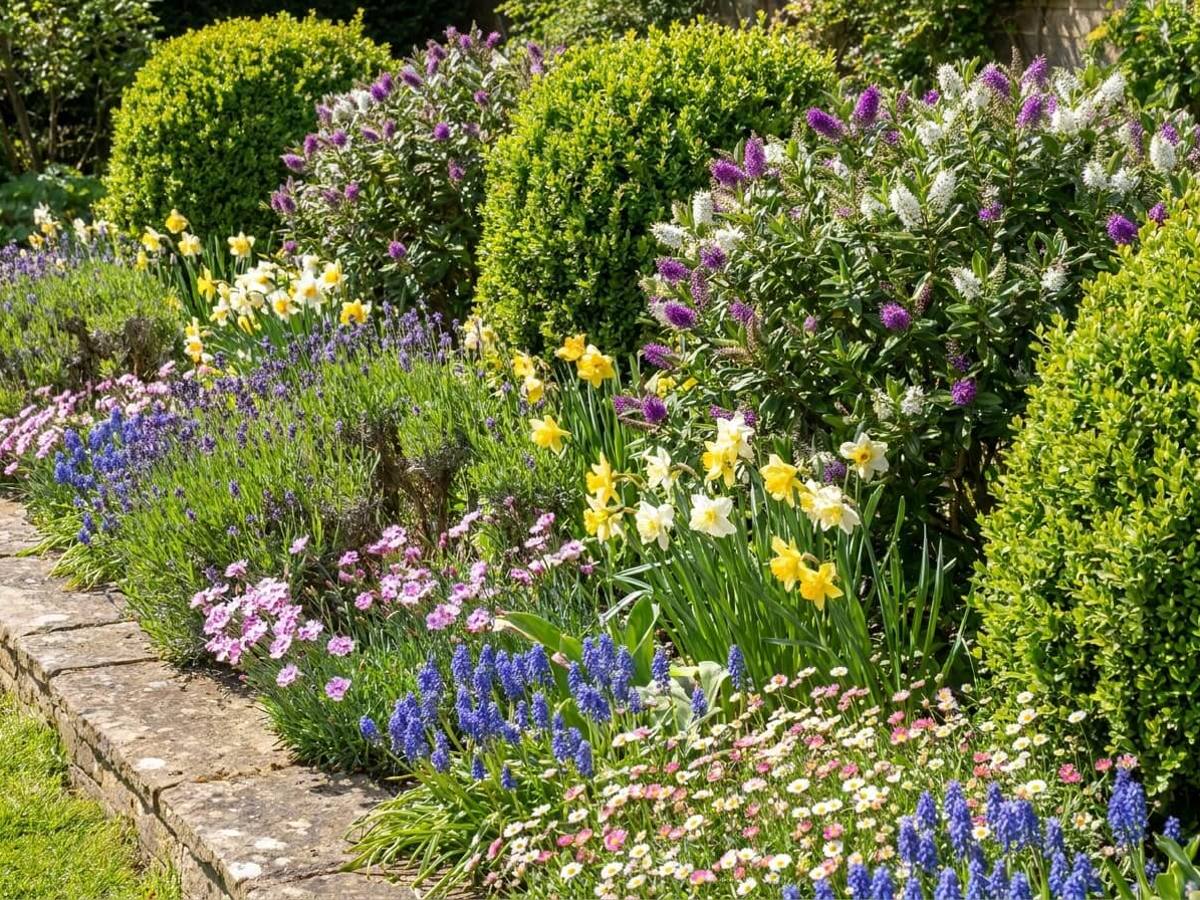
A border edging in full sun is the hardest strip in the garden: it bakes from mid-morning, drains fast after rain, and every gap in it shows from the path. It also has to look deliberate from one metre away, which means the planting needs clean edges, low mounds and a clear front line rather than a loose drift. A good scheme stacks low evergreen structure at the back, fills the middle with spring bulbs that come up through it, and finishes with a soft, spreading front rank that blurs the line between soil and paving.
From back to front: Boxwood, Hebe, Lavender, Narcissus, Garden pink, Grape hyacinth, Erigeron.
At the back of the edging, Boxwood gives you the one thing spring bulbs cannot: a solid green wall that is already there in February and still there in November. Clipped low, it reads as a line rather than a hedge, and it holds the whole scheme square against the lawn or path behind. Its dense, matt foliage is the perfect backdrop for pale spring flowers, which would otherwise disappear against bare soil.
Set just in front of the clipped line, Hebe breaks the formality with rounded, dome-shaped evergreen mounds. The leaves are glossier and often lighter than those behind it, so the two greens read as separate layers rather than one mass. It copes well with the heat and sharp drainage of an edging bed, and its neat outline means it never needs to be tidied away from the plants in front.
Grey foliage is what keeps a sunny edging from looking heavy, and Lavender supplies it all year. In spring it is purely a texture plant, a silvery haze that makes yellow and blue bulb flowers look twice as bright. Later it takes over as the main performer, which is exactly what you want once the spring display has gone over. Give it the hottest, driest stretch of the run.
Narcissus is the tallest thing in flower here and sets the height of the spring picture. Plant it so it comes up between and just behind the evergreen mounds, which hide the lower leaves and support the stems in wind. Choose shorter kinds for an edging so the flowers sit at the level of the clipped greenery rather than flopping over the path. When the flowers fade, the surrounding foliage covers the dying leaves while they feed the bulbs.
In the middle-front rank, Garden pink forms tight blue-grey cushions that look deliberate even out of flower. That cushion shape echoes the grey foliage behind it and ties the two halves of the scheme together. It flowers from late spring onwards, so it picks up the display just as the bulbs finish, and it shares the same love of sun and sharp drainage as everything else in the bed.
For the front edge in spring, Grape hyacinth gives you a low ribbon of deep blue right where the eye lands. The colour is strong enough to hold its own against the yellows above it, and the spikes are short enough never to lean onto the path. It bulks up year on year, so a thin first-season line fills into a proper band within two or three springs.
At the very front, Erigeron spills over the paving edge and softens the hard line completely. Its small daisies start in late spring and keep going for months, so it is the plant that carries the edging through summer once the bulbs are long gone. It self-seeds into cracks and gaps, which is a virtue here: it stitches the scheme to the path instead of stopping dead at it.
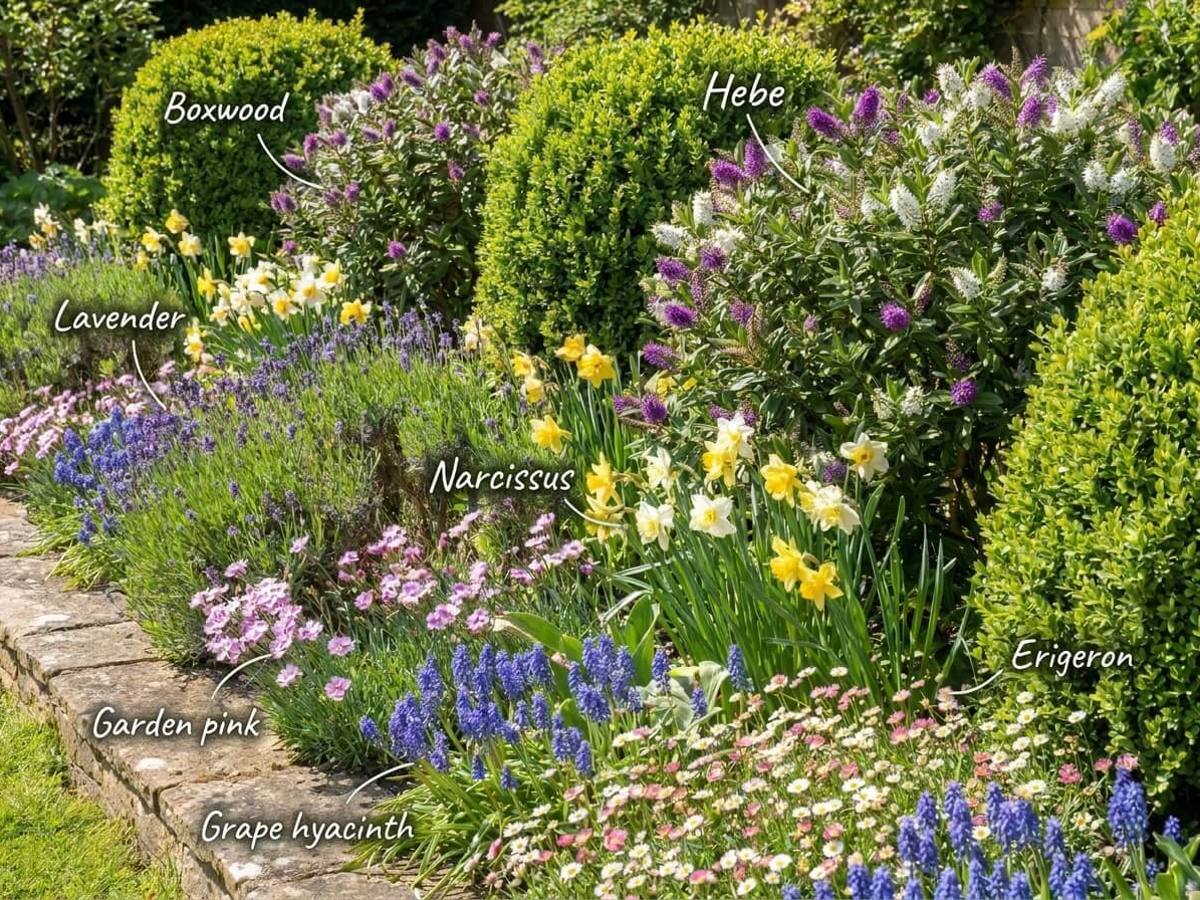
Work in a strip about 80 cm deep. Set Boxwood along the back in a single line, 30 cm apart, and clip it to roughly knee height. In front of it, space Hebe at 50 cm and Lavender at 45 cm, alternating them in groups of three rather than one-for-one, so each keeps its own shape. Tuck Narcissus bulbs in clumps of seven between those mounds, about 10 cm deep. Plant Garden pink at 25 cm along the middle-front, leave a 20 cm band of Grape hyacinth bulbs in a continuous drift just in front of it, planted 5 cm deep, and dot Erigeron every 30 cm along the outer edge where it can lean onto the paving.
In early spring the picture is Grape hyacinth blue at your feet and Narcissus above, lit against dark clipped green. Late spring brings Garden pink and the first Erigeron daisies as the bulbs retreat. Summer belongs to Lavender and Hebe, with Erigeron still flowering at the front, and by autumn the scheme falls back to shape and foliage: a clipped green line, grey cushions, rounded evergreen domes. That winter version is deliberately quiet, not empty, which is why the evergreen layer was planted first.