A border edging in full sun is the hardest strip in the garden: the soil dries fastest there, the paving or lawn edge throws back heat, and every gap shows because you walk past it at close range. It needs plants that take drought and glare without sulking, and that stay neat enough not to flop over the path. A good scheme stacks height from back to front, leans on silver and grey foliage to carry the dry weeks, and keeps something in flower from early summer until the first frosts.
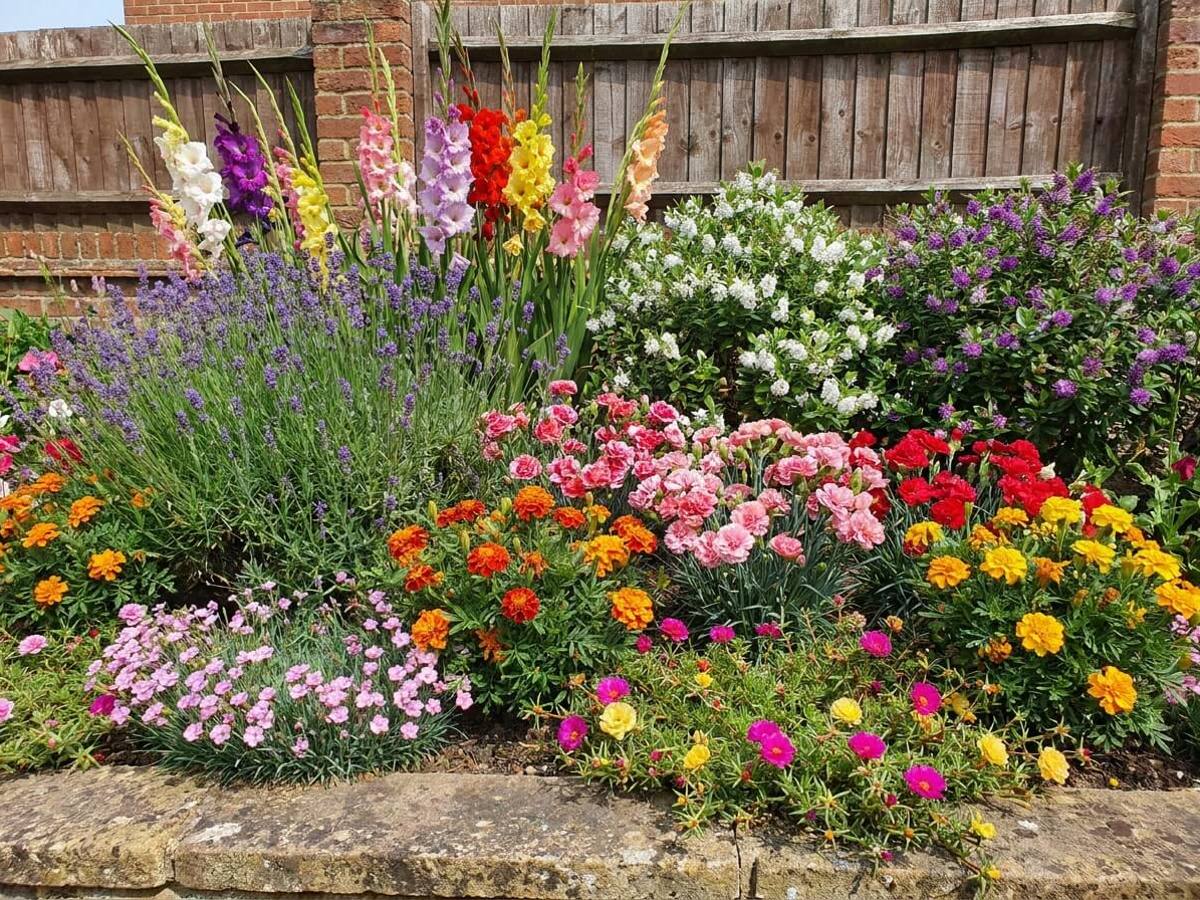
From back to front: Gladiolus, Lavender, Hebe, Carnation, French marigold, Maiden pink, Rose moss.
Gladiolus gives this low scheme its one vertical accent, with sword-shaped leaves and flower spikes that rise cleanly out of the planting behind everything else. Because the foliage is narrow and upright, it takes up very little ground, which matters in a strip this shallow. Plant it at the very back so the spikes read against a wall, fence or hedge rather than against open sky, and let the bushier plants in front hide the bare lower stems.
Lavender is the backbone of a hot, dry edging: grey-green evergreen foliage all year, scented flower spikes through the summer, and a rounded shape that holds its outline even when nothing is open. It thrives in exactly the free-draining, sun-baked conditions that defeat softer plants. Set it towards the back of the scheme where its bulk screens the base of Gladiolus, and clip it over after flowering so it never sprawls into the plants in front.
Hebe brings dense evergreen structure with neat, glossy, closely set leaves, so the border still looks furnished in winter when the summer flowers have gone. Its summer flower spikes repeat the upright line of Gladiolus on a much smaller scale. Use it as a repeated anchor along the middle of the strip, breaking up the softer, looser planting and giving the eye something solid to rest on between flowering groups.
Carnation adds narrow blue-grey leaves and clove-scented summer flowers on slightly taller stems than the front-row plants. The foliage colour echoes Lavender, which ties the middle of the border to the back without repeating the same shape. It likes the same sharp drainage and open sun, so it sits happily alongside Hebe without either plant crowding the other.
French marigold supplies the hot colour that grey foliage needs beside it: orange, mahogany and yellow, carried non-stop from early summer until frost. It is bushy and low, filling the space between the permanent shrubs while they are still young. Dot it through the middle and front of the scheme as an annual filler, and deadhead it regularly so it keeps producing rather than running to seed.
Maiden pink spreads into low evergreen mats of fine, dark foliage that soften the hard line where the border meets paving or grass. In early summer it is covered in small flat flowers held just above the leaves. It is the natural partner for Carnation, sharing the same grassy texture at a quarter of the height, and it smothers bare soil where weeds would otherwise appear.
Rose moss is the front-row specialist for a spot this hot, with succulent cylindrical leaves and bright, silky flowers that open in full sun. It copes with the driest, most reflected heat right at the edge, where even Lavender can struggle in a sandy strip. Sow or plant it along the very front, where it will creep over the kerb and fill any gaps left between the mats of Maiden pink.
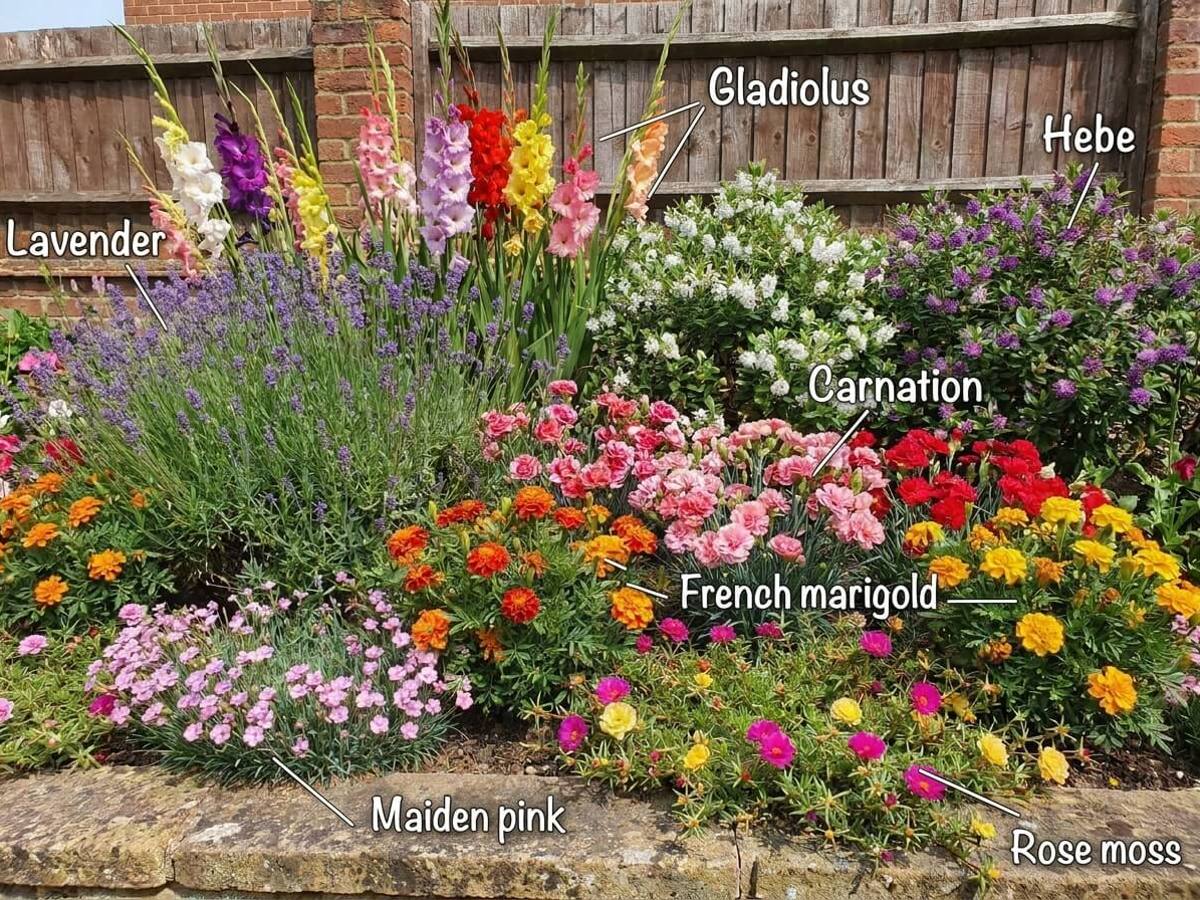
Work in a strip about 60 to 80 cm deep. Plant Gladiolus corms in groups of five to seven along the back, roughly 15 cm apart within each group, with a clear metre between groups so they read as accents. Set Lavender just in front at 40 cm spacing, and place Hebe as single plants every 1.5 to 2 m to punctuate the run. Fill the middle with groups of three Carnation at 30 cm spacing, slot French marigold in between at 25 cm, then edge the front with Maiden pink at 25 to 30 cm and Rose moss at 20 cm, letting both spill over the edge.
In spring the border is green and compact: Hebe and Lavender hold the shape, Maiden pink is already dense, and the Gladiolus leaves push up at the back. Early summer brings Maiden pink and Carnation, then Lavender and Hebe, with Gladiolus spikes opening above them. From midsummer to the first frosts, French marigold and Rose moss carry the colour at the front. Once they are cut down in autumn, the evergreen foliage of Hebe, Lavender and Maiden pink keeps the edge looking deliberate right through winter.