Under a canopy of deciduous trees or along the north-facing side of a wall, the ground tends to sit in dry, root-filled shade: bare soil in winter, a brief flood of light in early spring, then deep green gloom from May onwards. Nothing wants to grow there by accident, and what does grow often looks thin and patchy. A good scheme layers plants that come awake in that short spring window, then holds the ground with foliage for the rest of the year so no bare earth ever shows.
From back to front: Hellebore, Bluebells, Epimedium grandiflorum, Lily of the valley, Omphalodes, Leucojum vernum, Dead-nettle.
At the back of the scheme, Hellebore gives you the tallest and most substantial shape, with leathery, hand-shaped leaves that stand through winter. The nodding flowers open in late winter and hold on well into spring, in dusky plums, greens and creams that read beautifully against dark soil. It is slow and clump-forming rather than running, so it anchors the back line without bullying anything planted in front of it.
Threaded through and just in front of the taller clumps, Bluebells deliver the single strongest moment of the year: a haze of violet-blue at around knee height in mid to late spring. The strappy leaves arrive early, flower, then yellow off and vanish by midsummer. That disappearing act is exactly why they belong behind leafier neighbours, which close over the gap they leave.
Epimedium grandiflorum is the workhorse of the middle layer, with wiry stems carrying heart-shaped leaflets that flush bronze-red as they unfurl. The spurred spring flowers float above the foliage on thread-fine stalks, light enough to catch any stray shaft of sun. It copes with dry shade under tree roots better than almost anything else here, and its airy habit lets the colour of its neighbours show through.
Lily of the valley brings the scent, with arching stems of white bells in spring and broad, upright paddle-shaped leaves that stay fresh and green for months afterwards. It spreads by underground runners and will colonise steadily, so give it a defined pocket rather than scattering it everywhere. Set it where it can knit into the base of the taller clumps and cover the ground the bulbs leave behind.
Towards the front, Omphalodes throws up sprays of small, clear blue flowers in spring above low rosettes of pointed, softly textured leaves. The blue is brighter and cleaner than anything else in the planting, which makes it the thing your eye lands on first. It makes neat, slowly widening mounds, so it sits politely between a running carpet and a clump-former without being swallowed.
Leucojum vernum opens the season, with white bells tipped in green hanging from short stems while most of the bed is still bare. Plant it in small drifts near the front edge where you will actually see it from the path in late winter. Like the other bulbs here it dies back cleanly, so plan for something leafy to grow over its place.
At the very front, Dead-nettle is the carpet itself: low, spreading stems with silver-marked leaves that lighten the gloom all year and spring flowers in pink, mauve or white. It roots as it travels, so it fills gaps, softens the edge and smothers weed seedlings before they get going. Keep it to the front and shear it back if it starts climbing over the smaller clumps behind.
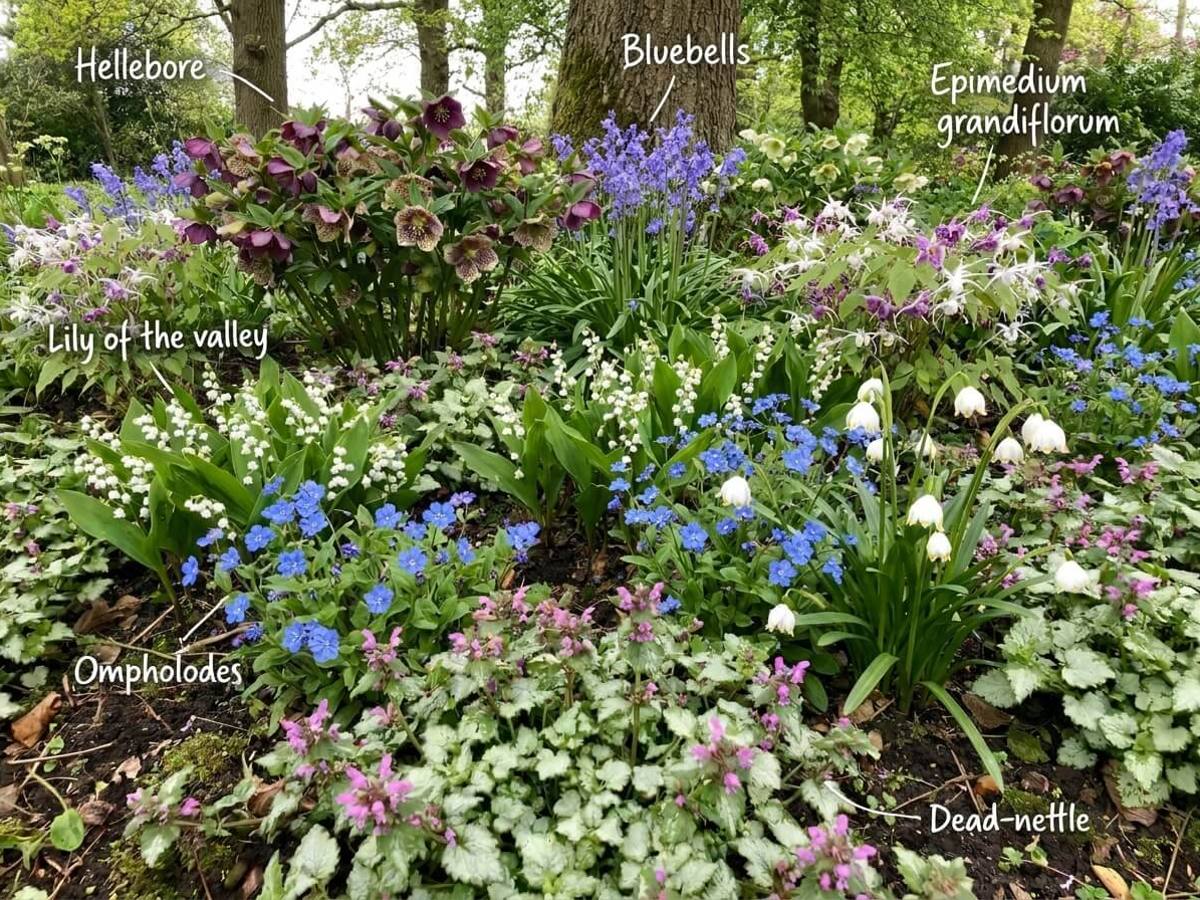
Work in bands. Set Hellebore along the back in groups of three, about 50 cm apart, with Bluebells planted in loose drifts of 20 or more bulbs between and around them in autumn. In front, run a ribbon of Epimedium grandiflorum at roughly 40 cm spacing, broken by one or two pockets of Lily of the valley of about half a square metre each. Bring the planting down to the edge with groups of three to five Omphalodes at 30 cm spacing, small clusters of ten Leucojum vernum bulbs tucked between them, and Dead-nettle planted at 40 cm along the front so it can run together into a continuous mat within a season or two.
From late winter the bed is white and green: Leucojum vernum at the front, Hellebore already in flower at the back. April and May bring the peak, with blue from Bluebells and Omphalodes, scent from Lily of the valley, and the spurred flowers and bronze new growth of Epimedium grandiflorum between them. By midsummer the flowers have gone and the scheme reads as texture alone — leathery, heart-shaped, broad and silver-marked foliage in layers. Autumn brings tidying rather than drama, and through winter the Hellebore, Epimedium grandiflorum and Dead-nettle keep leaves on the ground so the spot never looks abandoned.