A patio or balcony that catches a few hours of morning or late-afternoon sun, then sits in soft shade for the rest of the day, is one of the easiest places to garden badly. Full-sun bedding sulks and stretches, while deep-shade foliage plants give you green and nothing else, so the corner reads flat all summer. The answer is a layered set of pots: one tall shrub for structure, one or two mid-height shrubs that genuinely flower in half light, and low pots at the front that carry scent and small, repeated colour from June to the first frosts.
Pot by pot, tallest first: Hibiscus Althea, Unique hydrangea, Skimmia, Beardtongue, Ornamental tobacco, China pink.
This is the back of the group and the only plant here that behaves like a small tree. Hibiscus Althea opens its wide, papery flowers in the heat of midsummer, exactly when spring shrubs have gone quiet, and keeps going into early autumn. Its upright, rather bare-legged shape is a gift in a tight corner, because everything shorter can be tucked around its ankles without crowding it. Give it the brightest part of the terrace, where it gets the morning sun, and let the shade-lovers sit in its lee.
Set just in front and slightly to one side, Unique hydrangea supplies the big, soft mass that holds the whole arrangement together. The large conical heads open creamy white in summer and age slowly to pink and dusty rose, so the colour shifts for weeks without you doing anything. Its broad leaves are a deliberate contrast to the narrower foliage at the front, and the fading heads can be left on through winter for shape. Partial shade suits it far better than a baking wall.
Every group of pots needs one plant that looks the same in February as it does in July, and that is the job of Skimmia here. The glossy evergreen dome sits at mid-height, hides the bare lower stems of the taller shrubs, and gives the eye somewhere to rest when the summer flowers are over. Tight red buds through autumn and winter, scented flowers in spring, then a quiet green backdrop while everything else performs. It is the most shade-tolerant plant in the scheme, so give it the dimmest corner.
For upright spires of bell-shaped flowers from early summer well into autumn, Beardtongue is hard to beat in a pot. The slim stems and narrow leaves break up the solid mass of the shrubs behind, and the flowers keep coming as long as you remove the spent spikes. It copes with a half-shaded spot provided it is not in dense gloom, and it flowers in the same weeks as the two shrubs above, which is what makes the group peak all at once.
This is the scent of the scheme and the reason to sit out after dark. Ornamental tobacco carries loose sprays of tubular flowers on tall, airy stems from midsummer to the frosts, and it is one of the few summer annuals that actively prefers not to be roasted all day. Planted at the front, its see-through habit lets you look straight past it to the shrubs behind, so it adds height without blocking anything. Replant it each spring.
At the very front, low and tidy, China pink finishes the edge of the group with fringed flowers in pinks, reds and whites over neat grey-green tufts. It picks up the rose tones that develop in the hydrangea heads later in the season, which ties the front of the display to the back. Keep deadheading and it will flower on and off right through the summer. It needs the sunniest few hours the balcony can offer, so place it at the outer edge.
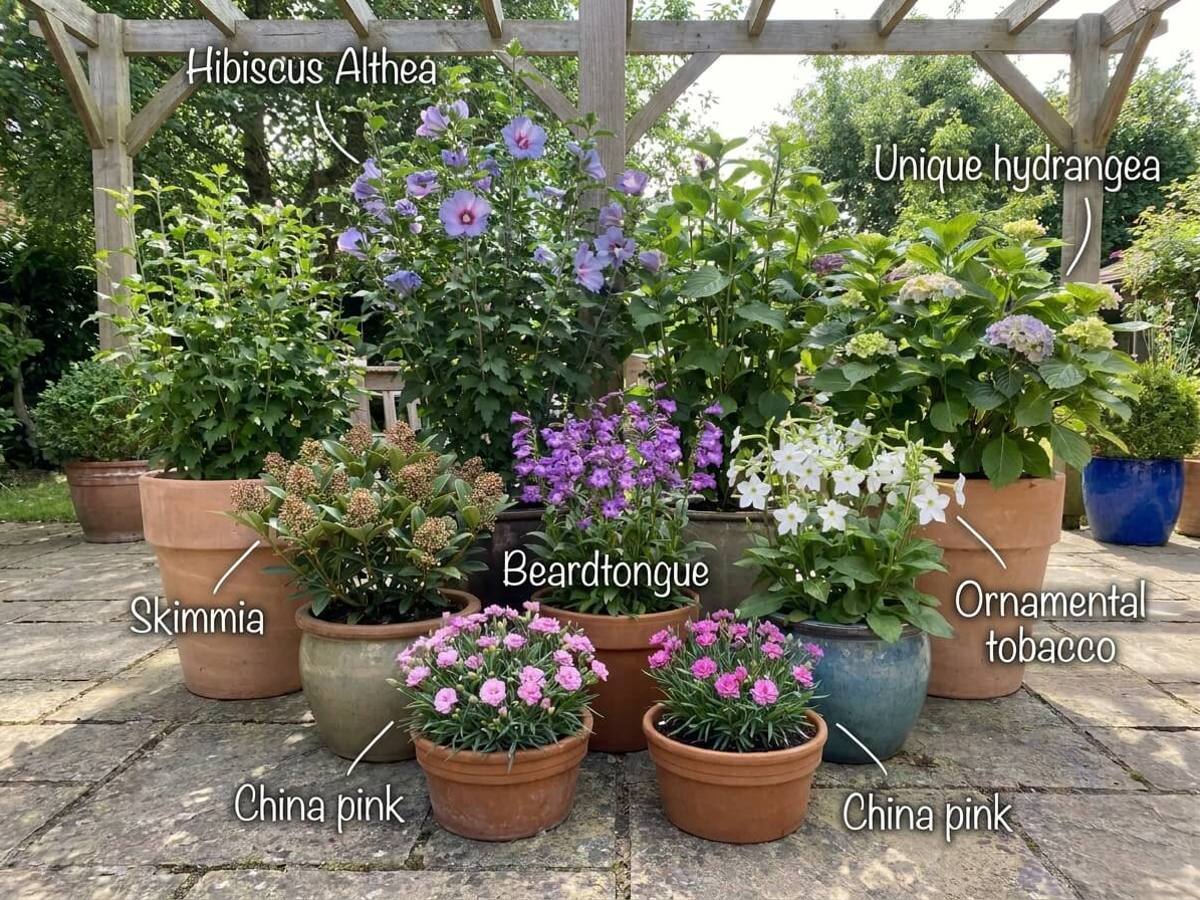
Give Hibiscus Althea its own pot of at least 50 cm across and stand it at the back corner; water deeply twice a week in summer, once a week in spring and autumn. Unique hydrangea needs a 45 cm pot of its own and the most water of the group — check it daily in hot weather, as it wilts quickly and sulks afterwards. Skimmia is happy in a 35 cm pot in ericaceous compost, watered twice a week with soft water if you have it. Beardtongue takes a 30 cm pot alone, watered twice a week; Ornamental tobacco and China pink are the only two that can share, in a long trough of about 30 cm depth, with the taller Ornamental tobacco at the back of the trough and China pink along the front edge — water that trough every day or two in summer, as the compost volume is small.
Spring opens quietly: Skimmia in bud and then in scented flower, fresh leaves breaking on the shrubs, and the troughs newly planted. From June to September the group reaches full voice, with Unique hydrangea and Hibiscus Althea carrying the mass of colour, Beardtongue pushing spires through the middle, and Ornamental tobacco and China pink lighting up the front and scenting the evenings. In October the hydrangea heads turn parchment and the last Beardtongue spikes fade, leaving the troughs to be cleared. Through winter nothing flowers, and that is when Skimmia earns its place, with the dried hydrangea heads and the bare upright frame of Hibiscus Althea giving the corner a shape worth looking at.