A patio or balcony that gets a few hours of soft morning light and shade for the rest of the day is one of the easier spots to plant well, once you stop fighting it. The difficulty is timing: these corners often sit empty and grey from November to May, exactly when you walk past them most. A good scheme stacks evergreen structure at the back, acid-loving spring flowers in the middle, and something low and bright at the front edge, so the group reads as furnished even on a wet March morning.
Pot by pot, tallest first: Camellia, Azalea japonica, Skimmia, White Pearl hyacinth, Winter heather.
This is the anchor of the group and the tallest thing in it, a dense evergreen with glossy, almost lacquered leaves that hold light in a dim corner all winter. Camellia flowers from late winter into spring, opening wide, formal blooms against that dark foliage just as everything else is still waking up. Set it at the back, where its bulk gives the other pots something to be seen against. It dislikes direct afternoon sun on frosted buds, which makes a part-shade wall exactly right.
Where the taller shrub gives weight, Azalea japonica gives a low, wide cushion of small leaves and a dense flush of spring flower that almost hides the plant underneath. Place it in front and slightly to one side, so the two layers overlap rather than line up. Pick a flower colour that either echoes or deliberately sits apart from the taller shrub behind — soft pink against white, or white against deep red, both read well in shade.
Skimmia is the plant that keeps the group honest between flushes. It carries tight clusters of buds through autumn and winter, opens them into scented spring flower, and holds neat evergreen foliage the rest of the year. Its rounded, upright habit sits comfortably between the taller shrub and the low cushion, filling the gap where a scheme usually goes thin.
For scent at nose height and a jolt of brightness, nothing in this group beats White Pearl hyacinth. The clean white spikes lift the whole arrangement out of the greens and pinks and carry a long way on still, damp spring air. Plant the bulbs in their own container so you can push them forward while they flower and slide them behind the shrubs once the spikes go over.
At the very front, winter heather does the job no shrub can: it covers the ground, softens the hard rim of the pots and flowers from midwinter right through the first part of spring. The fine, needle-like foliage is a complete change of texture after all those broad evergreen leaves. It also shares the same acid, free-draining compost as everything else here, so the whole group can be fed and watered the same way.
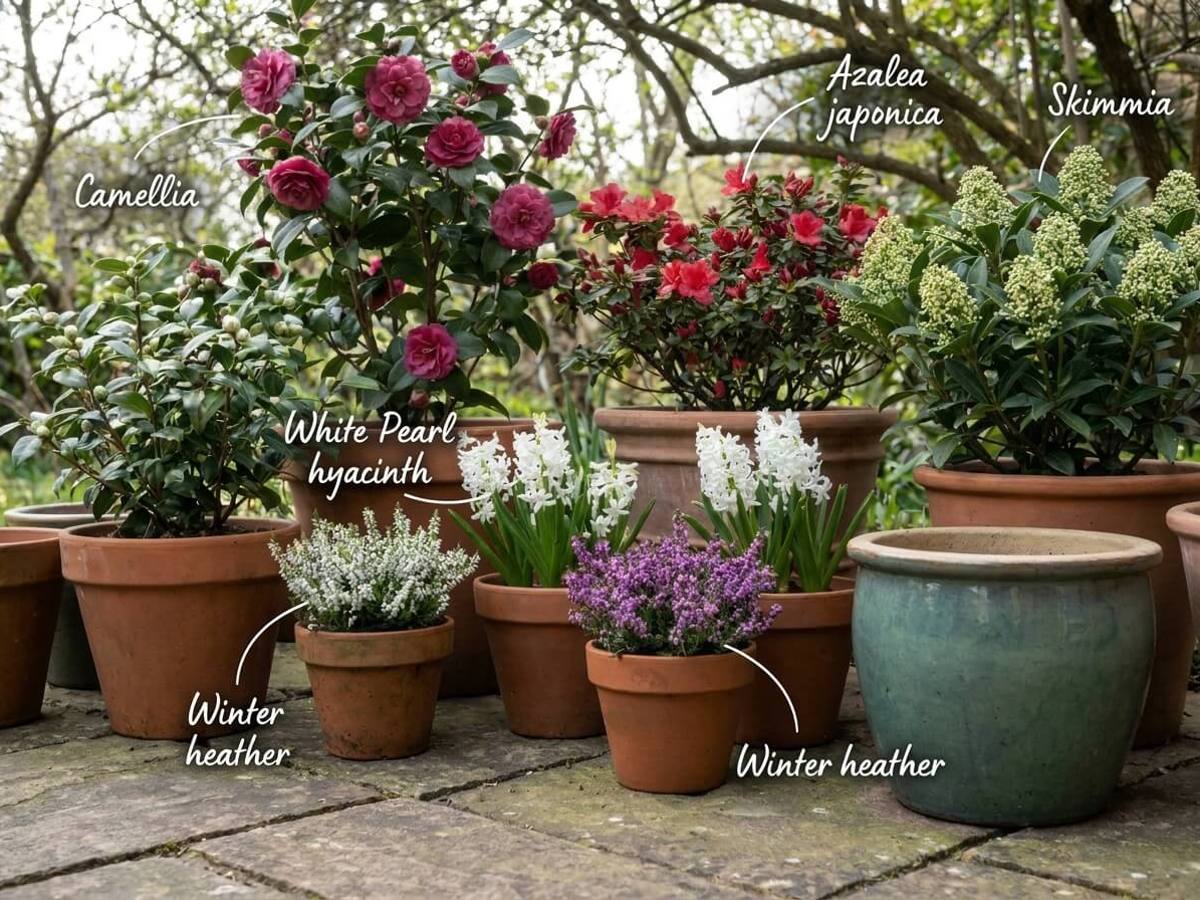
Give Camellia a pot of 45 to 50 cm across, on its own, standing at the back against the wall — it needs the root volume and will stay put for years. Azalea japonica takes a 35 cm pot and Skimmia a 30 cm pot, both standing forward of the first and staggered rather than in a row. Put White Pearl hyacinth in a wide, shallow bowl of about 25 cm with six to nine bulbs, and plant three or five plants of winter heather together in a 25 to 30 cm trough along the front edge. Use ericaceous compost throughout, and water with rainwater where you can. In spring and summer, expect to water the two largest pots roughly twice a week and the shallow bowl and trough every other day in warm weather, since they dry fastest; in winter, check once a week and water only if the compost is dry below the surface.
From December the front of the group is already working, with winter heather in flower and the bud clusters of Skimmia colouring up. Late winter into spring brings the main event: Camellia opens first, White Pearl hyacinth pushes up white spikes and scent, then Azalea japonica covers itself in flower as the hyacinths fade. Through summer the scheme is entirely green, and that is fine — three different leaf textures, from broad and glossy to small and matt to fine and needled, hold the corner together. Autumn is the quiet stretch, with buds forming again on Skimmia and the heather colouring, so that by the time the first cold nights arrive the display is already building for the next round.