Home » Health » Red cabbage: traditional uses, kitchen forms and cautions
Red cabbage: traditional uses, kitchen forms and cautions
·
0
Red cabbage (Brassica oleracea) is the dense purple-leaved headed cabbage of the Brassicaceae family, native to Central Europe. This page is for anyone who has one sitting on the worktop and wants to know what to do with it tonight: which forms herbalists and old kitchen traditions favour, how to shred, juice or steam it, and who should go carefully.
Red cabbage at a glance
Item
Detail
Botanical name
Brassica oleracea var. capitata f. rubra
Family
Brassicaceae (Cruciferae)
Part used
The leaves of the head; the pressed juice; outer leaves for poultices
Forms of use
Raw shredded, steamed, braised, fresh juice, lacto-fermented, leaf poultice
Harvest season
Late summer to late autumn, some varieties standing into early winter
Taste
Sweet-peppery, faintly mustardy raw; earthier and softer when cooked
What it is credited with
Old European home remedies treated cabbage as an expectorant, giving the cooking water or syrup for winter coughs and chesty colds.
In traditional herbalism, fresh pressed cabbage juice was taken before meals to ease sour stomach, heartburn and sluggish digestion.
Naturopathy credits the raw juice with supporting digestive comfort after heavy, fatty eating.
Country herbalism used crushed raw leaves as poultices laid on bruises, aching joints, stiff muscles and a heavy head.
Folk practice in several parts of Europe credited pressed cabbage juice with helping the body clear intestinal worms.
Herbalists have long placed brassicas among the “spring cleaning” vegetables, eaten in quantity at the turn of the seasons.
Its anthocyanin and vitamin C content give it a reputation, in naturopathic writing, as an antioxidant food supporting skin and general resilience.
How to use it
Raw, shredded (the everyday form)
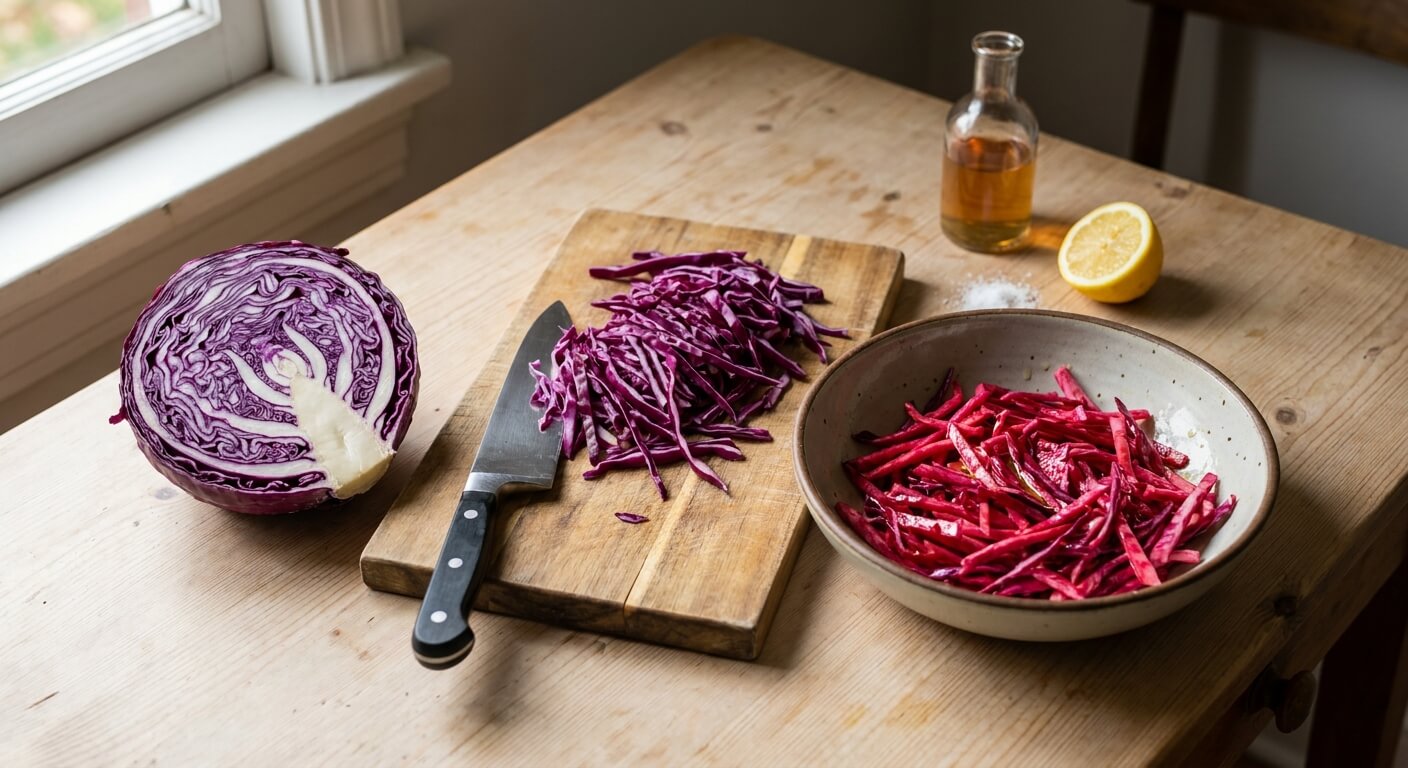
Quarter the head, cut out the hard core, then shred as finely as you can.
Count a good handful per person, about 2 oz (60 g), as a side salad.
Salt lightly and leave 20 to 30 minutes: the shreds soften and lose their squeak.
Dress with cider vinegar or lemon and oil; the acid turns the colour a bright pink-red.
Eaten two or three times a week is the naturopathic habit, not one enormous bowl once a month.
Steamed or braised
Steam shredded leaves 6 to 8 minutes only, so they stay crisp and keep their colour.
Braise with a peeled apple, a splash of vinegar and a few juniper berries for 35 to 45 minutes.
Add the vinegar at the start of braising, or the cabbage turns a dull blue-grey.
Keep the cooking water for a soup base rather than tipping it down the sink.
Fresh juice
Pass raw leaves through a juicer, or blitz with a little water and strain through muslin.
The traditional measure is a small glass, 3 to 4 fl oz (100 ml), taken before a meal.
Dilute it half and half with water or carrot juice the first few times: neat, it is strong and cabbagey.
Drink it within the hour, freshly pressed; it loses its edge and its colour quickly.
Traditional courses ran for a week or two at a time, then stopped, rather than continuously.
Leaf poultice
Take two or three large outer leaves, wash them, and cut out the thick central rib.
Crush or roll them with a rolling pin until the juice begins to show.
Lay them on the skin, cover with a cloth, and leave 30 minutes to an hour.
Remove at once if the skin reddens, itches or stings; never apply to broken or weeping skin.
Lacto-fermented
Shred, weigh, and add 2% of that weight in salt; massage until liquid runs freely.
Pack tight into a jar under its own brine and leave at room temperature one to three weeks.
Start with a spoonful or two at a meal; fermented brassicas are assertive on an unaccustomed gut.
Forms of red cabbage compared
Form
Preparation
What it is used for
Raw shredded
Finely sliced, salted, dressed with vinegar or lemon
The everyday form, keeping vitamin C and pigments intact
Steamed
6 to 8 minutes, still crisp
Gentler on the digestion than raw, for those who find brassicas heavy
Fresh juice
Juiced raw, drunk within the hour, diluted
The traditional digestive form, taken before meals in short courses
Leaf poultice
Outer leaves crushed, applied under a cloth
The old topical use on bruises and aching joints
Fermented
2% salt, one to three weeks under brine
A sour condiment, eaten in small spoonfuls
Frequently Asked Questions
The one thing to remember: shred it finely, dress it with vinegar or lemon, and eat it raw two or three times a week — that is where most of its reputation sits.
Shred it finely and dress it raw with vinegar
Is red cabbage better raw or cooked?
Raw keeps the most vitamin C and the most colour, and it is the form naturopathy favours. If raw brassicas leave you bloated, steam the shreds for 6 to 8 minutes so they stay crisp. Long boiling dulls both the colour and the texture.
Why did my red cabbage turn blue when I cooked it?
The anthocyanin pigments react to pH. In alkaline water they shift blue-grey; a splash of vinegar or lemon at the start of cooking brings back the pink-red. Add the acid early rather than at the end.
How much cabbage juice do people take, and for how long?
The traditional measure is a small glass of about 3 to 4 fl oz (100 ml) before a meal, diluted at first with water or carrot juice. Old practice ran it in short courses of one or two weeks, then stopped. Press it fresh and drink it within the hour.
Who should avoid red cabbage?
Anyone taking anticoagulant medicines should not eat it, because its vitamin K content interferes with the treatment. People with thyroid conditions, sensitive digestion, or who are pregnant or breastfeeding should check before taking it in concentrated or medicinal form.
When is red cabbage at its best?
Heads mature from late summer through late autumn, with some varieties standing into early winter. That is when they are heaviest and tightest. A whole unwashed head will then keep for a month or more in a cool place.
This information is provided for general interest and reflects the traditional use of plants. It is not a substitute for medical advice. If you are on medication, pregnant, or in any doubt, ask a healthcare professional.
Written by Gaspard Lorthiois | Loves helping out, especially when it comes to growing things. Worked in herbal medicine, runs a farm, and dabbles in tech. Master's degree and engineer.