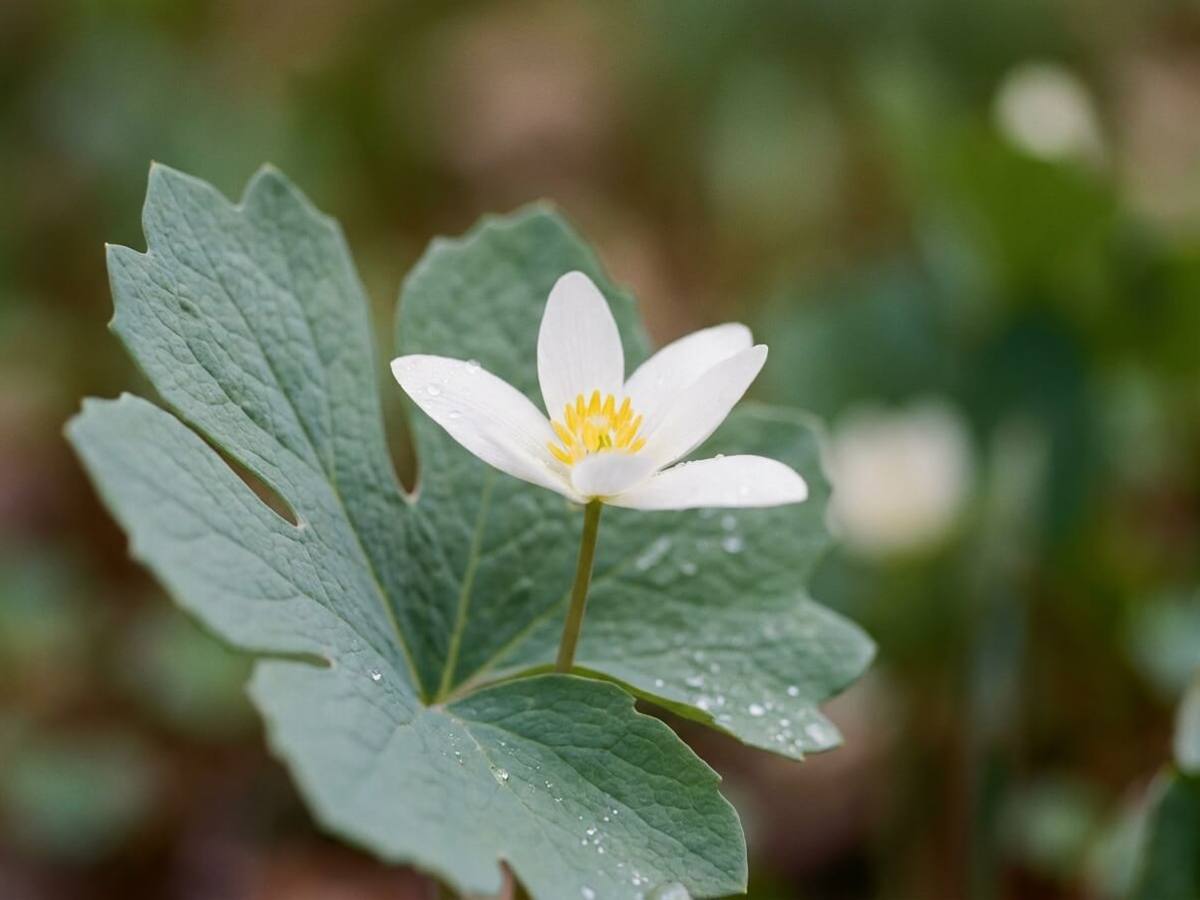
Bloodroot is one of the earliest and loveliest of the spring woodlanders, opening pure white, many-petalled flowers before most borders have stirred. Each bud pushes up wrapped in its own scalloped, blue-green leaf, like a hand holding a candle. Snap a rhizome and it bleeds a vivid orange-red sap — the source of both its common and botanical names.
Growing conditions
Think of the floor of a deciduous wood and you have the brief exactly. Bloodroot wants bright, open light in early spring while the canopy is bare, then dappled shade once the trees leaf out. Deep, unbroken shade from evergreens or buildings gives sparse flowering and floppy foliage.
Soil matters more than almost anything else. Give it a crumbly, leafy loam that holds moisture yet never sits wet — plenty of leaf mould, composted bark or well-rotted garden compost worked in before planting. A pH between about 5.5 and 7.0 suits it; heavy, compacted clay and thin chalk are the two situations where it most often fails.
It is exceptionally cold-hardy and needs a proper winter chill to flower well, so it thrives in northern and upland gardens. In hot, dry regions it simply retreats underground earlier, which is normal rather than a problem.
How to plant Sanguinaria
Plant dormant rhizomes in late summer or early autumn, from August to October, so the roots establish before the ground cools. Pot-grown plants can go in during spring while in leaf, provided they are watered attentively through their first season.
Spacing: set rhizomes 20–30 cm apart — close enough to knit into a drift within three or four years, far enough to avoid immediate congestion.
Depth and position: lay the rhizome horizontally with the growth buds pointing upwards, covered by just 2.5–5 cm of soil. Planting too deep is the commonest cause of weak flowering.
Soil preparation: fork a generous barrowload of leaf mould into the top 20 cm; on clay, plant on a slight mound to lift the crown clear of winter wet.
Watering in: water thoroughly after planting, then mulch with 3–5 cm of leaf litter, keeping it just clear of the buds.
Propagation: divide established clumps in late summer once the foliage dies back, cutting the rhizome into pieces with at least one plump bud each. Wear gloves — the sap stains skin and clothing.
Sanguinaria canadensis growing in a naturalistic garden border
Care through the seasons
Spring: Flowers appear almost as soon as the shoots break ground and last only a week or two, shattering quickly in wind or heavy rain. Top-dress with leaf mould as growth begins; no high-nitrogen feed is needed, as rich fertiliser encourages lush leaves at the expense of flowers. Leave the foliage entirely alone, since it is building next spring’s buds.
Summer: Keep the soil evenly moist through May and June while the leaves are still working. Once hot, dry weather arrives the plant goes dormant and the foliage yellows and disappears — this is natural, not death. Mark the position with a label so you do not spear the rhizomes while planting something else.
Autumn: There is nothing to cut back, as the plant has already vanished. This is the ideal moment to lift and divide congested clumps, and to replenish the mulch with fallen leaves or leaf mould. Avoid mushroom compost or anything strongly alkaline.
Winter: Completely dormant and reliably hardy, needing no protection in the open ground. In containers, sink the pot into the soil or move it to a sheltered spot so the rhizomes do not freeze solid and dry out.
Best varieties to grow
The wild species is beautiful, but a handful of selections extend the display considerably.
Sanguinaria canadensis f. multiplex ‘Plena’ — the fully double form, with tight white rosettes like miniature water lilies that last two to three times longer than the single; holds an RHS Award of Garden Merit.
Sanguinaria canadensis f. multiplex ‘Multiplex’ — essentially the same sterile double, sold under this name; sets no seed, so all its energy goes into the flower.
Sanguinaria canadensis ‘Amy’ — a semi-double selection with a looser, more informal flower that still shows its golden stamens.
Sanguinaria canadensis ‘Peter Harrison’ — a scarce single form with a soft pink flush to the petals and pink-tinted buds, worth hunting down from specialist woodland nurseries.
Pests, diseases and common problems
Slugs and snails: they rasp the emerging buds and shred the new leaves at ground level in March. Clear surrounding debris, use wool pellets or copper rings around young clumps, and patrol on mild damp evenings.
Crown and rhizome rot: plants fail to reappear in spring, and the rhizome is soft and brown when lifted. This follows winter waterlogging — improve drainage with grit and leaf mould, or replant on a raised mound.
Premature dormancy: foliage yellows and collapses in late May rather than July, meaning the plant has banked little energy. Deepen the mulch and water during dry spells in spring to extend the growing period.
🌿 Nature & Garden Newsletter
Gardening tips, recipes & seasonal advice, twice a week.