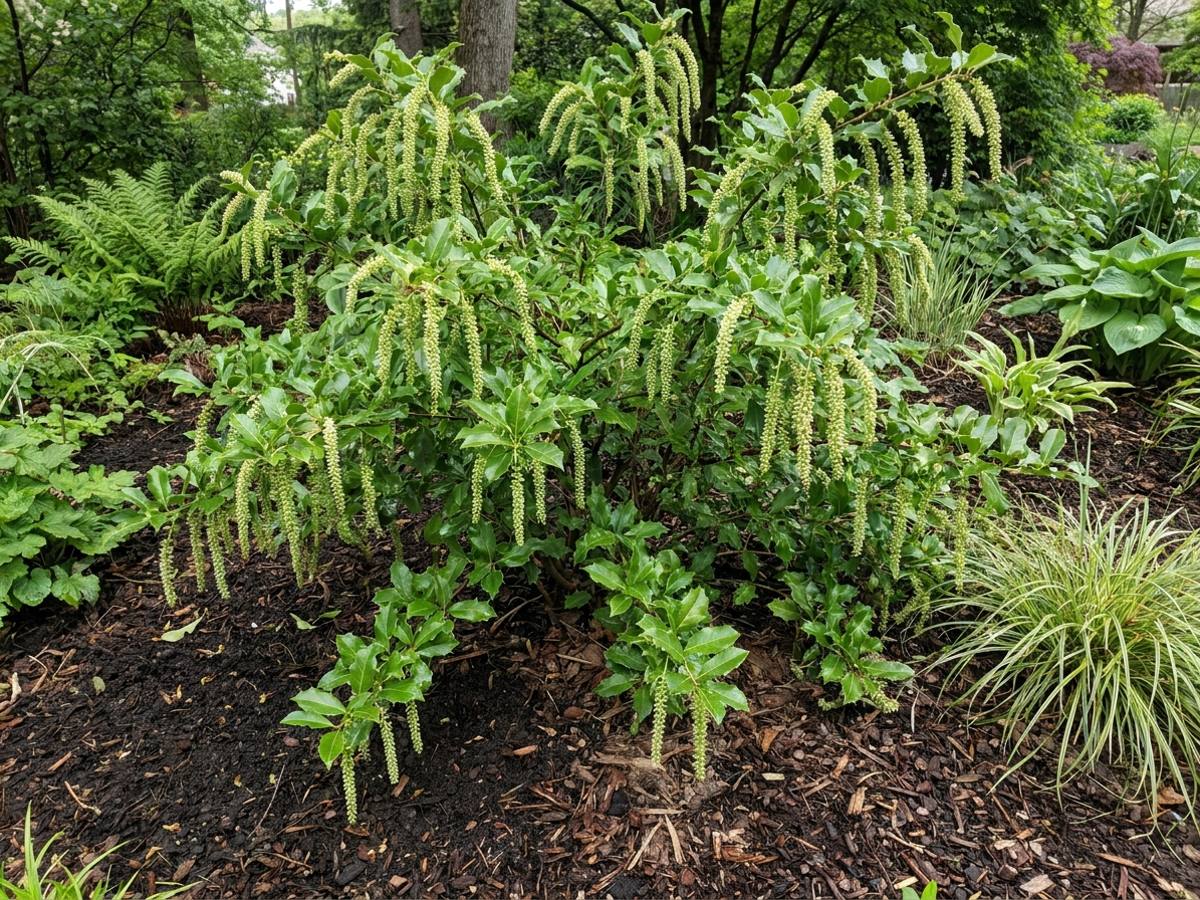
Itea ilicifolia is one of the most quietly theatrical evergreens you can grow against a warm wall, hanging with slender, honey-scented catkins up to 30 cm long in the depths of late summer. Its glossy, holly-like foliage gives year-round structure, whilst the greenish-cream flower tassels catch low evening light beautifully. Few shrubs flower so generously in August, when most of the garden is beginning to tire.
Itea flowers most freely in full sun, but it will cope happily with partial shade and actually keeps a richer leaf colour there. The essential requirement is shelter: cold, drying winds scorch the evergreen foliage and can kill young growth outright. A south- or west-facing wall is the classic position in cooler regions.
Give it a fertile, humus-rich soil that stays reliably moist yet drains freely in winter. It is unfussy about pH and performs well on chalk, loam and improved clay, though waterlogged ground in winter is the fastest route to failure. Dig in leaf mould or well-rotted compost before planting to hold summer moisture.
In milder maritime gardens and USDA zones 8–9, it can be grown as a free-standing shrub in the open border. In colder inland areas, treat it as a wall shrub and avoid frost pockets, as temperatures below −10 °C will damage unripened wood.
Plant in spring, once the soil has warmed and hard frosts have passed, so the shrub has a full growing season to establish before its first winter. Autumn planting is possible in mild coastal gardens, but spring is far safer elsewhere.
Almost everything this shrub asks for is a matter of doing the right job at the right moment — above all pruning, which decides whether you get catkins at all. The table below sets out the four key periods before they are described in detail.
| Season | Feeding and mulching | Pruning and training | Watch out for |
|---|---|---|---|
| Mid-spring | Balanced general fertiliser, then a generous compost mulch kept clear of the stems | The one moment to prune: shorten wayward shoots and tie in wall-trained stems whilst growth is soft | Foliage browned by winter cold — cut it out and fresh growth hides the gaps |
| Early to late summer | — | No deadheading: the fading catkins are next season’s framework | Drying out, especially wall-grown plants; water deeply in dry spells |
| Autumn | Top up the mulch to insulate the root zone | Resist heavy pruning — late cuts stimulate soft growth that will be frosted | Loose ties before the gales, and fallen leaves rotting in the crown |
| Winter | — | None | Bronzed or curled leaves are normal; fleece young plants below −8 °C |
Get the spring pruning right and the rest of the year is little more than mulching and watering.
Spring: Apply a balanced general fertiliser in April and mulch generously with compost, keeping it clear of the stems. This is the moment for any pruning — shorten wayward shoots and tie in wall-trained stems whilst growth is soft. Cut out any foliage browned by winter cold; fresh growth quickly hides the gaps.
Summer: Water deeply during dry spells, particularly for wall-grown specimens, which dry out faster than you expect. Do not deadhead: the fading catkins hang on attractively for weeks and cutting them removes next season’s framework. Take semi-ripe cuttings in late July if you want extra plants.
Autumn: Resist heavy pruning now, as late cuts stimulate soft growth that will be frosted. Instead, top up the mulch to insulate the root zone and check that ties on wall-trained plants are secure before autumn gales. Clear fallen leaves from the crown to discourage rot.
Winter: The foliage stays on the plant but may bronze or curl in hard frost, which is normal. In cold gardens, protect young plants with horticultural fleece when temperatures are forecast to drop below −8 °C.
The species itself is the star, but a handful of named forms and close relatives are worth seeking out.